Department of Biochemistry and Molecular Genetics, Northwestern University Feinberg School of Medicine, Chicago, IL 60611.
Simpson Querrey Institute for Epigenetics, Northwestern University Feinberg School of Medicine, Chicago, IL 60611.
Proc Natl Acad Sci U S A. 2023 Dec 26;120(52):e2310063120. doi: 10.1073/pnas.2310063120. Epub 2023 Dec 19.
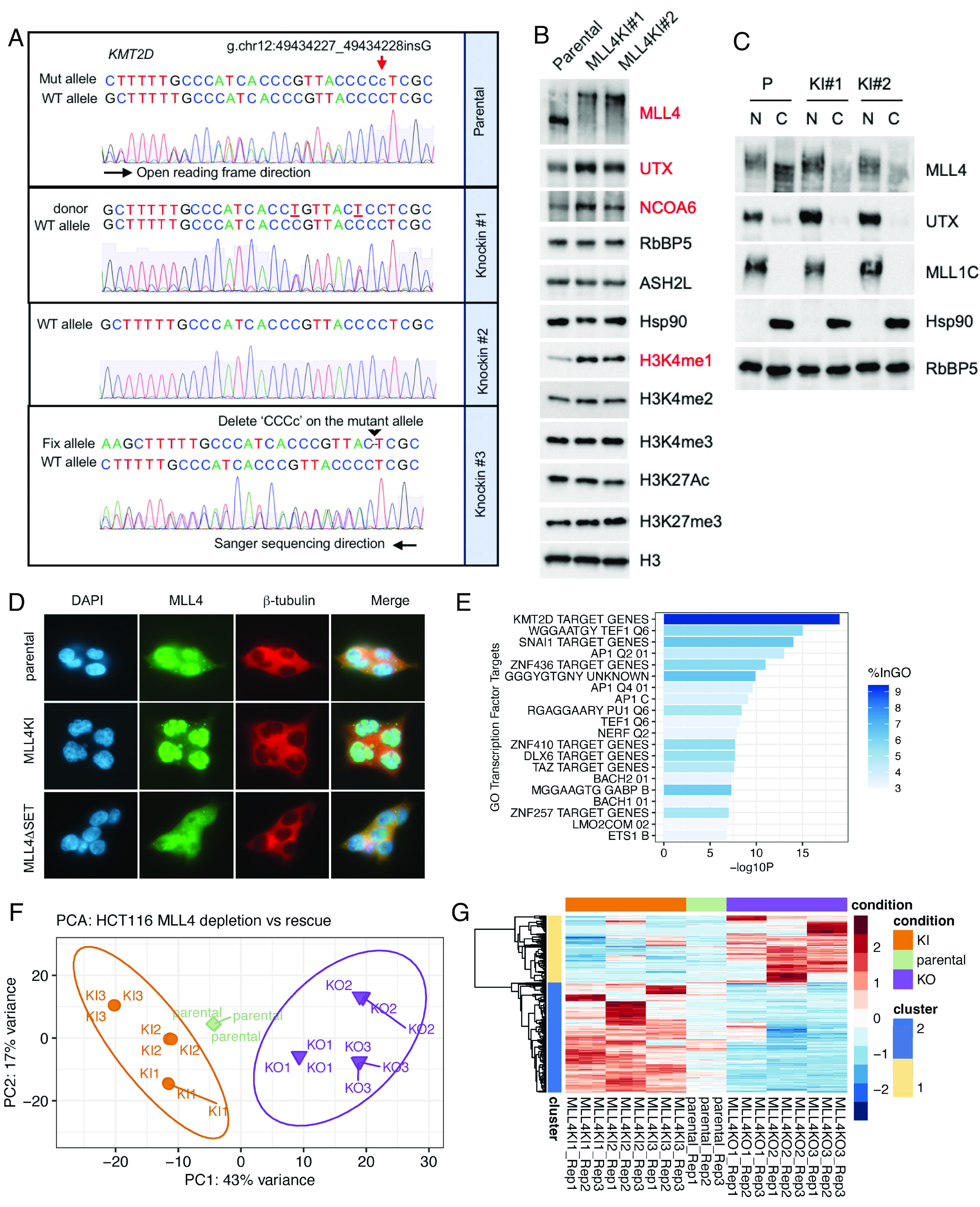
Cancer genome sequencing consortiums have recently catalogued an abundance of somatic mutations, across a wide range of human cancers, in the chromatin-modifying enzymes that regulate gene expression. Defining the molecular mechanisms underlying the potentially oncogenic functions of these epigenetic mutations could serve as the basis for precision medicine approaches to cancer therapy. MLL4 encoded by the gene highly mutated in a large number of human cancers, is a key histone lysine monomethyltransferase within the Complex of Proteins Associated with Set1 (COMPASS) family that regulates gene expression through enhancer function, potentially functioning as a tumor suppressor. We report that the mutations which cause MLL4 protein truncation also alter MLL4's subcellular localization, resulting in loss-of-function in the nucleus and gain-of-function in the cytoplasm. We demonstrate that isogenic correction of truncation mutation rescues the aberrant localization phenotype and restores multiple regulatory functions of MLL4, including COMPASS integrity/stabilization, histone H3K4 mono-methylation, enhancer activation, and therefore transcriptional regulation. Moreover, isogenic correction diminishes the sensitivity of -mutated cancer cells to targeted metabolic inhibition. Using immunohistochemistry, we identified that cytoplasmic MLL4 is unique to the tissue of bladder cancer patients with truncation mutations. Using a preclinical carcinogen model of bladder cancer in mouse, we demonstrate that truncated cytoplasmic MLL4 predicts response to targeted metabolic inhibition therapy for bladder cancer and could be developed as a biomarker for -mutated cancers. We also highlight the broader potential for prognosis, patient stratification and treatment decision-making based on mutation status in MLL4 truncation-relevant diseases, including human cancers and Kabuki Syndrome.
癌症基因组测序联盟最近在调节基因表达的染色质修饰酶中,对广泛存在于多种人类癌症中的大量体细胞突变进行了编目。定义这些表观遗传突变潜在致癌功能的分子机制,可以作为癌症治疗精准医学方法的基础。基因编码的 MLL4 在大量人类癌症中高度突变,是复合物相关蛋白的 SET1 组蛋白赖氨酸单甲基转移酶(COMPASS)家族中的一个关键组蛋白赖氨酸单甲基转移酶,通过增强子功能调节基因表达,可能作为肿瘤抑制因子发挥作用。我们报告说,导致 MLL4 蛋白截断的突变也改变了 MLL4 的亚细胞定位,导致核内功能丧失和细胞质内功能获得。我们证明,同源校正突变可以挽救异常的定位表型,并恢复 MLL4 的多种调节功能,包括 COMPASS 完整性/稳定、组蛋白 H3K4 单甲基化、增强子激活,从而调节转录。此外,同源校正还降低了携带突变的癌细胞对靶向代谢抑制的敏感性。通过免疫组织化学,我们发现截短的 MLL4 存在于膀胱癌患者组织中具有突变的患者中。通过在小鼠膀胱癌临床前致癌模型中,我们证明截短的细胞质 MLL4 预测对膀胱癌靶向代谢抑制治疗的反应,可以作为突变癌症的生物标志物进行开发。我们还强调了基于 MLL4 截断相关疾病中突变状态的预后、患者分层和治疗决策的更广泛潜力,包括人类癌症和歌舞伎综合征。