Department of Medical Laboratory Science, College of Medicine and Health Science, Dilla University, Dilla, Ethiopia.
Department of Immunology and Molecular Biology, School of Biomedical and Laboratory Science, College of Medicine and Health Science, University of Gondar, Gondar, Ethiopia.
Syst Rev. 2023 Dec 20;12(1):240. doi: 10.1186/s13643-023-02422-y.
Sensitive, robust, and fast point-of-care tests are needed for cutaneous leishmaniasis (CL) diagnosis. The recently developed CL Detect rapid test (InBios) for detecting Leishmania peroxidoxin antigen has been evaluated in several studies. However, diagnostic performances were controversial. Therefore, this systematic review and meta-analysis aimed to determine the pooled sensitivity and specificity of CL Detect for CL diagnosis.
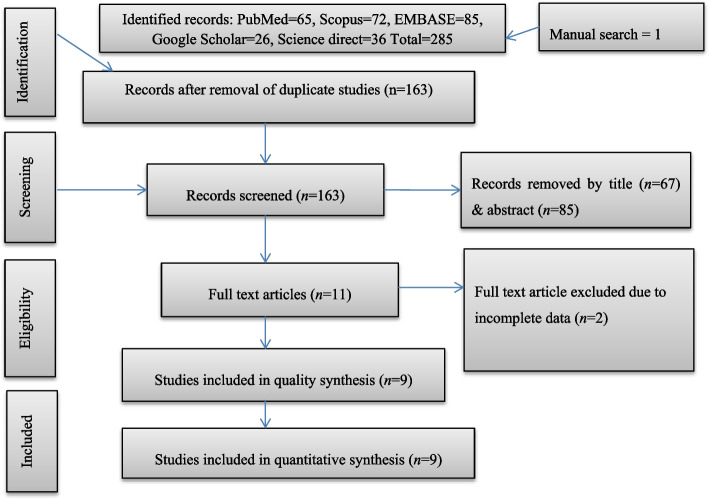
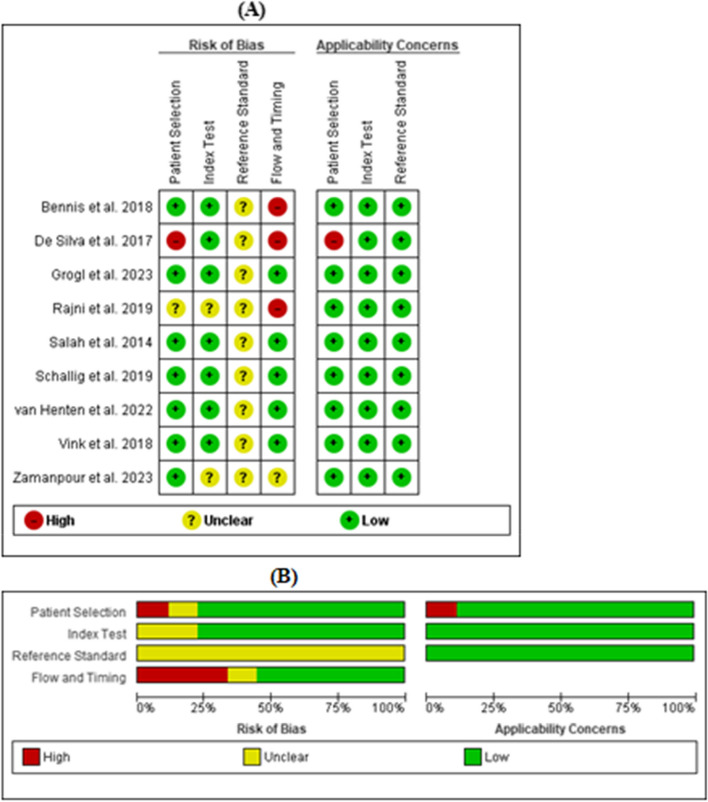
PubMed, Scopus, EMBASE, ScienceDirect, and Google Scholar were sources of articles. We included studies reporting the diagnostic accuracy of CL Detect and CL-suspected patients in the English language. The methodological qualities of the included studies were appraised using the quality assessment of diagnostic accuracy studies-2 (QUADAS-2). Meta-analysis was conducted using Stata 14.2 and R software.
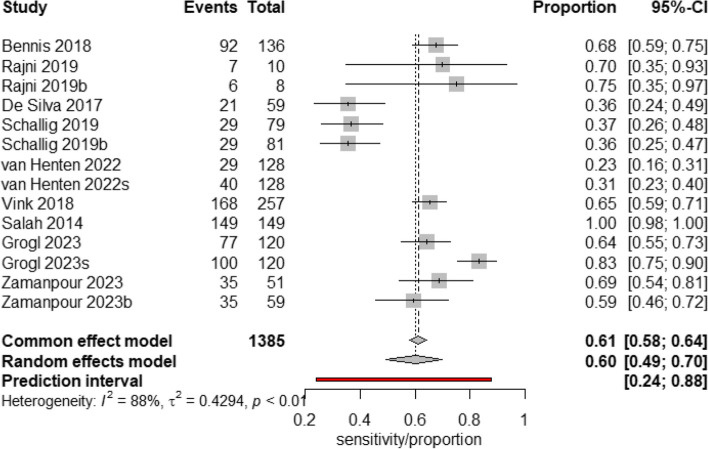
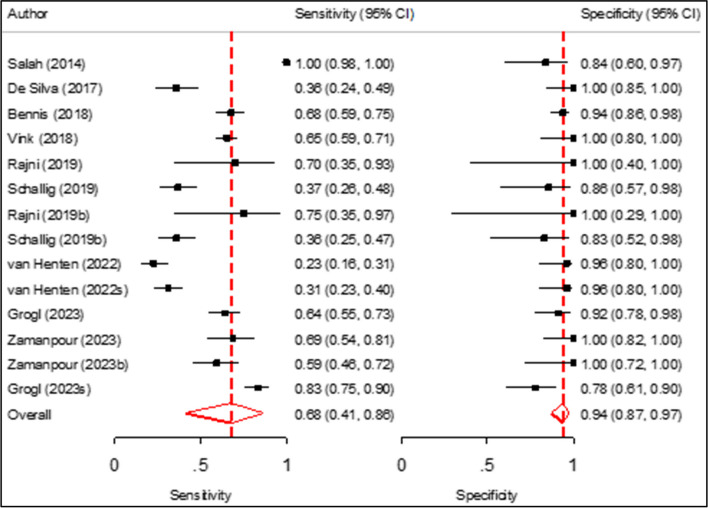
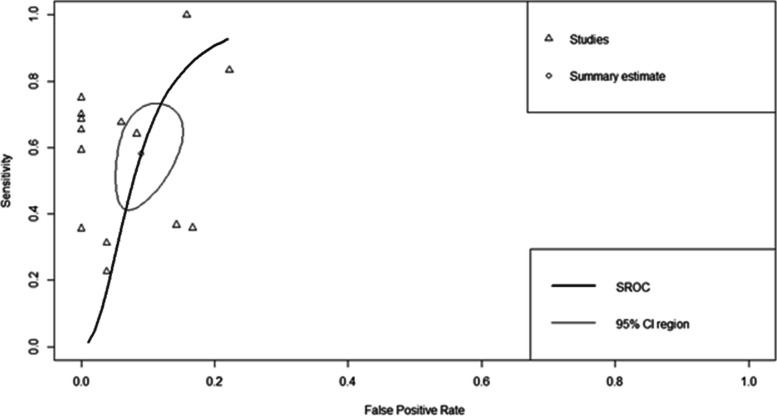
A total of 9 articles were included. The study sample size ranged from 11 to 274. The sensitivities of the individual studies ranged from 23 to 100%, and the specificities ranged from 78 to 100%. Pooled sensitivity and specificity were 68% (95% CI, 41-86%) and 94% (95% CI, 87-97%), respectively. AUC displayed 0.899. Pooled sensitivity was lower (47%, 95% CI, 34-61%) when PCR was used as a reference than microscopy (83%, 95% CI, 39-97%). Pooled sensitivity was lower (48%, 95% CI, 30-67%) for all lesion durations compared to ≤ 4 months (89%, 95% CI, 43-99%).
CL Detect has poor sensitivity and does not meet the minimal sensitivity of 95% of target product profiles designed for CL point-of-care tests. Currently, the CL Detect test looks unsuitable for CL diagnosis, despite its high specificity. Findings are limited by the low number of studies available. Further large-scale studies are recommended.
PROSPERO CRD42022323497.
我们需要灵敏、稳健且快速的即时检测来诊断皮肤利什曼病(CL)。最近开发的用于检测利什曼过氧化物酶抗原的 CL Detect 快速检测(InBios)已在多项研究中进行了评估。然而,其诊断性能存在争议。因此,本系统评价和荟萃分析旨在确定 CL Detect 对 CL 诊断的汇总敏感性和特异性。
我们检索了 PubMed、Scopus、EMBASE、ScienceDirect 和 Google Scholar 等英文文献数据库,纳入了报道 CL Detect 对疑似 CL 患者的诊断准确性的研究。使用诊断准确性研究质量评估 2 版(QUADAS-2)评估纳入研究的方法学质量。使用 Stata 14.2 和 R 软件进行荟萃分析。
共纳入 9 项研究。研究样本量从 11 例至 274 例不等。各研究的敏感性范围为 23%至 100%,特异性范围为 78%至 100%。汇总敏感性和特异性分别为 68%(95%置信区间,41%-86%)和 94%(95%置信区间,87%-97%)。AUC 为 0.899。当以 PCR 为参考时,CL Detect 的汇总敏感性(47%,95%置信区间,34%-61%)低于以显微镜检查为参考(83%,95%置信区间,39%-97%)。与病变持续时间≤4 个月(89%,95%置信区间,43%-99%)相比,所有病变持续时间的汇总敏感性(48%,95%置信区间,30%-67%)均较低。
CL Detect 的敏感性较差,不符合为 CL 即时检测设计的目标产品特性文件中 95%的最低敏感性要求。尽管特异性较高,但目前 CL Detect 检测似乎不适合 CL 诊断。由于可用研究数量较少,因此研究结果存在局限性。建议进行更大规模的研究。
PROSPERO CRD42022323497。