Department of Community Health Sciences, Cumming School of Medicine, University of Calgary, 3D10-3280 Hospital Drive NW, Calgary, AB, T2N 4Z6, Canada.
Strategic Clinical Networks™, Provincial Clinical Excellence, Alberta Health Services, Calgary, AB, Canada.
Health Res Policy Syst. 2023 Dec 22;21(1):139. doi: 10.1186/s12961-023-00958-y.
Health research partnership approaches have grown in popularity over the past decade, but the systematic evaluation of their outcomes and impacts has not kept equal pace. Identifying partnership assessment tools and key partnership characteristics is needed to advance partnerships, partnership measurement, and the assessment of their outcomes and impacts through systematic study.
To locate and identify globally available tools for assessing the outcomes and impacts of health research partnerships.
We searched four electronic databases (Ovid MEDLINE, Embase, CINAHL + , PsychINFO) with an a priori strategy from inception to June 2021, without limits. We screened studies independently and in duplicate, keeping only those involving a health research partnership and the development, use and/or assessment of tools to evaluate partnership outcomes and impacts. Reviewer disagreements were resolved by consensus. Study, tool and partnership characteristics, and emerging research questions, gaps and key recommendations were synthesized using descriptive statistics and thematic analysis.
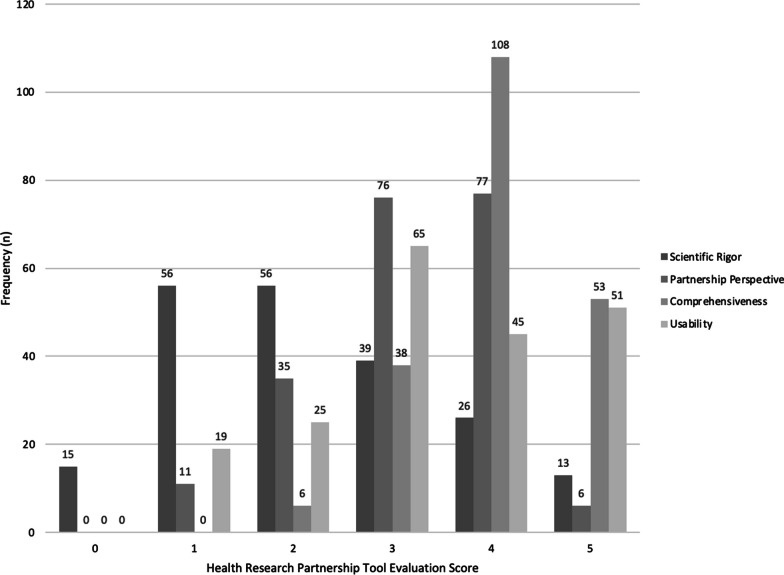
We screened 36 027 de-duplicated citations, reviewed 2784 papers in full text, and kept 166 studies and three companion reports. Most studies originated in North America and were published in English after 2015. Most of the 205 tools we identified were questionnaires and surveys targeting researchers, patients and public/community members. While tools were comprehensive and usable, most were designed for single use and lacked validity or reliability evidence. Challenges associated with the interchange and definition of terms (i.e., outcomes, impacts, tool type) were common and may obscure partnership measurement and comparison. Very few of the tools identified in this study overlapped with tools identified by other, similar reviews. Partnership tool development, refinement and evaluation, including tool measurement and optimization, are key areas for future tools-related research.
This large scoping review identified numerous, single-use tools that require further development and testing to improve their psychometric and scientific qualities. The review also confirmed that the health partnership research domain and its measurement tools are still nascent and actively evolving. Dedicated efforts and resources are required to better understand health research partnerships, partnership optimization and partnership measurement and evaluation using valid, reliable and practical tools that meet partners' needs.
健康研究伙伴关系方法在过去十年中越来越受欢迎,但对其结果和影响的系统评估并没有跟上步伐。需要确定伙伴关系评估工具和关键伙伴关系特征,以通过系统研究来推进伙伴关系、伙伴关系衡量以及对其结果和影响的评估。
定位和确定全球可用的评估健康研究伙伴关系结果和影响的工具。
我们按照预先制定的策略,从开始到 2021 年 6 月,在四个电子数据库(Ovid MEDLINE、Embase、CINAHL+、PsychINFO)中进行了搜索,没有任何限制。我们独立并重复筛选研究,只保留涉及健康研究伙伴关系以及开发、使用和/或评估工具以评估伙伴关系结果和影响的研究。通过协商解决审查员的分歧。使用描述性统计和主题分析综合研究、工具和伙伴关系特征以及新出现的研究问题、差距和关键建议。
我们筛选了 36027 条去重引文,全文审查了 2784 篇论文,并保留了 166 项研究和 3 份配套报告。大多数研究源自北美,并且是 2015 年后以英文发表的。我们确定的 205 个工具中,大多数是针对研究人员、患者和公众/社区成员的问卷和调查。虽然这些工具全面且可用,但大多数都是为单次使用而设计的,缺乏有效性或可靠性证据。与术语(即结果、影响、工具类型)的互换和定义相关的挑战很常见,可能会掩盖伙伴关系的衡量和比较。在这项研究中确定的工具中,很少有与其他类似综述中确定的工具重叠。伙伴关系工具的开发、改进和评估,包括工具的衡量和优化,是未来工具相关研究的关键领域。
这项大规模的范围综述确定了许多单一用途的工具,这些工具需要进一步开发和测试,以提高其心理测量学和科学性。该综述还证实,健康伙伴关系研究领域及其测量工具仍处于初期阶段,并且正在积极发展。需要投入专门的努力和资源,使用满足合作伙伴需求的有效、可靠和实用的工具,更好地了解健康研究伙伴关系、伙伴关系优化以及伙伴关系的衡量和评估。