Heishima Kazuki, Aketa Naohiko, Heishima Mizuki, Kawachi Asuka
Institute for Advanced Study (GUiAS), Gifu University, Gifu, Japan.
Center for One Medicine Innovative Translational Research (COMIT), Gifu University, Gifu, Japan.
Front Oncol. 2023 Dec 7;13:1250766. doi: 10.3389/fonc.2023.1250766. eCollection 2023.
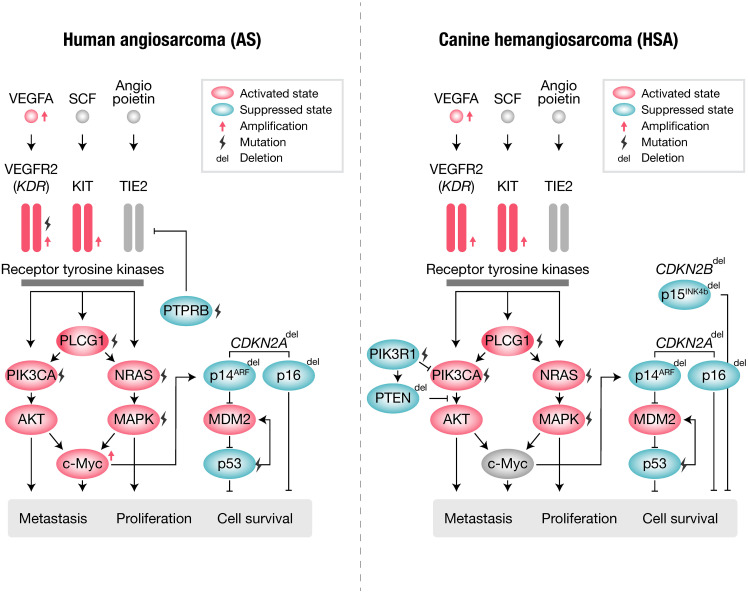
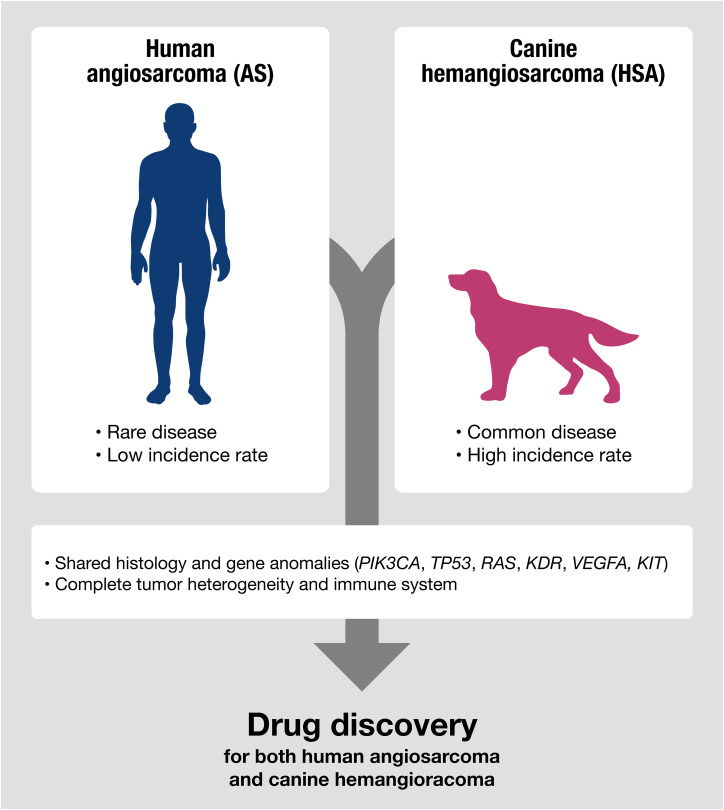
Since the domestication of dogs 10,000 years ago, they have shared their living environment with humans and have co-evolved. The breeding process that dogs have undergone in only a few centuries has led to a significant accumulation of specific genetic alterations that could induce particular diseases in certain breeds. These canine diseases are similar to what is found in humans with several differences; therefore, comparing such diseases occurring in humans and dogs can help discover novel disease mechanisms, pathways, and causal genetic factors. Human angiosarcoma (AS) and canine hemangiosarcoma (HSA), which are sarcomas originating from endothelium, are examples of diseases shared between humans and dogs. They exhibit similar characteristics and clinical behaviors, although with some critical differences resulting from evolution. In this review, we will describe the similarities and differences in terms of clinical and molecular characteristics between human AS and canine HSA, and discuss how these similarities and differences can be applied to advance the treatment of these diseases.
自一万年前狗被驯化以来,它们就与人类共享生活环境并共同进化。狗在短短几个世纪内经历的育种过程导致特定基因改变大量积累,这些改变可能在某些品种中引发特定疾病。这些犬类疾病与人类疾病有一些差异但也有相似之处;因此,比较人类和狗身上发生的此类疾病有助于发现新的疾病机制、途径和致病基因因素。人类血管肉瘤(AS)和犬类血管肉瘤(HSA)均起源于内皮细胞的肉瘤,是人类和狗共有的疾病实例。它们表现出相似的特征和临床行为,尽管进化导致了一些关键差异。在本综述中,我们将描述人类AS和犬类HSA在临床和分子特征方面的异同,并讨论如何利用这些异同来推进这些疾病的治疗。