Department of Chemistry, Institute of Biochemistry, University of Natural Resources and Life Sciences, Vienna, Austria.
Department of Biotechnology, Institute of Animal Cell Technology and Systems Biology, University of Natural Resources and Life Sciences, Vienna, Austria.
Sci Rep. 2023 Dec 27;13(1):23024. doi: 10.1038/s41598-023-48528-0.
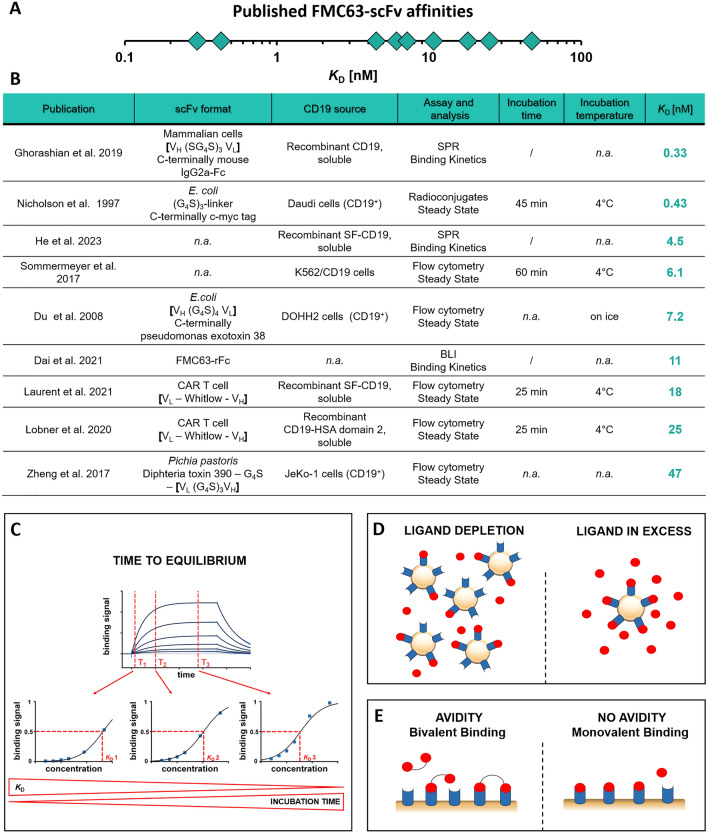
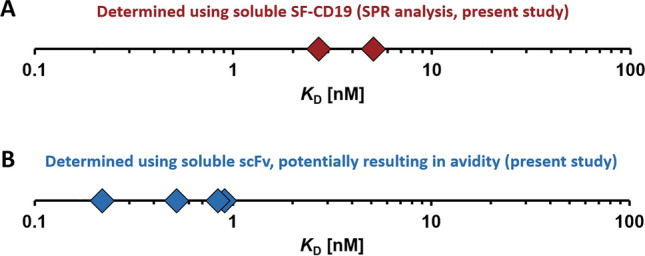
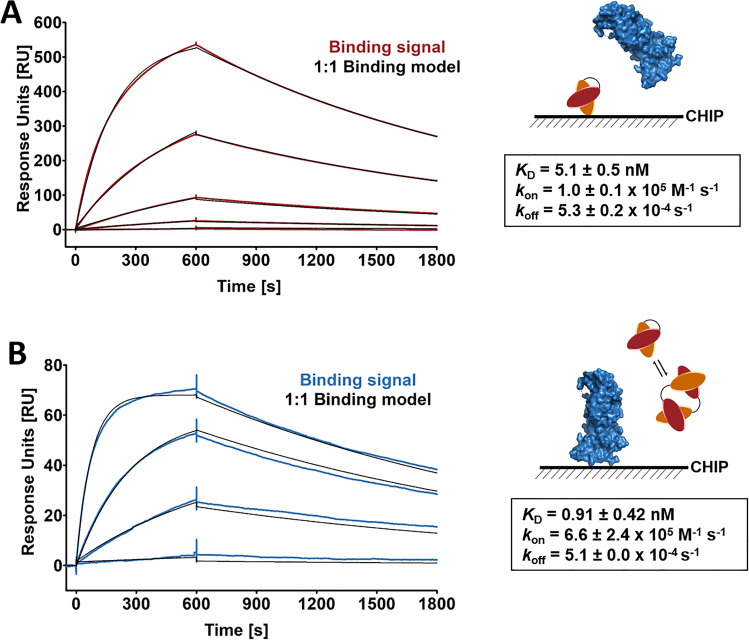
The majority of approved CAR T cell products are based on the FMC63-scFv directed against CD19. Surprisingly, although antigen binding affinity is a major determinant for CAR function, the affinity of the benchmark FMC63-scFv has not been unambiguously determined. That is, a wide range of affinities have been reported in literature, differing by more than 100-fold. Using a range of techniques, we demonstrate that suboptimal experimental designs can cause artefacts that lead to over- or underestimation of the affinity. To minimize these artefacts, we performed SPR with strictly monomeric and correctly folded soluble CD19, yielding an FMC63-scFv affinity of 2-6 nM. Together, apart from analyzing the FMC63-scFv affinity under optimized conditions, we also provide potential explanations for the wide range of published affinities. We expect that this study will be highly valuable for interpretations of CAR affinity-function relationships, as well as for the design of future CAR T cell generations.
大多数已批准的 CAR T 细胞产品都是基于针对 CD19 的 FMC63-scFv。令人惊讶的是,尽管抗原结合亲和力是 CAR 功能的主要决定因素,但基准 FMC63-scFv 的亲和力尚未明确确定。也就是说,文献中报道了广泛的亲和力范围,相差超过 100 倍。我们使用一系列技术证明,次优的实验设计会导致伪影,从而导致亲和力的高估或低估。为了最大程度地减少这些伪影,我们使用严格的单体和正确折叠的可溶性 CD19 进行 SPR,得到 FMC63-scFv 的亲和力为 2-6 nM。总之,除了在优化条件下分析 FMC63-scFv 的亲和力外,我们还为广泛报道的亲和力提供了潜在的解释。我们希望这项研究对于解释 CAR 亲和力-功能关系以及设计未来的 CAR T 细胞代际具有很高的价值。