Miller Robert J H, Bednarski Bryan P, Pieszko Konrad, Kwiecinski Jacek, Williams Michelle C, Shanbhag Aakash, Liang Joanna X, Huang Cathleen, Sharir Tali, Hauser M Timothy, Dorbala Sharmila, Di Carli Marcelo F, Fish Mathews B, Ruddy Terrence D, Bateman Timothy M, Einstein Andrew J, Kaufmann Philipp A, Miller Edward J, Sinusas Albert J, Acampa Wanda, Han Donghee, Dey Damini, Berman Daniel S, Slomka Piotr J
Departments of Medicine (Division of Artificial Intelligence in Medicine), Biomedical Sciences, and Imaging, Cedars-Sinai Medical Center, Los Angeles, CA, USA; Department of Cardiac Sciences, University of Calgary and Libin Cardiovascular Institute, Calgary, AB, Canada.
Departments of Medicine (Division of Artificial Intelligence in Medicine), Biomedical Sciences, and Imaging, Cedars-Sinai Medical Center, Los Angeles, CA, USA.
EBioMedicine. 2024 Jan;99:104930. doi: 10.1016/j.ebiom.2023.104930. Epub 2024 Jan 1.
Myocardial perfusion imaging (MPI) is one of the most common cardiac scans and is used for diagnosis of coronary artery disease and assessment of cardiovascular risk. However, the large majority of MPI patients have normal results. We evaluated whether unsupervised machine learning could identify unique phenotypes among patients with normal scans and whether those phenotypes were associated with risk of death or myocardial infarction.
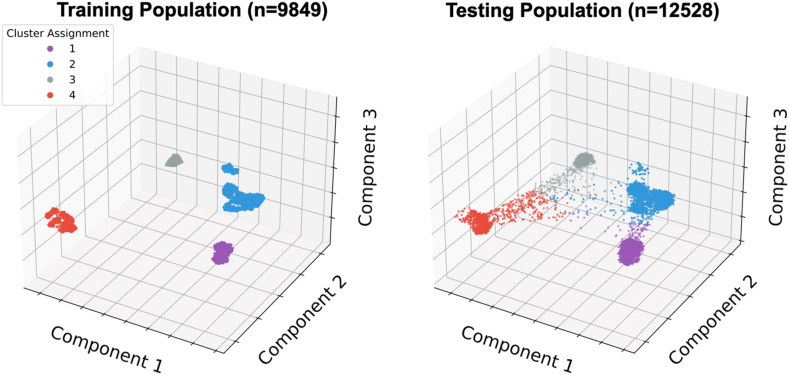
Patients from a large international multicenter MPI registry (10 sites) with normal perfusion by expert visual interpretation were included in this cohort analysis. The training population included 9849 patients, and external testing population 12,528 patients. Unsupervised cluster analysis was performed, with separate training and external testing cohorts, to identify clusters, with four distinct phenotypes. We evaluated the clinical and imaging features of clusters and their associations with death or myocardial infarction.
Patients in Clusters 1 and 2 almost exclusively underwent exercise stress, while patients in Clusters 3 and 4 mostly required pharmacologic stress. In external testing, the risk for Cluster 4 patients (20.2% of population, unadjusted hazard ratio [HR] 6.17, 95% confidence interval [CI] 4.64-8.20) was higher than the risk associated with pharmacologic stress (HR 3.03, 95% CI 2.53-3.63), or previous myocardial infarction (HR 1.82, 95% CI 1.40-2.36).
Unsupervised learning identified four distinct phenotypes of patients with normal perfusion scans, with a significant proportion of patients at very high risk of myocardial infarction or death. Our results suggest a potential role for patient phenotyping to improve risk stratification of patients with normal imaging results.
This work was supported by the National Heart, Lung, and Blood Institute at the National Institutes of Health [R35HL161195 to PS]. The REFINE SPECT database was supported by the National Heart, Lung, and Blood Institute at the National Institutes of Health [R01HL089765 to PS]. MCW was supported by the British Heart Foundation [FS/ICRF/20/26002].
心肌灌注成像(MPI)是最常见的心脏扫描检查之一,用于诊断冠状动脉疾病和评估心血管风险。然而,绝大多数MPI检查的患者结果正常。我们评估了无监督机器学习能否在扫描结果正常的患者中识别出独特的表型,以及这些表型是否与死亡或心肌梗死风险相关。
本队列分析纳入了来自大型国际多中心MPI注册研究(10个站点)且经专家视觉解读灌注正常的患者。训练人群包括9849例患者,外部测试人群包括12528例患者。进行无监督聚类分析,将训练队列和外部测试队列分开,以识别具有四种不同表型的聚类。我们评估了聚类的临床和影像特征及其与死亡或心肌梗死的关联。
第1组和第2组的患者几乎都进行了运动负荷试验,而第3组和第4组的患者大多需要药物负荷试验。在外部测试中,第4组患者(占总体的20.2%,未调整风险比[HR]6.17,95%置信区间[CI]4.64 - 8.20)的风险高于药物负荷试验相关风险(HR 3.03,95% CI 2.53 - 3.63)或既往心肌梗死相关风险(HR 1.82,95% CI 1.40 - 2.36)。
无监督学习识别出了灌注扫描正常的患者的四种不同表型,其中相当一部分患者有非常高的心肌梗死或死亡风险。我们的结果表明,患者表型分析在改善影像结果正常患者的风险分层方面可能具有潜在作用。
这项工作得到了美国国立卫生研究院国家心肺血液研究所的支持[给PS的R35HL161195]。REFINE SPECT数据库得到了美国国立卫生研究院国家心肺血液研究所的支持[给PS的R01HL089765]。MCW得到了英国心脏基金会的支持[FS/ICRF/20/26002]。