Hayes D, Fancourt D, Burton A
The Social Biobehavioural Research Group, Research Department of Behavioural Science and Health, Institute of Epidemiology & Health Care, University College London (UCL), 1-19 Torrington Place, London, WC1E 7HB, UK.
Child Adolesc Psychiatry Ment Health. 2024 Jan 3;18(1):2. doi: 10.1186/s13034-023-00697-6.
Young carers are children or young people aged up to 25 years old who undertake unpaid caring responsibilities for a friend or family member. Young carers faced significant challenges brought on by the COVID-19 pandemic. We explored the impact of the pandemic and associated restrictions on mental health, wellbeing and access to support in young carers in the United Kingdom (UK) to understand how to improve services, as well as support this population in future health emergencies.
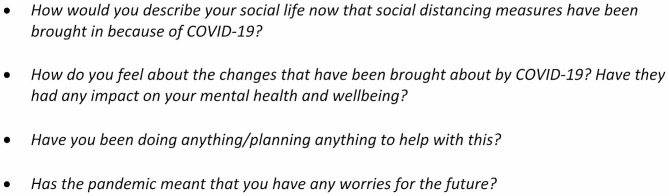
We conducted 22 qualitative semi-structured interviews from May to November 2021 with 14 young carers and eight staff working in organisations that supported them. Interviews took place remotely over video or telephone call and explored participant experiences of the pandemic and its impact on their health, wellbeing and caring responsibilities. We used reflexive thematic analysis to analyse interview transcripts.
We identified four overarching themes pertaining to the impact of the pandemic and associated restrictions on mental health, wellbeing and access to support in young carers in the UK: (1) challenges in protecting loved ones from the virus, (2) changes to and loss of routine, (3) reduced access to pre-pandemic informal and formal support structures and (4) better understanding of inner resilience and goals. Many participants struggled with their mental health and wellbeing as a result of pandemic related restrictions which impacted on support structures for themselves and the individual they cared for. However, positive impacts pertained to additional support provided by local authority and third sector organisations.
Our findings highlight some of the changes that affected young carers during the COVID-19 pandemic. The impact of changes to routine and a reduction in pre-pandemic support were the greatest concerns reported by participants in this study. The additional support provided by local authority and third sector organisations during social restrictions suggests such organisations could play a greater role in supporting this population going forward and that schools and Governments may wish to put in additional strategies and provisions to protect young carers in the future.
年轻照料者是指年龄在25岁及以下,为朋友或家庭成员承担无偿照料责任的儿童或年轻人。新冠疫情给年轻照料者带来了重大挑战。我们探究了疫情及其相关限制措施对英国年轻照料者心理健康、幸福感和获得支持情况的影响,以了解如何改进服务,并在未来的健康紧急情况中为这一群体提供支持。
2021年5月至11月,我们对14名年轻照料者以及在支持他们的组织中工作的8名工作人员进行了22次定性半结构化访谈。访谈通过视频或电话远程进行,探讨了参与者对疫情的经历及其对他们健康、幸福感和照料责任的影响。我们采用反思性主题分析来分析访谈记录。
我们确定了四个总体主题,涉及疫情及其相关限制措施对英国年轻照料者心理健康、幸福感和获得支持情况的影响:(1)保护亲人免受病毒感染方面的挑战;(2)日常生活的改变和丧失;(3)获得疫情前非正式和正式支持结构的机会减少;(4)对内在复原力和目标有了更好的理解。由于与疫情相关的限制措施影响了他们自己以及他们所照料的人的支持结构,许多参与者在心理健康和幸福感方面挣扎。然而,积极影响涉及地方当局和第三部门组织提供的额外支持。
我们的研究结果突出了新冠疫情期间影响年轻照料者的一些变化。日常安排的改变以及疫情前支持减少的影响是本研究参与者报告的最大担忧。社会限制期间地方当局和第三部门组织提供的额外支持表明,这些组织在未来支持这一群体方面可以发挥更大作用,学校和政府可能希望制定更多策略和措施来保护年轻照料者。