Applied Clinical Research Center, Children's Hospital of Philadelphia, Philadelphia, Pennsylvania.
Fitzhugh Mullan Institute for Health Workforce Equity, Milken Institute School of Public Health, George Washington University, Washington, DC.
JAMA Netw Open. 2024 Jan 2;7(1):e2350379. doi: 10.1001/jamanetworkopen.2023.50379.
A first step toward understanding whether pediatric medical subspecialists are meeting the needs of the nation's children is describing rates of use and trends over time.
To quantify rates of outpatient pediatric medical subspecialty use.
DESIGN, SETTING, AND PARTICIPANTS: This repeated cross-sectional study of annual subspecialist use examined 3 complementary data sources: electronic health records from PEDSnet (8 large academic medical centers [January 1, 2010, to December 31, 2021]); administrative data from the Healthcare Integrated Research Database (HIRD) (14 commercial health plans [January 1, 2011, to December 31, 2021]); and administrative data from the Transformed Medicaid Statistical Information System (T-MSIS) (44 state Medicaid programs [January 1, 2016, to December 31, 2019]). Annual denominators included 493 628 to 858 551 patients younger than 21 years with a general pediatric visit in PEDSnet; 5 million beneficiaries younger than 21 years enrolled for at least 6 months in HIRD; and 35 million Medicaid or Children's Health Insurance Program beneficiaries younger than 19 years enrolled for any amount of time in T-MSIS.
Calendar year and type of medical subspecialty.
Annual number of children with at least 1 completed visit to any pediatric medical subspecialist in an outpatient setting per population. Use rates excluded visits in emergency department or inpatient settings.
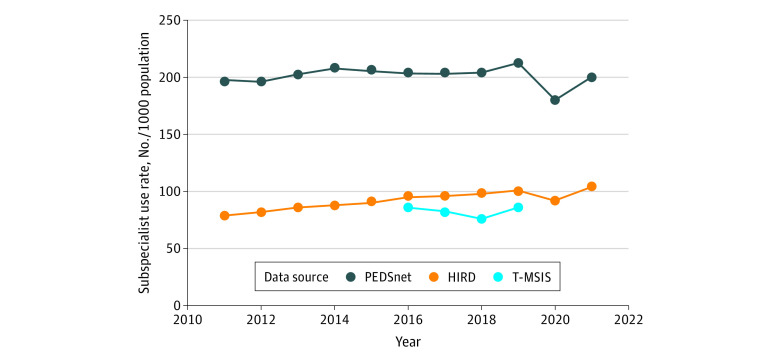
Among the study population, the proportion of girls was 51.0% for PEDSnet, 51.1% for HIRD, and 49.3% for T-MSIS; the proportion of boys was 49.0% for PEDSnet, 48.9% for HIRD, and 50.7% for T-MSIS. The proportion of visits among children younger than 5 years was 37.4% for PEDSnet, 20.9% for HIRD, and 26.2% for T-MSIS; most patients were non-Hispanic Black (29.7% for PEDSnet and 26.1% for T-MSIS) or non-Hispanic White (44.9% for PEDSnet and 43.2% for T-MSIS). Annual rates for PEDSnet ranged from 18.0% to 21.3%, which were higher than rates for HIRD (range, 7.9%-10.4%) and T-MSIS (range, 7.6%-8.6%). Subspecialist use increased in the HIRD commercial health plans (annual relative increase of 2.4% [95% CI, 1.6%-3.1%]), but rates were essentially flat in the other data sources (PEDSnet, -0.2% [95% CI, -1.1% to 0.7%]; T-MSIS, -0.7% [95% CI, -6.5% to 5.5%]). The flat PEDSnet growth reflects a balance between annual use increases among those with commercial insurance (1.2% [95% CI, 0.3%-2.1%]) and decreases in use among those with Medicaid (-0.9% [95% CI, -1.6% to -0.2%]).
The findings of this cross-sectional study suggest that among children, 8.6% of Medicaid beneficiaries, 10.4% of those with commercial insurance, and 21.3% of those whose primary care is received in academic health systems use pediatric medical subspecialty care each year. There was a small increase in rates of subspecialty use among children with commercial but not Medicaid insurance. These data may help launch innovations in the primary-specialty care interface.
了解儿科医学专家是否满足国家儿童的需求的第一步是描述使用率和随时间的趋势。
量化儿科医学专科门诊就诊率。
设计、设置和参与者:这项对专科门诊使用率的重复横断面研究使用了 3 种互补数据源:来自 PEDSnet(8 家大型学术医疗中心 [2010 年 1 月 1 日至 2021 年 12 月 31 日])的电子健康记录;来自 HIRD(14 家商业健康计划 [2011 年 1 月 1 日至 2021 年 12 月 31 日])的医疗保健综合研究数据库的行政数据;以及来自 Transformed Medicaid Statistical Information System(T-MSIS)(44 个州的 Medicaid 计划 [2016 年 1 月 1 日至 2019 年 12 月 31 日])的行政数据。每年的分母包括 PEDSnet 中年龄在 21 岁以下有普通儿科就诊的 493628 至 858551 名患者;HIRD 中至少有 6 个月保险期限的 500 万未满 21 岁的受益人的数据;以及 T-MSIS 中在任何时间注册的未满 19 岁的 3500 万 Medicaid 或儿童健康保险计划受益人的数据。
日历年度和医疗专科类型。
每年每 10 万人口中有至少 1 名儿童在门诊环境中接受任何儿科医学专科治疗的人数。使用率排除了急诊或住院环境中的就诊。
在研究人群中,PEDSnet 的女孩比例为 51.0%,HIRD 为 51.1%,T-MSIS 为 49.3%;男孩比例为 PEDSnet 的 49.0%,HIRD 的 48.9%,T-MSIS 的 50.7%。PEDSnet 中 5 岁以下儿童就诊比例为 37.4%,HIRD 为 20.9%,T-MSIS 为 26.2%;大多数患者是非西班牙裔黑人(PEDSnet 为 29.7%,T-MSIS 为 26.1%)或非西班牙裔白人(PEDSnet 为 44.9%,T-MSIS 为 43.2%)。PEDSnet 的年就诊率为 18.0%至 21.3%,高于 HIRD(7.9%-10.4%)和 T-MSIS(7.6%-8.6%)。HIRD 商业健康计划中的专科使用率增加(每年相对增加 2.4% [95%CI,1.6%-3.1%]),但其他数据源的使用率基本持平(PEDSnet,-0.2% [95%CI,-1.1% 至 0.7%];T-MSIS,-0.7% [95%CI,-6.5% 至 5.5%])。PEDSnet 增长率的平稳反映了商业保险患者就诊率增加(1.2% [95%CI,0.3%-2.1%])和 Medicaid 患者就诊率下降(-0.9% [95%CI,-1.6% 至 -0.2%])之间的平衡。
这项横断面研究的结果表明,在儿童中,8.6%的 Medicaid 受益人和 10.4%的商业保险受益人和 21.3%的其初级保健在学术医疗系统中接受儿科医学专科治疗的儿童每年都需要使用儿科医疗专科服务。商业保险患者的专科使用率略有增加,但 Medicaid 保险患者没有增加。这些数据可能有助于在初级保健和专科医疗的接口处进行创新。