Malone Center of Engineering in Healthcare, Johns Hopkins University School of Medicine, Baltimore, MD, USA.
Department Artificial Intelligence in Biomedical Engineering, Friedrich-Alexander-Universität Erlangen-Nürnberg, Erlangen, Germany.
Sci Rep. 2024 Jan 5;14(1):599. doi: 10.1038/s41598-023-50597-0.
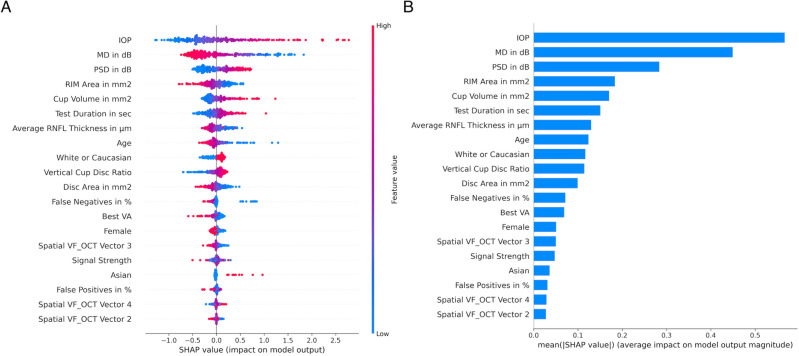
To develop and evaluate the performance of a deep learning model (DLM) that predicts eyes at high risk of surgical intervention for uncontrolled glaucoma based on multimodal data from an initial ophthalmology visit. Longitudinal, observational, retrospective study. 4898 unique eyes from 4038 adult glaucoma or glaucoma-suspect patients who underwent surgery for uncontrolled glaucoma (trabeculectomy, tube shunt, xen, or diode surgery) between 2013 and 2021, or did not undergo glaucoma surgery but had 3 or more ophthalmology visits. We constructed a DLM to predict the occurrence of glaucoma surgery within various time horizons from a baseline visit. Model inputs included spatially oriented visual field (VF) and optical coherence tomography (OCT) data as well as clinical and demographic features. Separate DLMs with the same architecture were trained to predict the occurrence of surgery within 3 months, within 3-6 months, within 6 months-1 year, within 1-2 years, within 2-3 years, within 3-4 years, and within 4-5 years from the baseline visit. Included eyes were randomly split into 60%, 20%, and 20% for training, validation, and testing. DLM performance was measured using area under the receiver operating characteristic curve (AUC) and precision-recall curve (PRC). Shapley additive explanations (SHAP) were utilized to assess the importance of different features. Model prediction of surgery for uncontrolled glaucoma within 3 months had the best AUC of 0.92 (95% CI 0.88, 0.96). DLMs achieved clinically useful AUC values (> 0.8) for all models that predicted the occurrence of surgery within 3 years. According to SHAP analysis, all 7 models placed intraocular pressure (IOP) within the five most important features in predicting the occurrence of glaucoma surgery. Mean deviation (MD) and average retinal nerve fiber layer (RNFL) thickness were listed among the top 5 most important features by 6 of the 7 models. DLMs can successfully identify eyes requiring surgery for uncontrolled glaucoma within specific time horizons. Predictive performance decreases as the time horizon for forecasting surgery increases. Implementing prediction models in a clinical setting may help identify patients that should be referred to a glaucoma specialist for surgical evaluation.
为了开发和评估一种深度学习模型(DLM)的性能,该模型基于初始眼科就诊时的多模态数据,预测患有不可控青光眼的高危眼睛需要手术干预。这是一项纵向、观察性、回顾性研究。纳入了 2013 年至 2021 年间接受手术治疗(包括小梁切除术、引流管分流术、XEN 或二极管手术)或未接受青光眼手术但有 3 次或以上眼科就诊记录的 4038 例成人青光眼或疑似青光眼患者的 4898 只眼。我们构建了一个 DLM,以预测从基线就诊到各个时间范围内青光眼手术的发生情况。模型输入包括空间定向视野(VF)和光学相干断层扫描(OCT)数据以及临床和人口统计学特征。使用相同架构的单独 DLM 分别训练以预测从基线就诊后 3 个月内、3-6 个月内、6 个月-1 年内、1-2 年内、2-3 年内、3-4 年内和 4-5 年内发生手术的情况。纳入的眼睛随机分为 60%、20%和 20%用于训练、验证和测试。使用接受者操作特征曲线(ROC)下面积(AUC)和精确性-召回率曲线(PRC)来衡量 DLM 性能。利用 Shapley 加性解释(SHAP)来评估不同特征的重要性。模型预测 3 个月内不可控青光眼手术的 AUC 最佳,为 0.92(95%CI 0.88,0.96)。对于所有预测 3 年内发生手术的模型,DLM 都达到了临床有用的 AUC 值(>0.8)。根据 SHAP 分析,在预测青光眼手术发生的 7 个模型中,所有模型都将眼内压(IOP)放在前 5 个最重要特征中。6 个模型中,平均偏差(MD)和平均视网膜神经纤维层(RNFL)厚度都被列为前 5 个最重要特征之一。DLM 可以成功识别在特定时间范围内需要手术治疗的青光眼高危眼。随着预测手术时间的增加,预测性能会降低。在临床环境中实施预测模型可能有助于识别需要转诊给青光眼专家进行手术评估的患者。