Hryhorczuk Daniel, Levy Barry S, Prodanchuk Mykola, Kravchuk Oleksandr, Bubalo Nataliia, Hryhorczuk Alex, Erickson Timothy B
Divisions of Environmental and Occupational Health Sciences and Epidemiology, University of Illinois School of Public Health, Chicago, USA.
Department of Public Health and Community Medicine, Tufts University School of Medicine, Boston, USA.
J Occup Med Toxicol. 2024 Jan 5;19(1):1. doi: 10.1186/s12995-023-00398-y.
Russia's invasion of Ukraine in February 2022 ignited the largest armed conflict in Europe since World War II. Ukrainian government agencies, civil society organizations, and international agencies have gathered an unprecedented amount of data about the impact of war on the environment, which is often the silent victim of war. We review these data and highlight the limitations of international governance for protection of the environment during time of war.
We performed an integrative review of academic, institutional, and media information resources using the search terms "Ukraine", "Russia", "war", "environment", "health", "human rights", "international humanitarian law", "international human rights law", "ecocide", and "war crimes".
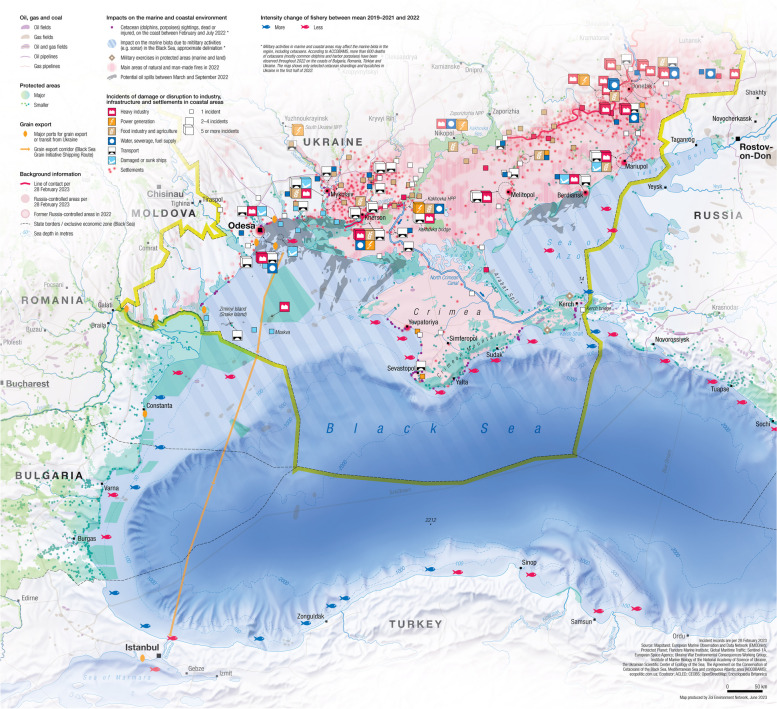
Nearly 500,000 military personnel have been killed or wounded during the war, and more than 30,000 civilians have been killed or injured. Indirect health effects of the war have likely accounted for an even greater amount of civilian morbidity and mortality. The war has displaced more than 11 million people. Russia's military forces have caused extensive damage to civilian infrastructure. The war has devastated Ukraine's economy and reduced food and energy security in many countries. The war has caused more than $56.4 billion in damage to the environment. There has been widespread chemical contamination of air, water, and soil, and 30% of Ukraine has been contaminated with landmines and unexploded ordnance. Landscape destruction, shelling, wildfires, deforestation, and pollution have adversely affected 30% of Ukraine's protected areas. Russia's seizure of the Zaporizhzhia Nuclear Power Plant and destruction of the Nova Kakhovka Dam have posed risks of long-term environmental catastrophe. Most of these environmental impacts threaten human health.
In addition to enormous human costs, Russia's war on Ukraine has had devastating impacts on the natural environment and the built environment. International law mandates that methods of warfare must be implemented with due regard to the protection and preservation of the natural environment. A just and lasting peace necessitates, among other requirements, rebuilding and restoration of Ukraine's natural environment and built environment. The environmental consequences of all wars need to be investigated and more effective measures need to be implemented to protect the environment during war.
2022年2月俄罗斯对乌克兰的入侵引发了自第二次世界大战以来欧洲最大规模的武装冲突。乌克兰政府机构、民间社会组织和国际机构收集了关于战争对环境影响的前所未有的大量数据,而环境往往是战争中无声的受害者。我们审视这些数据,并强调战时环境保护国际治理的局限性。
我们使用“乌克兰”“俄罗斯”“战争”“环境”“健康”“人权”“国际人道主义法”“国际人权法”“生态灭绝”和“战争罪行”等搜索词,对学术、机构和媒体信息资源进行了综合审查。
战争期间有近50万军事人员伤亡,3万多名平民伤亡。战争对健康的间接影响可能导致了更多的平民发病和死亡。战争使1100多万人流离失所。俄罗斯军队对民用基础设施造成了广泛破坏。战争摧毁了乌克兰的经济,降低了许多国家的粮食和能源安全。战争对环境造成了超过564亿美元的破坏。空气、水和土壤受到广泛的化学污染,乌克兰30%的地区被地雷和未爆弹药污染。景观破坏、炮击、野火、森林砍伐和污染对乌克兰30%的保护区产生了不利影响。俄罗斯占领扎波罗热核电站和摧毁新卡霍夫卡大坝带来了长期环境灾难的风险。这些环境影响大多威胁着人类健康。
除了巨大的人力成本外,俄罗斯对乌克兰的战争对自然环境和人造环境造成了毁灭性影响。国际法规定,作战方法的实施必须适当考虑到对自然环境的保护和维护。公正持久的和平除其他要求外,还需要重建和恢复乌克兰的自然环境和人造环境。所有战争的环境后果都需要进行调查,并且需要采取更有效的措施在战争期间保护环境。