
系统鉴定嗜酸性粒细胞性食管炎中与基因型相关的增强子变异。
Systematic identification of genotype-dependent enhancer variants in eosinophilic esophagitis.
机构信息
Center for Autoimmune Genomics and Etiology, Cincinnati Children's Hospital Medical Center, Cincinnati, OH 45229, USA.
Department of Pediatrics, University of Cincinnati College of Medicine, Cincinnati, OH 45229, USA; Division of Allergy and Immunology, Cincinnati Children's Hospital Medical Center, Cincinnati, OH 45229, USA.
出版信息
Am J Hum Genet. 2024 Feb 1;111(2):280-294. doi: 10.1016/j.ajhg.2023.12.008. Epub 2024 Jan 5.
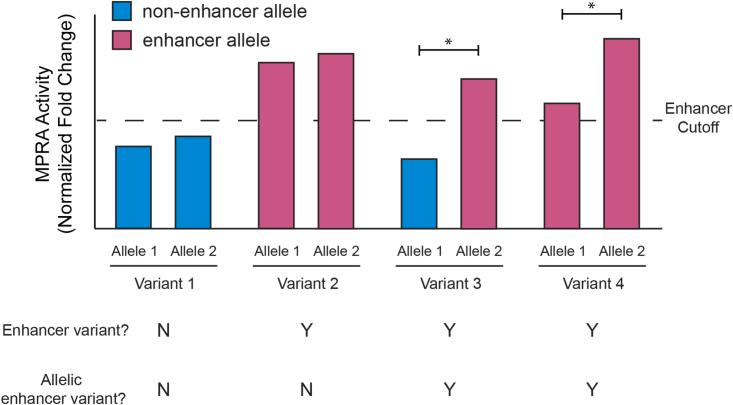
Eosinophilic esophagitis (EoE) is a rare atopic disorder associated with esophageal dysfunction, including difficulty swallowing, food impaction, and inflammation, that develops in a small subset of people with food allergies. Genome-wide association studies (GWASs) have identified 9 independent EoE risk loci reaching genome-wide significance (p < 5 × 10) and 27 additional loci of suggestive significance (5 × 10 < p < 1 × 10). In the current study, we perform linkage disequilibrium (LD) expansion of these loci to nominate a set of 531 variants that are potentially causal. To systematically interrogate the gene regulatory activity of these variants, we designed a massively parallel reporter assay (MPRA) containing the alleles of each variant within their genomic sequence context cloned into a GFP reporter library. Analysis of reporter gene expression in TE-7, HaCaT, and Jurkat cells revealed cell-type-specific gene regulation. We identify 32 allelic enhancer variants, representing 6 genome-wide significant EoE loci and 7 suggestive EoE loci, that regulate reporter gene expression in a genotype-dependent manner in at least one cellular context. By annotating these variants with expression quantitative trait loci (eQTL) and chromatin looping data in related tissues and cell types, we identify putative target genes affected by genetic variation in individuals with EoE. Transcription factor enrichment analyses reveal possible roles for cell-type-specific regulators, including GATA3. Our approach reduces the large set of EoE-associated variants to a set of 32 with allelic regulatory activity, providing functional insights into the effects of genetic variation in this disease.
嗜酸性粒细胞性食管炎 (EoE) 是一种罕见的特应性疾病,与食管功能障碍有关,包括吞咽困难、食物嵌塞和炎症,在一小部分食物过敏人群中发展。全基因组关联研究 (GWAS) 已经确定了 9 个独立的 EoE 风险位点,达到全基因组显著水平 (p < 5 × 10),还有 27 个额外的具有提示意义的位点 (5 × 10 < p < 1 × 10)。在目前的研究中,我们对这些位点进行了连锁不平衡 (LD) 扩展,以提名一组 531 个潜在因果的变体。为了系统地研究这些变体的基因调控活性,我们设计了一个大规模平行报告基因测定 (MPRA),其中包含每个变体在其基因组序列背景下的等位基因克隆到 GFP 报告基因库中。在 TE-7、HaCaT 和 Jurkat 细胞中分析报告基因的表达,揭示了细胞类型特异性的基因调控。我们确定了 32 个等位基因增强变体,代表 6 个全基因组显著的 EoE 位点和 7 个提示性的 EoE 位点,这些变体以基因型依赖的方式在至少一种细胞环境中调节报告基因的表达。通过在相关组织和细胞类型中用表达数量性状基因座 (eQTL) 和染色质环化数据注释这些变体,我们确定了个体遗传变异影响的潜在靶基因在 EoE 中。转录因子富集分析揭示了细胞类型特异性调节剂的可能作用,包括 GATA3。我们的方法将大量的 EoE 相关变体减少到一组具有等位基因调控活性的 32 个变体,为该疾病中遗传变异的影响提供了功能见解。




 Zotero 插件