Christenson Chase, Wu Chengyue, Hormuth David A, Huang Shiliang, Bao Ande, Brenner Andrew, Yankeelov Thomas E
Departments of Biomedical Engineering, USA.
Oden Institute for Computational Engineering and Sciences, The University of Texas at Austin, Austin, TX 78712, USA.
Brain Multiphys. 2023 Dec;5. doi: 10.1016/j.brain.2023.100084. Epub 2023 Oct 29.
Rhenium-186 (Re) labeled nanoliposome (RNL) therapy for recurrent glioblastoma patients has shown promise to improve outcomes by locally delivering radiation to affected areas. To optimize the delivery of RNL, we have developed a framework to predict patient-specific response to RNL using image-guided mathematical models.
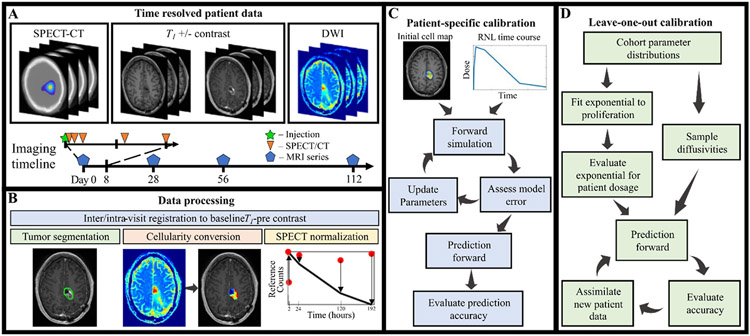
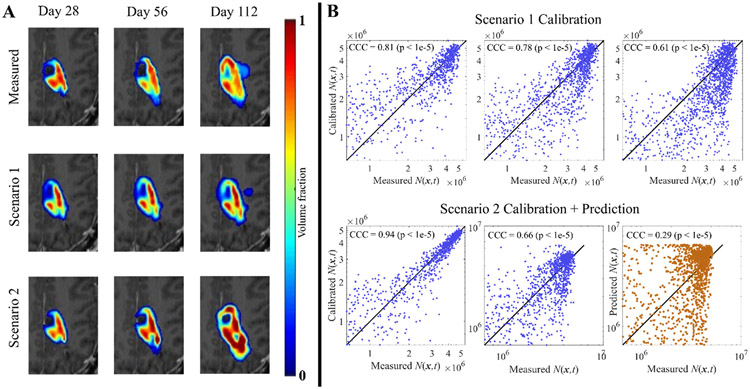
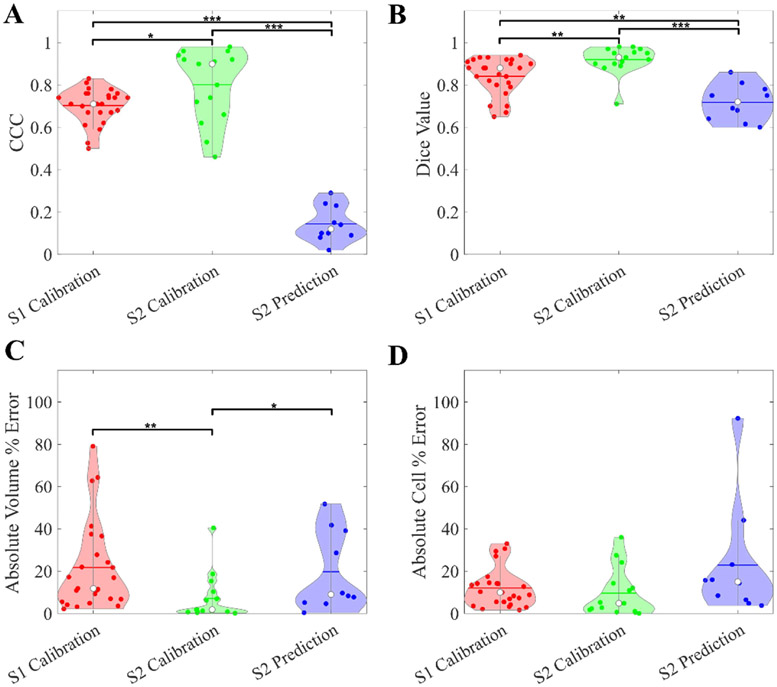
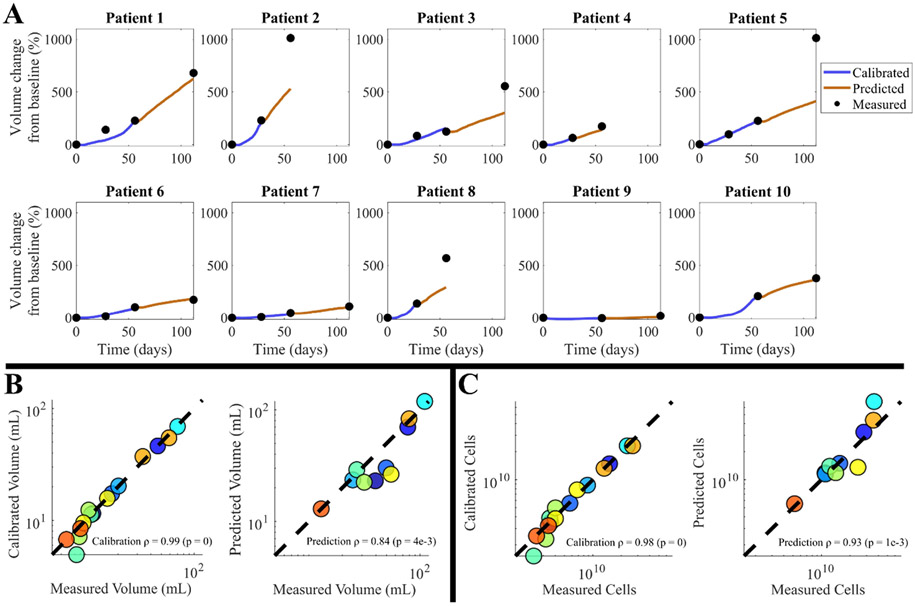
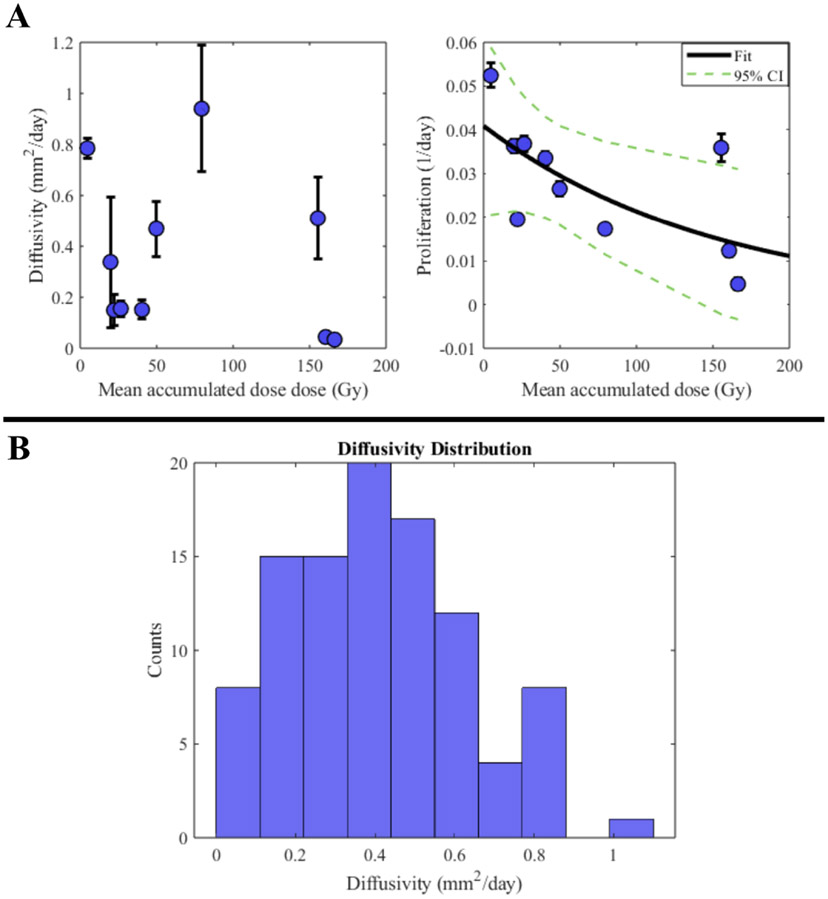
We calibrated a family of reaction-diffusion type models with multi-modality imaging data from ten patients (NCR01906385) to predict the spatio-temporal dynamics of each patient's tumor. The data consisted of longitudinal magnetic resonance imaging (MRI) and single photon emission computed tomography (SPECT) to estimate tumor burden and local RNL activity, respectively. The optimal model from the family was selected and used to predict future growth. A simplified version of the model was used in a leave-one-out analysis to predict the development of an individual patient's tumor, based on cohort parameters.
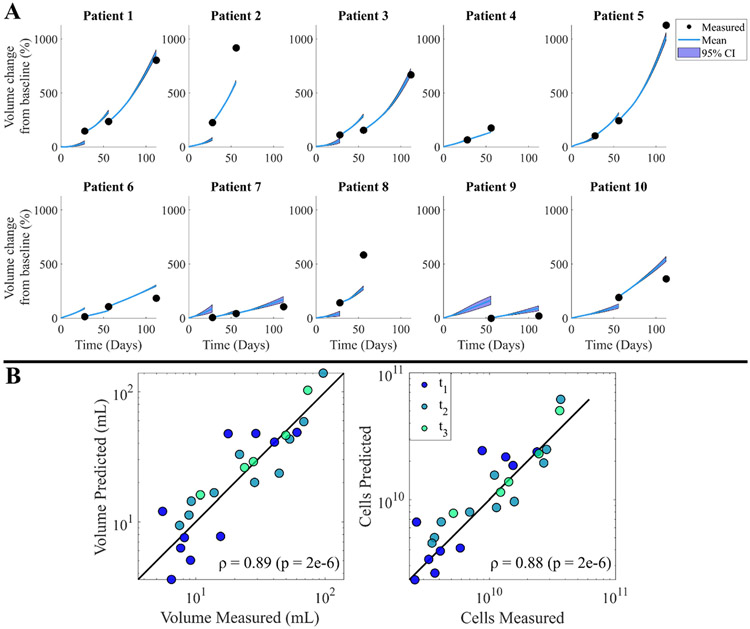
Across the cohort, predictions using patient-specific parameters with the selected model were able to achieve Spearman correlation coefficients (SCC) of 0.98 and 0.93 for tumor volume and total cell number, respectively, when compared to the measured data. Predictions utilizing the leave-one-out method achieved SCCs of 0.89 and 0.88 for volume and total cell number across the population, respectively.
We have shown that patient-specific calibrations of a biology-based mathematical model can be used to make early predictions of response to RNL therapy. Furthermore, the leave-one-out framework indicates that radiation doses determined by SPECT can be used to assign model parameters to make predictions directly following the conclusion of RNL treatment.
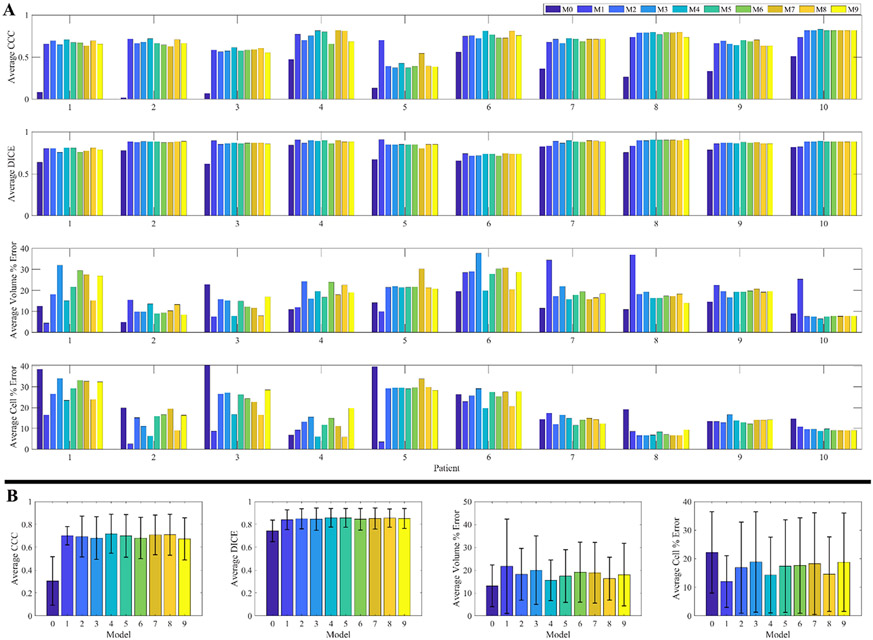
This manuscript explores the application of computational models to predict response to radionuclide therapy in glioblastoma. There are few, to our knowledge, examples of mathematical models used in clinical radionuclide therapy. We have tested a family of models to determine the applicability of different radiation coupling terms for response to the localized radiation delivery. We show that with patient-specific parameter estimation, we can make accurate predictions of future glioblastoma response to the treatment. As a comparison, we have shown that population trends in response can be used to forecast growth from the moment the treatment has been delivered.In addition to the high simulation and prediction accuracy our modeling methods have achieved, the evaluation of a family of models has given insight into the response dynamics of radionuclide therapy. These dynamics, while different than we had initially hypothesized, should encourage future imaging studies involving high dosage radiation treatments, with specific emphasis on the local immune and vascular response.
铼 - 186(Re)标记的纳米脂质体(RNL)疗法用于复发性胶质母细胞瘤患者,已显示出通过向受影响区域局部递送辐射来改善治疗效果的前景。为了优化RNL的递送,我们开发了一个框架,使用图像引导的数学模型预测患者对RNL的特异性反应。
我们使用来自10名患者(NCR01906385)的多模态成像数据校准了一组反应 - 扩散类型模型,以预测每个患者肿瘤的时空动态。数据包括纵向磁共振成像(MRI)和单光子发射计算机断层扫描(SPECT),分别用于估计肿瘤负荷和局部RNL活性。从该组模型中选择最优模型并用于预测未来生长。基于队列参数,该模型的简化版本用于留一法分析,以预测个体患者肿瘤的发展。
在整个队列中,与测量数据相比,使用所选模型的患者特异性参数进行预测时,肿瘤体积和总细胞数的斯皮尔曼相关系数(SCC)分别能够达到0.98和0.93。利用留一法进行的预测在总体上肿瘤体积和总细胞数的SCC分别为0.89和0.88。
我们已经表明,基于生物学的数学模型的患者特异性校准可用于对RNL治疗反应进行早期预测。此外,留一法框架表明,由SPECT确定的辐射剂量可用于分配模型参数,以便在RNL治疗结束后直接进行预测。
本手稿探讨了计算模型在预测胶质母细胞瘤放射性核素治疗反应中的应用。据我们所知,在临床放射性核素治疗中使用数学模型的例子很少。我们测试了一组模型,以确定不同辐射耦合项对局部辐射递送反应的适用性。我们表明,通过患者特异性参数估计,我们可以准确预测未来胶质母细胞瘤对治疗的反应。作为比较,我们已经表明,治疗开始后,反应的总体趋势可用于预测生长。除了我们的建模方法所实现的高模拟和预测准确性之外,对一组模型的评估深入了解了放射性核素治疗的反应动态。这些动态虽然与我们最初假设的不同,但应该鼓励未来涉及高剂量放射治疗的成像研究,特别强调局部免疫和血管反应。