Hormuth David A, Jarrett Angela M, Davis Tessa, Yankeelov Thomas E
Oden Institute for Computational Engineering and Sciences, The University of Texas at Austin, Austin, TX 78712, USA.
Livestrong Cancer Institutes, The University of Texas at Austin, Austin, TX 78712, USA.
Cancers (Basel). 2021 Apr 7;13(8):1765. doi: 10.3390/cancers13081765.
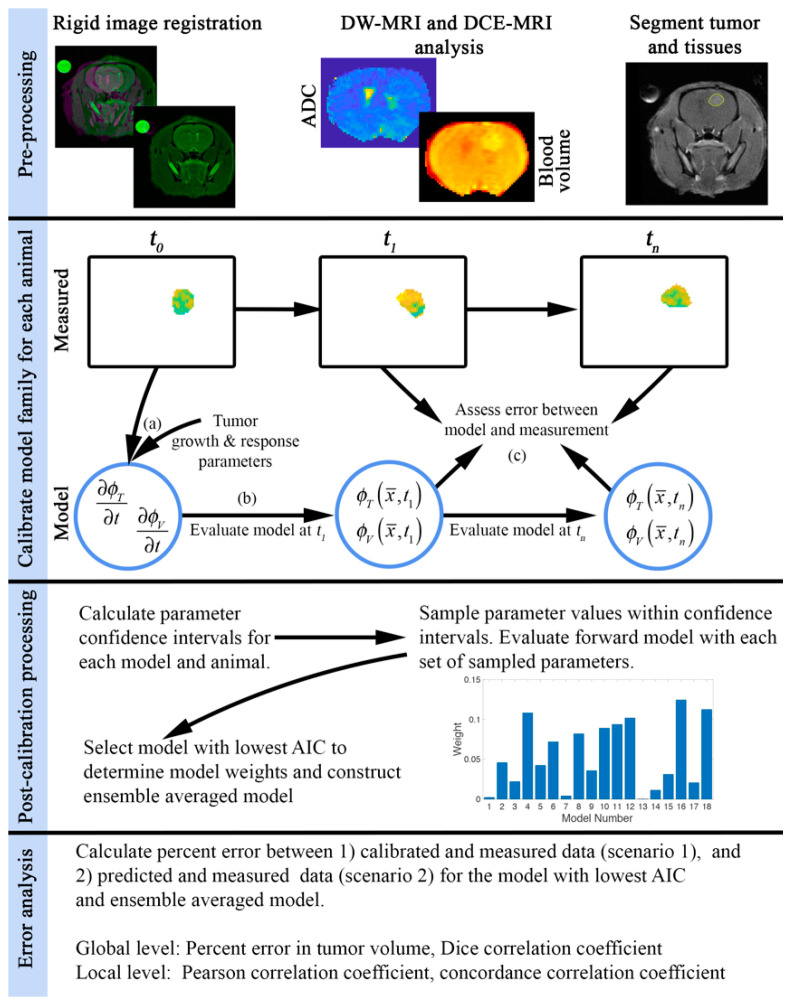
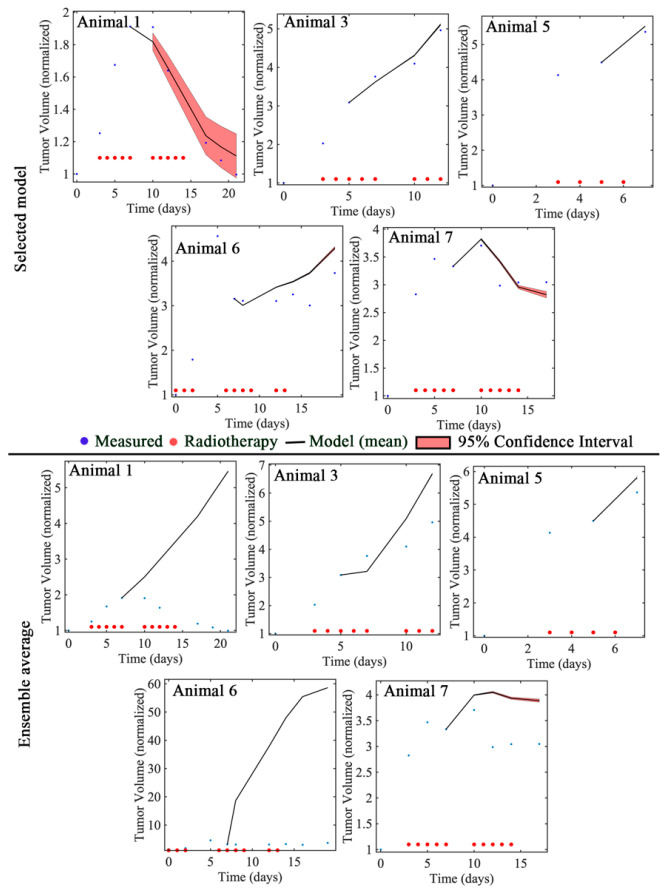
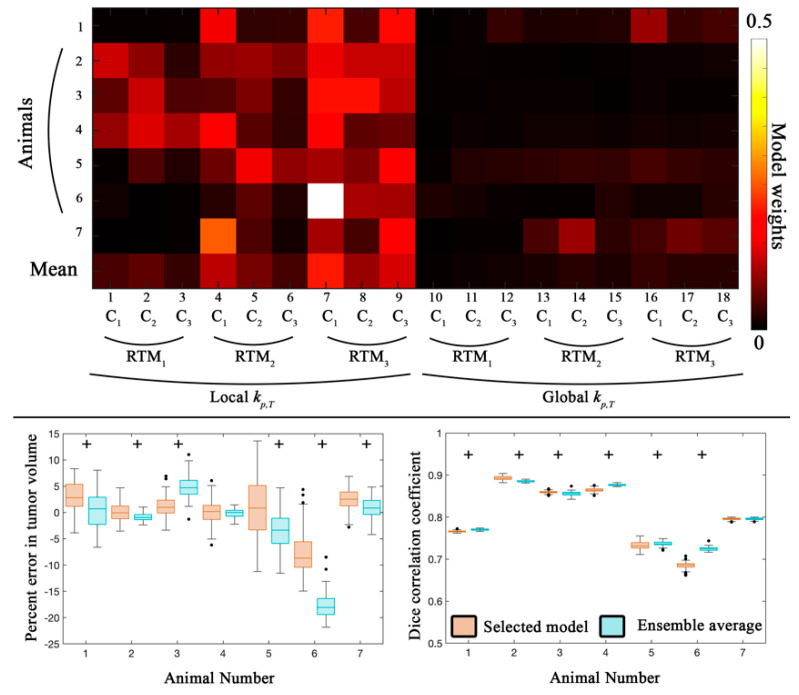
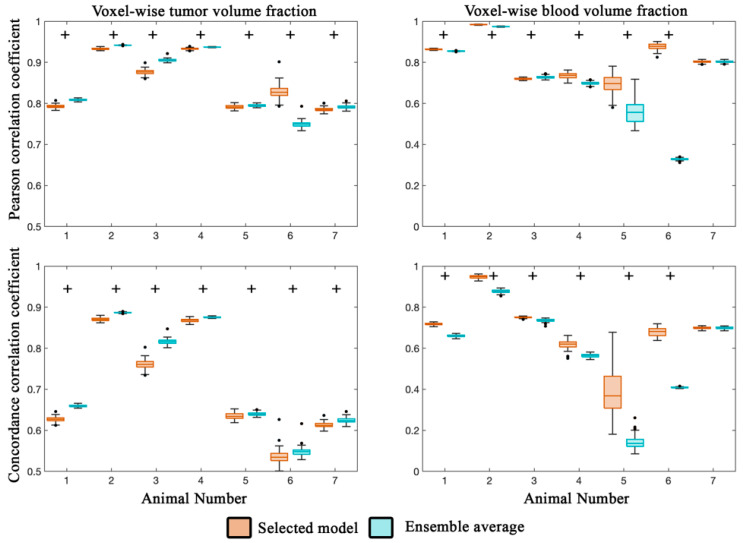
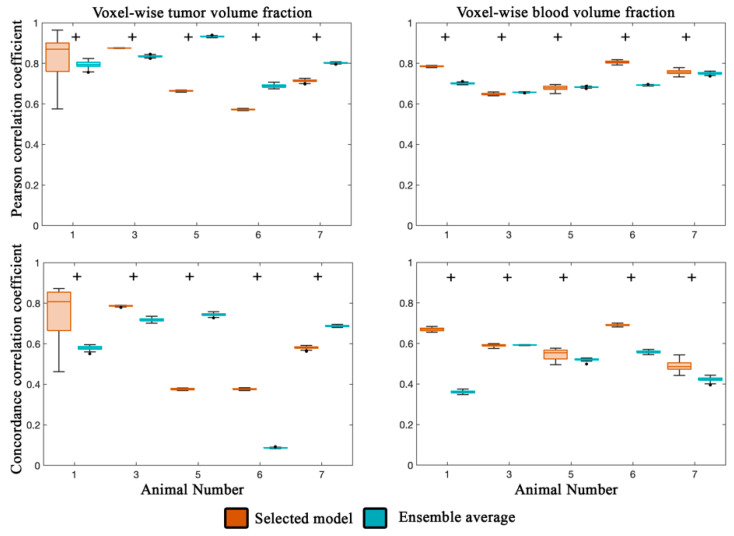
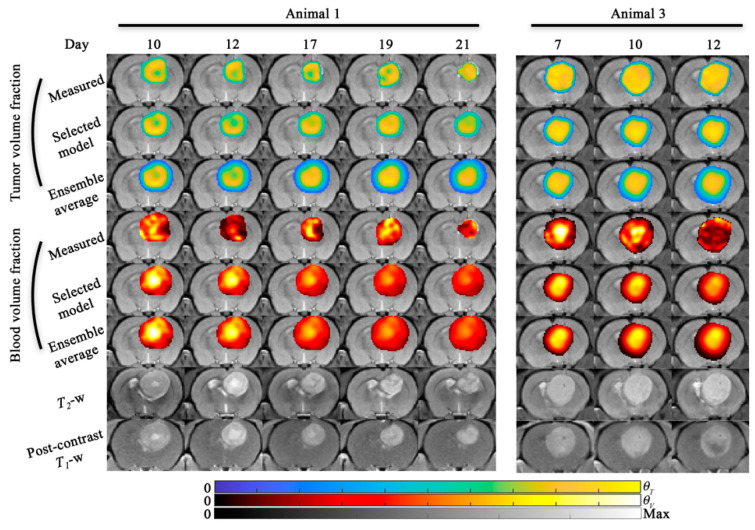
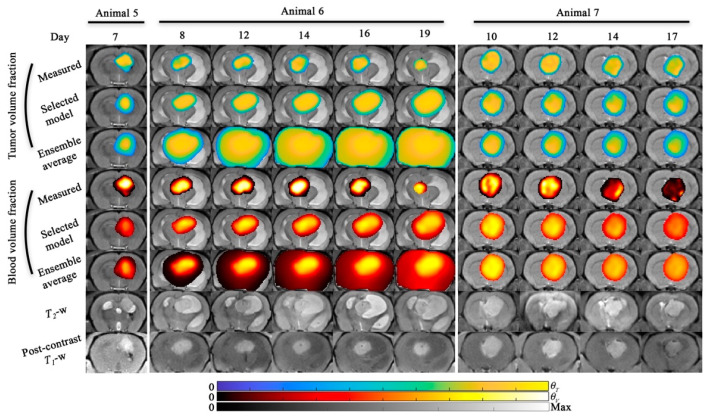
Fractionated radiation therapy is central to the treatment of numerous malignancies, including high-grade gliomas where complete surgical resection is often impractical due to its highly invasive nature. Development of approaches to forecast response to fractionated radiation therapy may provide the ability to optimize or adapt treatment plans for radiotherapy. Towards this end, we have developed a family of 18 biologically-based mathematical models describing the response of both tumor and vasculature to fractionated radiation therapy. Importantly, these models can be personalized for individual tumors via quantitative imaging measurements. To evaluate this family of models, rats (n = 7) with U-87 glioblastomas were imaged with magnetic resonance imaging (MRI) before, during, and after treatment with fractionated radiotherapy (with doses of either 2 Gy/day or 4 Gy/day for up to 10 days). Estimates of tumor and blood volume fractions, provided by diffusion-weighted MRI and dynamic contrast-enhanced MRI, respectively, were used to calibrate tumor-specific model parameters. The Akaike Information Criterion was employed to select the most parsimonious model and determine an ensemble averaged model, and the resulting forecasts were evaluated at the global and local level. At the global level, the selected model's forecast resulted in less than 16.2% error in tumor volume estimates. At the local (voxel) level, the median Pearson correlation coefficient across all prediction time points ranged from 0.57 to 0.87 for all animals. While the ensemble average forecast resulted in increased error (ranging from 4.0% to 1063%) in tumor volume predictions over the selected model, it increased the voxel wise correlation (by greater than 12.3%) for three of the animals. This study demonstrates the feasibility of calibrating a model of response by serial quantitative MRI data collected during fractionated radiotherapy to predict response at the conclusion of treatment.
分割放射治疗是众多恶性肿瘤治疗的核心,包括高级别胶质瘤,由于其高度浸润性,完整的手术切除往往不切实际。开发预测分割放射治疗反应的方法可能有助于优化或调整放射治疗计划。为此,我们开发了一系列18个基于生物学的数学模型,描述肿瘤和血管对分割放射治疗的反应。重要的是,这些模型可以通过定量成像测量针对个体肿瘤进行个性化。为了评估这一系列模型,对7只患有U-87胶质母细胞瘤的大鼠在分割放射治疗(剂量为2 Gy/天或4 Gy/天,持续10天)之前、期间和之后进行磁共振成像(MRI)扫描。分别由扩散加权MRI和动态对比增强MRI提供的肿瘤和血容量分数估计值用于校准肿瘤特异性模型参数。采用赤池信息准则选择最简约的模型并确定总体平均模型,并在全局和局部水平评估所得预测结果。在全局水平上,所选模型的预测在肿瘤体积估计中的误差小于16.2%。在局部(体素)水平上,所有动物在所有预测时间点的中位数皮尔逊相关系数范围为0.57至0.87。虽然总体平均预测在肿瘤体积预测中导致的误差比所选模型增加(范围为4.0%至1063%),但它使三只动物的体素相关性提高了超过12.3%。本研究证明了通过在分割放射治疗期间收集的系列定量MRI数据校准反应模型以预测治疗结束时反应的可行性。