Institute of Communication Research, Seoul National University, Seoul, Korea.
Bowers College of Computing and Information Science, Cornell University, Ithaca, New York, USA.
Cyberpsychol Behav Soc Netw. 2024 Jan;27(1):37-46. doi: 10.1089/cyber.2022.0400.
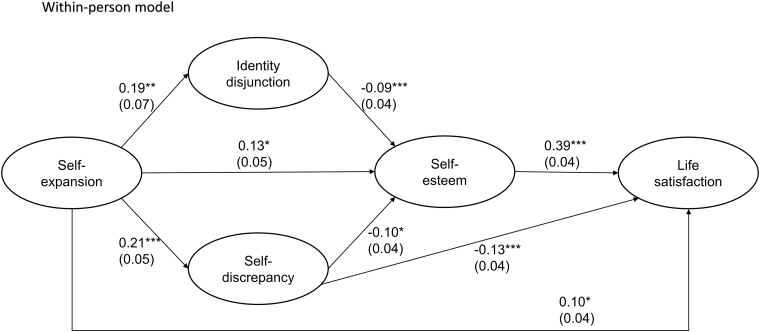
This study researches the impact of self-expansion experiences in the Metaverse on users' identity perception, self-esteem, and life satisfaction. To do so, the researchers conducted a two-wave panel study with a 3-month interval ( = 486) in VRChat, one of the most popular social virtual reality (VR) platforms. As predicted, the increase in self-expansion experience in VR environments positively predicted users' self-esteem and life satisfaction. However, when self-expansion led to a loss of coherency in the self-concept by causing identity disjunction or self-discrepancy, it damaged self-esteem and life satisfaction, respectively. The current findings exhibit that experimenting with and enlarging identity through immersive experiences in the Metaverse could benefit the individual, but only when it does not cause a disconnection between virtual and offline identities. This article discusses the potential opportunities and risks in the Metaverse, emphasizing the importance of advancing our understanding of the self-expansion experience in immersive media.
本研究旨在探讨元宇宙中的自我扩展体验对用户身份认知、自尊和生活满意度的影响。为此,研究人员在最受欢迎的社交虚拟现实 (VR) 平台之一 VRChat 中进行了一项为期 3 个月( = 486)的两波面板研究。正如预测的那样,VR 环境中自我扩展体验的增加正向预测了用户的自尊和生活满意度。然而,当自我扩展通过造成身份不连贯或自我差异导致自我概念的不连贯性时,它分别损害了自尊和生活满意度。本研究结果表明,通过在元宇宙中进行沉浸式体验来尝试和扩大身份可以使个体受益,但前提是它不会导致虚拟和线下身份之间的脱节。本文讨论了元宇宙中的潜在机会和风险,强调了在沉浸式媒体中深入了解自我扩展体验的重要性。