Human Performance Laboratory, Department of Biology, Appalachian State University, North Carolina Research Campus, Kannapolis, NC 28081, USA.
UNCG Center for Translational Biomedical Research, University of North Carolina at Greensboro, North Carolina Research Campus, Kannapolis, NC 28081, USA.
Nutrients. 2023 Dec 21;16(1):36. doi: 10.3390/nu16010036.
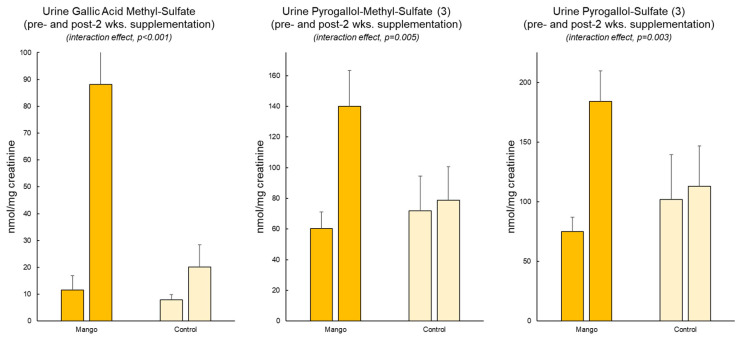
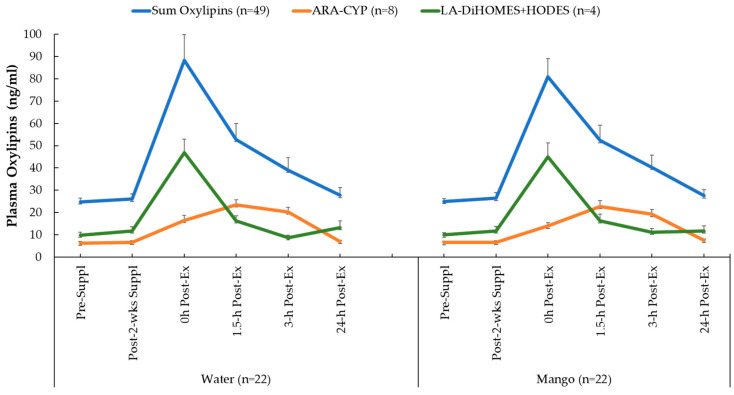
Mangoes have a unique nutrient profile (carotenoids, polyphenols, sugars, and vitamins) that we hypothesized would mitigate post-exercise inflammation. This study examined the effects of mango ingestion on moderating exercise-induced inflammation in a randomized crossover trial with 22 cyclists. In random order with trials separated by a 2-week washout period, the cyclists ingested 330 g mango/day with 0.5 L water or 0.5 L of water alone for 2 weeks, followed by a 2.25 h cycling bout challenge. Blood and urine samples were collected pre- and post-2 weeks of supplementation, with additional blood samples collected immediately post-exercise and 1.5-h, 3-h, and 24 h post-exercise. Urine samples were analyzed for targeted mango-related metabolites. The blood samples were analyzed for 67 oxylipins, which are upstream regulators of inflammation and other physiological processes. After 2 weeks of mango ingestion, three targeted urine mango-related phenolic metabolites were significantly elevated compared to water alone (interaction effects, ≤ 0.003). Significant post-exercise increases were measured for 49 oxylipins, but various subgroup analyses showed no differences in the pattern of change between trials (all interaction effects, > 0.150). The 2.25 h cycling bouts induced significant inflammation, but no countermeasure effect was found after 2 weeks of mango ingestion despite the elevation of mango gut-derived phenolic metabolites.
芒果具有独特的营养成分(类胡萝卜素、多酚、糖和维生素),我们假设这些成分可以减轻运动后的炎症。本研究通过一项随机交叉试验,对 22 名自行车运动员进行了研究,检验了芒果摄入对调节运动引起的炎症的影响。22 名自行车运动员以随机顺序进行试验,两次试验之间间隔 2 周洗脱期。在 2 周的时间内,他们分别摄入 330 克芒果加 0.5 升水或单独摄入 0.5 升水,随后进行 2.25 小时的自行车挑战。在补充 2 周前后以及运动后立即、1.5 小时、3 小时和 24 小时采集血液和尿液样本。尿液样本用于分析目标芒果相关代谢物,血液样本用于分析 67 种氧化脂,这些氧化脂是炎症和其他生理过程的上游调节剂。与单独摄入水相比,摄入芒果 2 周后,有 3 种靶向尿液芒果相关酚类代谢物显著升高(交互效应, ≤ 0.003)。49 种氧化脂在运动后显著升高,但各种亚组分析表明,试验之间的变化模式没有差异(所有交互效应,>0.150)。2.25 小时的自行车挑战会引起明显的炎症,但在摄入芒果 2 周后,没有发现对抗措施的效果,尽管肠道衍生的芒果酚类代谢物水平升高。