Institute of Agricultural Resources and Regional Planning, Chinese Academy of Agricultural Sciences, Beijing 100081, China.
State Key Laboratory of Efficient Utilization of Arid and Semi-Arid Arable Land in Northern China, Beijing 100081, China.
Nutrients. 2023 Dec 21;16(1):43. doi: 10.3390/nu16010043.
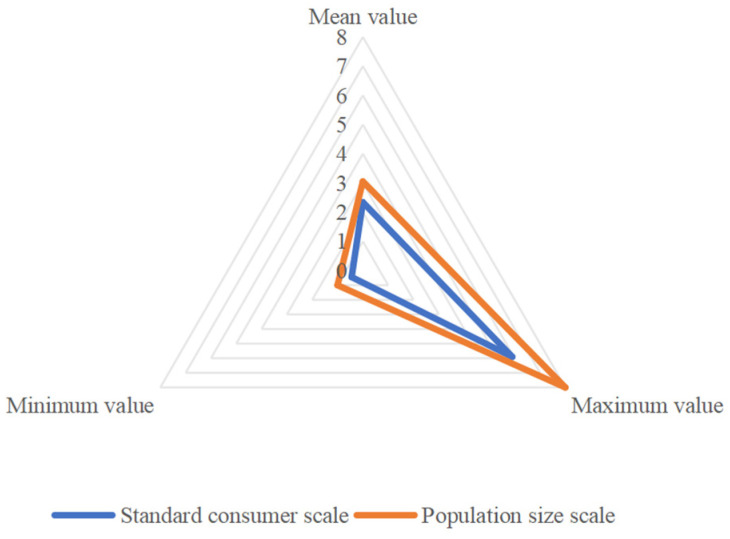
China's population is showing the characteristics of "fewer children" and "aging", which will have a long-term and far-reaching impact on the food and nutritional needs of China and the world. In this paper, adult equivalent scale () variables representing the household population structure were introduced into the energy intake model to quantify the impact of population structure changes on energy intake and reveal the characteristics of energy intake changes in the life cycle of Chinese residents. It is found that the change in the population structure has a significant impact on the energy intake of urban households in China, and the elasticity is 0.446. The energy intake of Chinese elderly over the age of 60 shows a trend of first increasing and then decreasing, especially after the age of 65, which indicates that the aging will promote a decline in food consumption in China. The energy intake of 1-10-year-old children, 22-30 year old, and 40-45 year old women all showed a change of first a decrease and then an increase, which may be related to parents' care for young children and women with children's management of body size. The average household size expressed by the adult equivalent scales of energy consumption is 2.341, which is smaller than the 3.052 calculated by the population number. The conclusion indicates that the prediction of the food and nutritional demand should be adjusted according to the changes and differences in accordance with the intensification of "fewer children" and "aging", as well as the life cycle changes in residents' energy intake, which is conducive to the formulation of food and nutrition security policies.
中国的人口呈现“少子化”和“老龄化”的特征,这将对中国乃至世界的食物和营养需求产生长期而深远的影响。本文将代表家庭人口结构的成人当量尺度()变量引入到能量摄入模型中,量化人口结构变化对能量摄入的影响,揭示中国居民生命周期中能量摄入的变化特征。研究发现,人口结构变化对中国城镇家庭的能量摄入有显著影响,其弹性为 0.446。中国 60 岁以上老年人的能量摄入呈先增后减的趋势,尤其是 65 岁以后,这表明老龄化将促进中国食物消费的下降。1-10 岁儿童、22-30 岁和 40-45 岁女性的能量摄入都表现为先减少后增加的变化,这可能与父母对幼儿的照顾和有子女的女性对身材的管理有关。用能量消耗的成人当量尺度表示的平均家庭规模为 2.341,小于用人口数量计算的 3.052。这一结论表明,应根据“少子化”和“老龄化”的变化和差异,以及居民能量摄入的生命周期变化,调整食物和营养需求的预测,这有利于制定粮食和营养安全政策。