Nuclear Medicine, Faculty of Medicine, University of Augsburg, Augsburg, Germany.
Pathology, Faculty of Medicine, University of Augsburg, Augsburg, Germany.
BMC Cancer. 2024 Jan 12;24(1):65. doi: 10.1186/s12885-023-11771-9.
Recently, we introduced Stroma-AReactive-Invasion-Front-Areas (SARIFA) as a novel hematoxylin-eosin (H&E)-based histopathologic prognostic biomarker for various gastrointestinal cancers, closely related to lipid metabolism. To date, no studies on SARIFA, which is defined as direct tumor-adipocyte-interaction, beyond the alimentary tract exist. Hence, the objective of our current investigation was to study the significance of SARIFA in pT3a prostate cancer (PCa) and explore its association with lipid metabolism in PCa as lipid metabolism plays a key role in PCa development and progression.
To this end, we evaluated SARIFA-status in 301 radical prostatectomy specimens and examined the relationship between SARIFA-status, clinicopathological characteristics, overall survival, and immunohistochemical expression of FABP4 and CD36 (proteins closely involved in fatty-acid metabolism). Additionally, we investigated the correlation between SARIFA and biochemical recurrence-free survival (BRFS) and PSMA-positive recurrences in PET/CT imaging in a patient subgroup. Moreover, a quantitative SARIFA cut-off was established to further understand the underlying tumor biology.
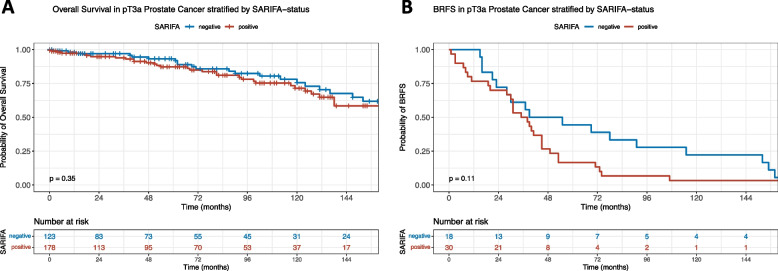
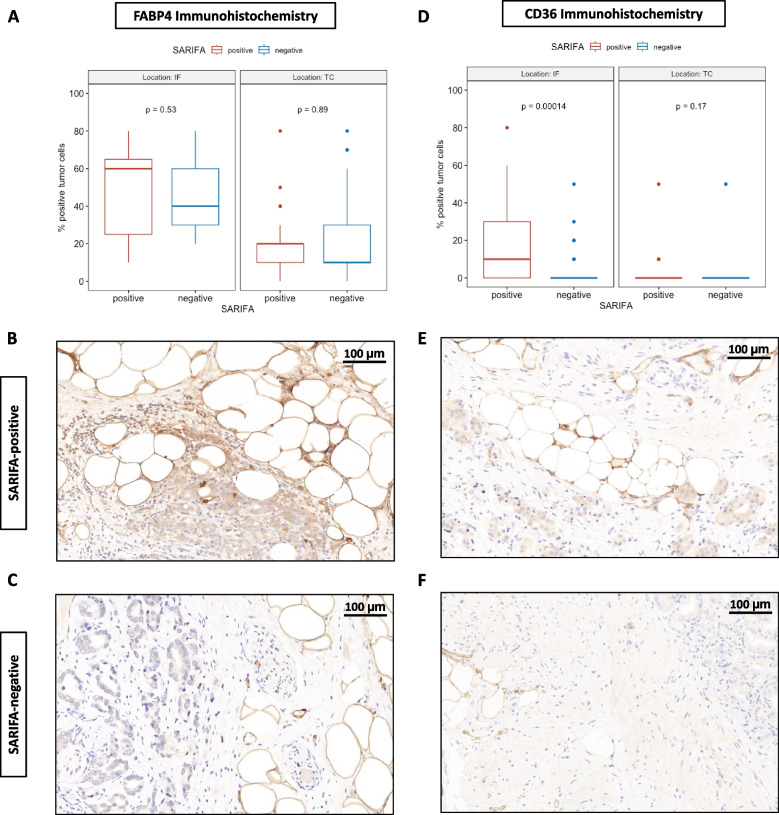
SARIFA positivity occurred in 59.1% (n = 178) of pT3a PCas. Our analysis demonstrated that SARIFA positivity is strongly associated with established high-risk features, such as R1 status, extraprostatic extension, and higher initial PSA values. Additionally, we observed an upregulation of immunohistochemical CD36 expression specifically at SARIFAs (p = 0.00014). Kaplan-Meier analyses revealed a trend toward poorer outcomes, particularly in terms of BRFS (p = 0.1). More extensive tumor-adipocyte interaction, assessed as quantity-dependent SARIFA-status on H&E slides, is also significantly associated with high-risk features, such as lymph node metastasis, and seems to be associated with worse survival outcomes (p = 0.16). Moreover, SARIFA positivity appeared to be linked to more distant lymph node and bone metastasis, although statistical significance was slightly not achieved (both p > 0.05).
This is the first study to introduce SARIFA as easy-and-fast-to-assess H&E-based biomarker in locally advanced PCa. SARIFA as the histopathologic correlate of a distinct tumor biology, closely related to lipid metabolism, could pave the way to a more detailed patient stratification and to the development of novel drugs targeting lipid metabolism in pT3a PCa. On the basis of this biomarker discovery study, further research efforts on the prognostic and predictive role of SARIFA in PCa can be designed.
最近,我们提出了 Stroma-AReactive-Invasion-Front-Areas(SARIFA)作为一种新的苏木精和伊红(H&E)基于组织病理学的胃肠癌预后生物标志物,与脂质代谢密切相关。迄今为止,尚无关于 SARIFA 的研究,该研究定义为直接肿瘤-脂肪细胞相互作用,超出了消化道。因此,我们目前的研究目的是研究 SARIFA 在 pT3a 前列腺癌(PCa)中的意义,并探讨其与 PCa 中脂质代谢的关系,因为脂质代谢在 PCa 的发展和进展中起着关键作用。
为此,我们评估了 301 例根治性前列腺切除术标本中的 SARIFA 状态,并检查了 SARIFA 状态与临床病理特征、总生存以及 FABP4 和 CD36(密切参与脂肪酸代谢的蛋白质)免疫组化表达之间的关系。此外,我们还研究了 SARIFA 与生化无复发生存(BRFS)和 PET/CT 成像中 PSMA 阳性复发之间的相关性在患者亚组中。此外,建立了定量 SARIFA 截断值以进一步了解肿瘤的潜在生物学。
SARIFA 阳性发生在 59.1%(n=178)的 pT3a PCas 中。我们的分析表明,SARIFA 阳性与既定的高危特征密切相关,例如 R1 状态、前列腺外延伸和较高的初始 PSA 值。此外,我们观察到 CD36 免疫组化表达在 SARIFAs 中上调(p=0.00014)。Kaplan-Meier 分析显示,BRFS (p=0.1)的结果有恶化趋势。在 H&E 切片上,作为数量依赖性 SARIFA 状态评估的更广泛的肿瘤-脂肪细胞相互作用,也与淋巴结转移等高危特征显著相关,并且似乎与生存结果较差相关(p=0.16)。此外,SARIFA 阳性似乎与更远的淋巴结和骨转移有关,尽管统计学意义略有未达到(均 p>0.05)。
这是第一项介绍 SARIFA 作为局部晚期 PCa 中易于评估的 H&E 基于生物标志物的研究。SARIFA 作为与脂质代谢密切相关的独特肿瘤生物学的组织病理学相关性,可能为更详细的患者分层和开发针对 pT3a PCa 中脂质代谢的新药铺平道路。基于这项生物标志物发现研究,可以设计进一步研究 SARIFA 在 PCa 中的预后和预测作用。