Department of Medicine and Surgery, Pathology, University of Milano-Bicocca, IRCCS (Scientific Institute for Research, Hospitalization and Healthcare) Fondazione San Gerardo dei Tintori, Monza, Italy.
Google Health, Google LLC, Palo Alto, California.
JAMA Netw Open. 2023 Mar 1;6(3):e2254891. doi: 10.1001/jamanetworkopen.2022.54891.
Identifying new prognostic features in colon cancer has the potential to refine histopathologic review and inform patient care. Although prognostic artificial intelligence systems have recently demonstrated significant risk stratification for several cancer types, studies have not yet shown that the machine learning-derived features associated with these prognostic artificial intelligence systems are both interpretable and usable by pathologists.
To evaluate whether pathologist scoring of a histopathologic feature previously identified by machine learning is associated with survival among patients with colon cancer.
DESIGN, SETTING, AND PARTICIPANTS: This prognostic study used deidentified, archived colorectal cancer cases from January 2013 to December 2015 from the University of Milano-Bicocca. All available histologic slides from 258 consecutive colon adenocarcinoma cases were reviewed from December 2021 to February 2022 by 2 pathologists, who conducted semiquantitative scoring for tumor adipose feature (TAF), which was previously identified via a prognostic deep learning model developed with an independent colorectal cancer cohort.
Prognostic value of TAF for overall survival and disease-specific survival as measured by univariable and multivariable regression analyses. Interpathologist agreement in TAF scoring was also evaluated.
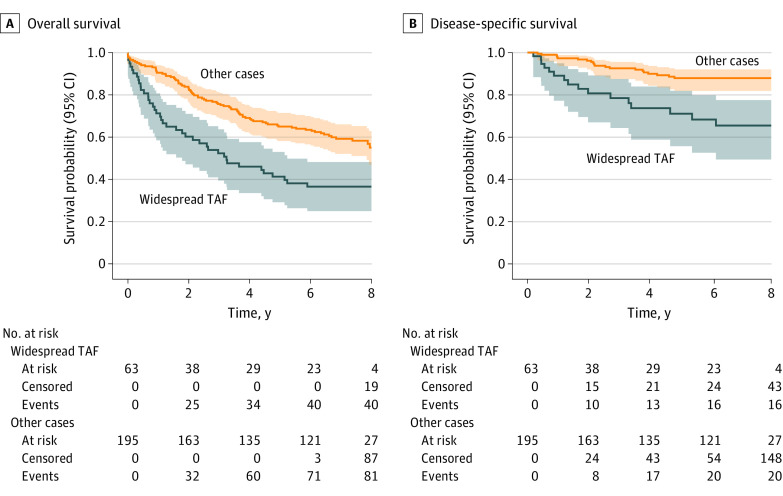
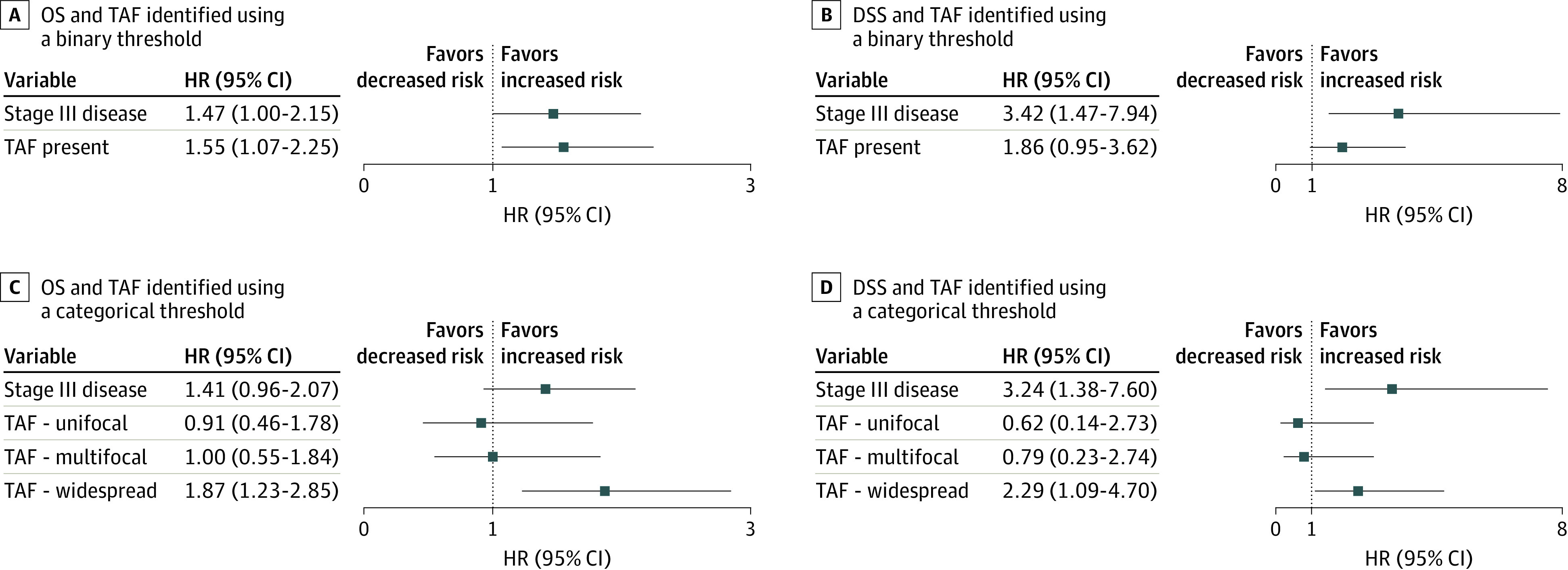
A total of 258 colon adenocarcinoma histopathologic cases from 258 patients (138 men [53%]; median age, 67 years [IQR, 65-81 years]) with stage II (n = 119) or stage III (n = 139) cancer were included. Tumor adipose feature was identified in 120 cases (widespread in 63 cases, multifocal in 31, and unifocal in 26). For overall survival analysis after adjustment for tumor stage, TAF was independently prognostic in 2 ways: TAF as a binary feature (presence vs absence: hazard ratio [HR] for presence of TAF, 1.55 [95% CI, 1.07-2.25]; P = .02) and TAF as a semiquantitative categorical feature (HR for widespread TAF, 1.87 [95% CI, 1.23-2.85]; P = .004). Interpathologist agreement for widespread TAF vs lower categories (absent, unifocal, or multifocal) was 90%, corresponding to a κ metric at this threshold of 0.69 (95% CI, 0.58-0.80).
In this prognostic study, pathologists were able to learn and reproducibly score for TAF, providing significant risk stratification on this independent data set. Although additional work is warranted to understand the biological significance of this feature and to establish broadly reproducible TAF scoring, this work represents the first validation to date of human expert learning from machine learning in pathology. Specifically, this validation demonstrates that a computationally identified histologic feature can represent a human-identifiable, prognostic feature with the potential for integration into pathology practice.
在结肠癌中识别新的预后特征有可能改进组织病理学检查并为患者护理提供信息。尽管最近的预后人工智能系统已经在多种癌症类型中展示了显著的风险分层,但研究尚未表明与这些预后人工智能系统相关的机器学习衍生特征既具有可解释性,又可供病理学家使用。
评估病理学家对先前通过机器学习确定的组织病理学特征的评分是否与结肠癌患者的生存相关。
设计、设置和参与者:这项预后研究使用了 2013 年 1 月至 2015 年 12 月米兰比科卡大学的匿名、存档的结直肠癌病例。2021 年 12 月至 2022 年 2 月,2 名病理学家对 258 例连续结肠腺癌病例的所有可用组织学切片进行了回顾,这些病例通过独立的结直肠癌队列开发的预后深度学习模型进行了肿瘤脂肪特征(TAF)的半定量评分。
通过单变量和多变量回归分析评估 TAF 对总生存和疾病特异性生存的预后价值。还评估了 TAF 评分中病理学家之间的一致性。
共纳入 258 例来自 258 例患者(男性 138 例[53%];中位年龄 67 岁[IQR,65-81 岁])的结肠腺癌组织病理学病例,其中 II 期(n=119)或 III 期(n=139)。在 120 例病例中发现了肿瘤脂肪特征(广泛存在于 63 例,多灶性存在于 31 例,单灶性存在于 26 例)。在调整肿瘤分期后进行总生存分析时,TAF 以 2 种方式具有独立的预后意义:TAF 作为二分类特征(存在 vs 不存在:存在 TAF 的 HR,1.55[95%CI,1.07-2.25];P=0.02)和 TAF 作为半定量分类特征(广泛 TAF 的 HR,1.87[95%CI,1.23-2.85];P=0.004)。广泛 TAF 与较低类别(不存在、单灶或多灶)之间的病理学家间一致性为 90%,相应的κ度量值为 0.69(95%CI,0.58-0.80)。
在这项预后研究中,病理学家能够学习并可重现地对 TAF 进行评分,在这个独立的数据集上提供了显著的风险分层。尽管需要进一步的工作来了解该特征的生物学意义并建立广泛可重现的 TAF 评分,但这项工作代表了迄今为止对病理学中机器学习的人类专家学习的首次验证。具体来说,这项验证表明,计算确定的组织学特征可以代表人类可识别的、具有潜在预后意义的特征,并有可能整合到病理学实践中。