Sweeney Patrick L, Suri Yash, Basu Arnab, Koshkin Vadim S, Desai Arpita
Deming Department of Medicine, Tulane University School of Medicine, New Orleans, LA 70112, USA.
University of Arizona College of Medicine, Tucson, AZ 85724, USA.
Cancer Drug Resist. 2023 Dec 28;6(4):858-873. doi: 10.20517/cdr.2023.89. eCollection 2023.
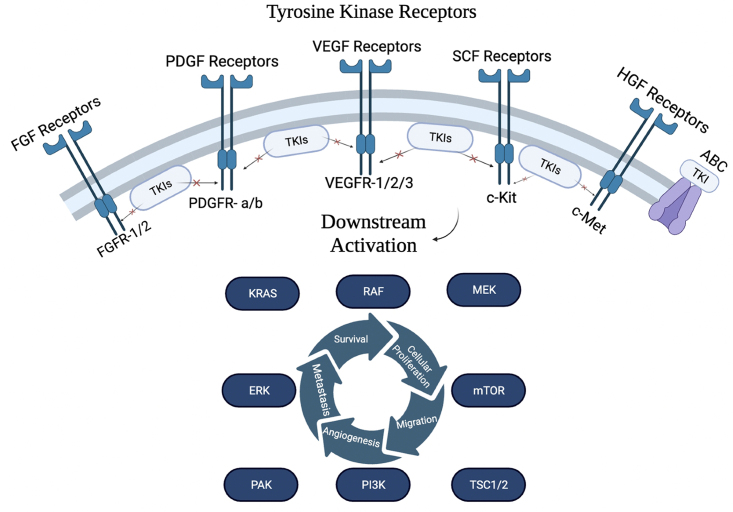
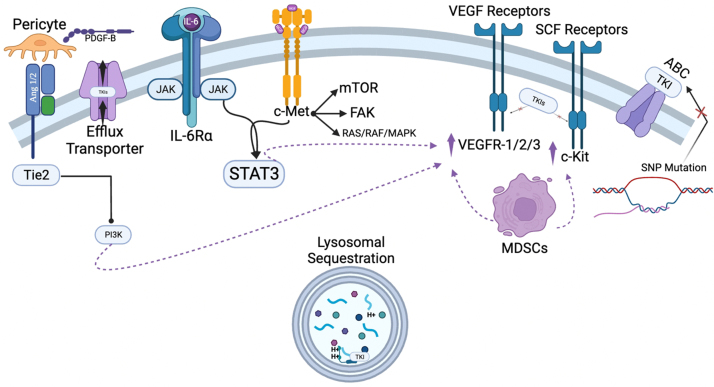
Renal cell carcinoma (RCC), the most prevalent type of kidney cancer, is a significant cause of cancer morbidity and mortality worldwide. Antiangiogenic tyrosine kinase inhibitors (TKIs), in combination with immune checkpoint inhibitors (ICIs), are among the first-line treatment options for patients with advanced RCC. These therapies target the vascular endothelial growth factor receptor (VEGFR) tyrosine kinase pathway and other kinases crucial to cancer proliferation, survival, and metastasis. TKIs have yielded substantial improvements in progression-free survival (PFS) and overall survival (OS) for patients with advanced RCC. However, nearly all patients eventually progress on these drugs as resistance develops. This review provides an overview of TKI resistance in RCC and explores different mechanisms of resistance, including upregulation of alternative proangiogenic pathways, epithelial-mesenchymal transition (EMT), decreased intracellular drug concentrations due to efflux pumps and lysosomal sequestration, alterations in the tumor microenvironment including bone marrow-derived cells (BMDCs) and tumor-associated fibroblasts (TAFs), and genetic factors such as single nucleotide polymorphisms (SNPs). A comprehensive understanding of these mechanisms opens the door to the development of innovative therapeutic approaches that can effectively overcome TKI resistance, thereby improving outcomes for patients with advanced RCC.
肾细胞癌(RCC)是最常见的肾癌类型,是全球癌症发病率和死亡率的一个重要原因。抗血管生成酪氨酸激酶抑制剂(TKIs)与免疫检查点抑制剂(ICIs)联合使用,是晚期RCC患者的一线治疗选择之一。这些疗法靶向血管内皮生长因子受体(VEGFR)酪氨酸激酶途径以及对癌症增殖、存活和转移至关重要的其他激酶。TKIs已使晚期RCC患者的无进展生存期(PFS)和总生存期(OS)有了显著改善。然而,几乎所有患者最终都会因产生耐药性而对这些药物产生进展。本综述概述了RCC中TKI耐药性,并探讨了不同的耐药机制,包括替代促血管生成途径的上调、上皮-间质转化(EMT)、由于外排泵和溶酶体隔离导致的细胞内药物浓度降低、肿瘤微环境的改变,包括骨髓来源细胞(BMDCs)和肿瘤相关成纤维细胞(TAFs),以及遗传因素,如单核苷酸多态性(SNPs)。对这些机制的全面理解为开发能够有效克服TKI耐药性的创新治疗方法打开了大门,从而改善晚期RCC患者的治疗结果。