Department of Laboratory Medicine, Ruijin Hospital, Shanghai Jiao Tong University School of Medicine, Shanghai, China.
Department of Laboratory Medicine, Ruijin Hospital Luwan Branch, Shanghai Jiao Tong University School of Medicine, Shanghai, China.
Front Cell Infect Microbiol. 2024 Jan 4;13:1321094. doi: 10.3389/fcimb.2023.1321094. eCollection 2023.
has emerged as a fungal pathogen with high infection and mortality rates, and its primary virulence factors are related to adhesion and biofilm formation. These virulence factors in are primarily mediated by epithelial adhesins (Epas), most of which are encoded in subtelomeric regions and regulated by subtelomeric silencing mechanisms. The transcription factor Mss11, known for its regulatory role in adhesion, biofilm formation, and filamentous growth in and , has also been implicated in the expression of , suggesting its potential influence on virulence. The present study aims to determine the regulatory role of Mss11 in the virulence of .
In this work, a null mutant and its complemented strain were constructed from a standard strain. The impact of the transcription factor Mss11 on the virulence of was investigated through a series of phenotypic experiments, including the microbial adhesion to hydrocarbons (MATH) test, adherence assay, biofilm assay, scanning electron microscopy and virulence assay. Furthermore, transcriptome sequencing, quantitative reverse transcription polymerase chain reaction (RT-qPCR), and chromatin immunoprecipitation sequencing (ChIP-seq) were employed to investigate the molecular mechanisms behind the regulation of Mss11.
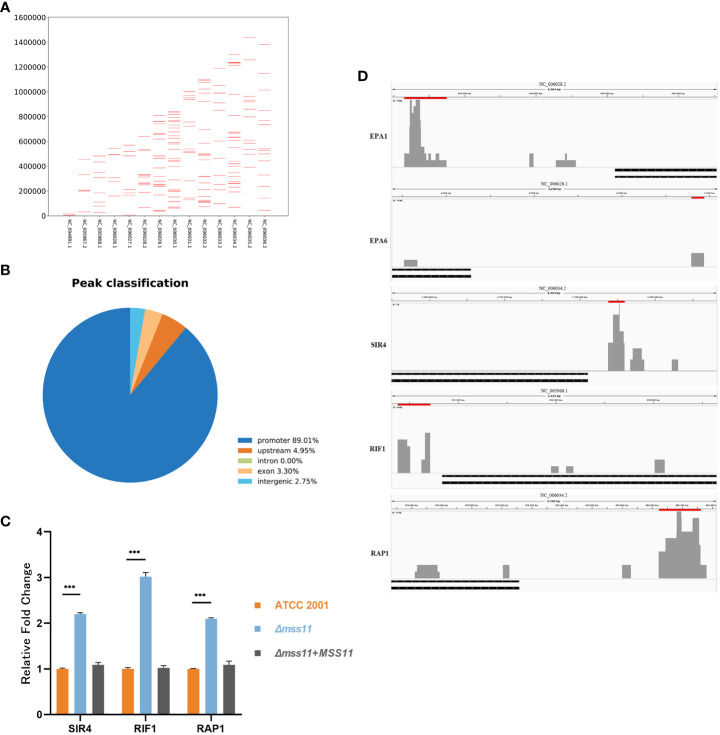
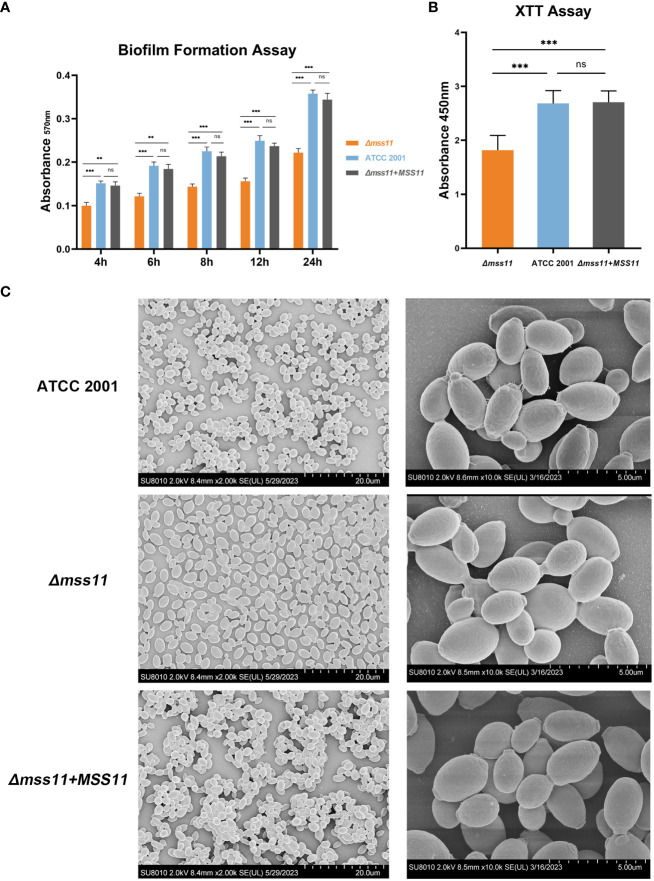
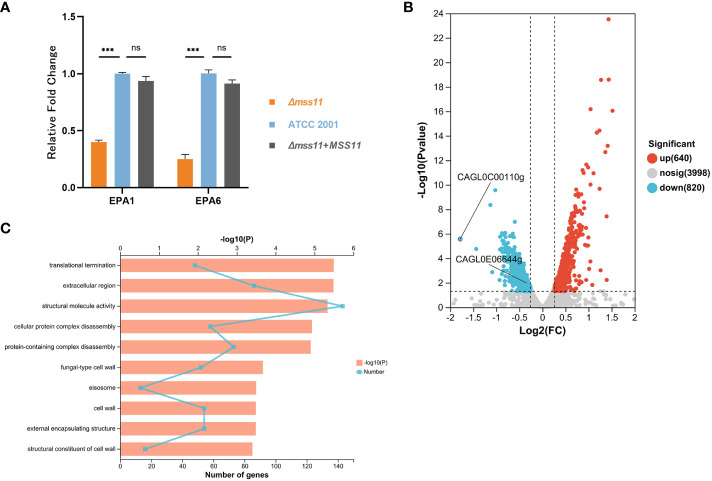
In , the loss of led to a significant reduction in several virulence factors including cell surface hydrophobicity, epithelial cell adhesion, and biofilm formation. These observations were consistent with the decreased virulence of the mutant observed in the infection model. Further exploration demonstrated that Mss11 modulates virulence by regulating and expression. It binds to the upstream regions of and , as well as the promoter regions of the subtelomeric silencing-related genes , , and , indicating the dual regulatory role of Mss11.
Mss11 plays a crucial role in adhesion and biofilm formation, and thus has a broad influence on virulence. This regulation is achieved by regulating the expression of and through both promoter-specific regulation and subtelomeric silencing.
已成为一种具有高感染率和死亡率的真菌病原体,其主要毒力因子与粘附和生物膜形成有关。 中的这些毒力因子主要由上皮黏附素 (Epas) 介导,其中大多数编码在端粒附近区域,并受端粒沉默机制调节。转录因子 Mss11 以其在 中的粘附、生物膜形成和丝状生长的调节作用而闻名,也与 的表达有关,表明其对 的潜在影响。本研究旨在确定 Mss11 在 毒力中的调节作用。
在这项工作中,从标准菌株构建了一个 缺失突变体及其互补菌株。通过一系列表型实验,包括微生物粘附烃(MATH)试验、粘附试验、生物膜试验、扫描电子显微镜和 毒力试验,研究了转录因子 Mss11 对 毒力的影响。此外,还进行了转录组测序、定量逆转录聚合酶链反应 (RT-qPCR) 和染色质免疫沉淀测序 (ChIP-seq),以研究 Mss11 调节的分子机制。
在 中, 的缺失导致几个毒力因子的显著减少,包括细胞表面疏水性、上皮细胞粘附和生物膜形成。这些观察结果与在 感染模型中观察到的 突变体毒力降低一致。进一步探索表明,Mss11 通过调节 和 的表达来调节 毒力。它与 和 的上游区域以及端粒沉默相关基因 、 和 的启动子区域结合,表明 Mss11 具有双重调节作用。
Mss11 在 粘附和生物膜形成中起关键作用,因此对毒力有广泛影响。这种调节是通过调节 和 的表达来实现的,包括启动子特异性调节和端粒沉默。