National Health Commission Key Laboratory of Thrombosis and Hemostasis, Jiangsu Institute of Hematology, The First Affiliated Hospital of Soochow University, Suzhou, Jiangsu 215006, P.R. China.
Mol Med Rep. 2024 Mar;29(3). doi: 10.3892/mmr.2024.13164. Epub 2024 Jan 19.
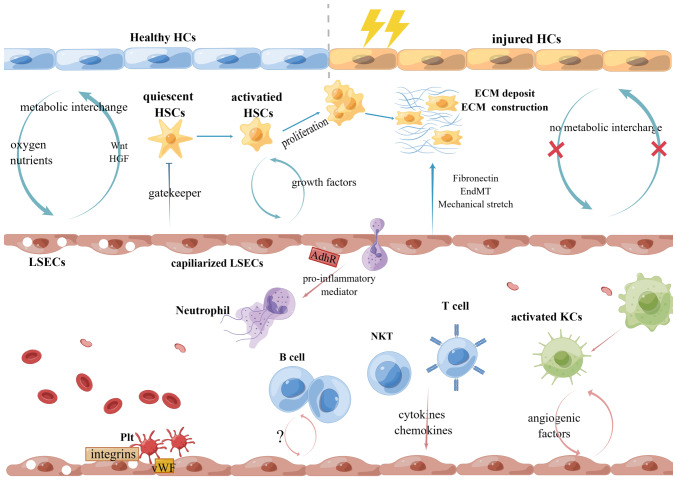
Liver fibrosis due to viral or metabolic chronic liver diseases is a major challenge of global health. It is a critical pre‑stage condition of severe hepatopathy, characterized by excessive accumulation of extracellular matrix components and ongoing chronic inflammation. To date, early prevention of liver fibrosis remains challenging. As the most abundant non‑parenchymal hepatic cell population, liver sinusoidal endothelial cells (LSECs) are stabilizers that maintain the intrahepatic environment. Notably, LSECs dysfunction appears to be implicated in the progression of liver fibrosis via numerous mechanisms. Following sustained liver injury, they lose their fenestrae (cytoplasmic pores) and change their crosstalk with other cellular interactions in the hepatic blood environment. LSEC‑targeted therapy has shown promising effects on fibrosis resolution, opening up new opportunities for anti‑fibrotic therapy. In light of this, the present study summarized changes in LSECs during liver fibrosis and their interactions with hepatic milieu, as well as possible therapeutic approaches that specially target LSECs.
由于病毒性或代谢性慢性肝病导致的肝纤维化是全球健康的主要挑战。它是严重肝病的关键前期状态,其特征是细胞外基质成分的过度积累和持续的慢性炎症。迄今为止,肝纤维化的早期预防仍然具有挑战性。作为最丰富的非实质肝细胞群体,肝窦内皮细胞(LSEC)是维持肝内环境稳定的细胞。值得注意的是,LSEC 功能障碍似乎通过多种机制参与肝纤维化的进展。在持续的肝损伤后,它们失去窗孔(细胞质孔),并改变它们与肝血液环境中其他细胞相互作用的串扰。针对 LSEC 的靶向治疗在纤维化消退方面显示出良好的效果,为抗纤维化治疗开辟了新的机会。有鉴于此,本研究总结了肝纤维化过程中 LSEC 的变化及其与肝内环境的相互作用,以及可能专门针对 LSEC 的治疗方法。