Department of Public Health, College of Health Sciences, QU Health, Qatar University, P.O. Box 2713, Doha, Qatar.
Department of Nutrition and Food Sciences, Faculty of Agricultural and Food Sciences, American University of Beirut, P.O. Box 11-0236, Beirut, Lebanon.
BMC Pediatr. 2024 Jan 19;24(1):57. doi: 10.1186/s12887-024-04535-2.
Intakes of fiber, iron, zinc, calcium, vitamin D, vitamin A, and folate were shown to be low in a substantial proportion of infants and children in Lebanon. The study aims to identify the top food sources of fiber, iron, zinc, calcium, vitamin D, vitamin A, and folate amongst infants and young children in Lebanon and to evaluate the evolution of food sources of these nutrients from the beginning of the complementary feeding journey up until the age of 47.9 months.
A national cross-sectional survey was conducted in 2012 as part of the "Early Life Nutrition and Health in Lebanon" project using stratified cluster sampling. Dietary intakes for infants and young children aged 6-47.9 months (n = 763) were assessed using 24- Hour Dietary Recall. Food items were categorized into food groups and the percent contribution of each food group to nutrient intakes was determined to identify the top food sources of fiber and selected micronutrients for three age groups: 6-11.9 m (infants), 12-23.9 m (toddlers), and 24-47.9 m (preschoolers).
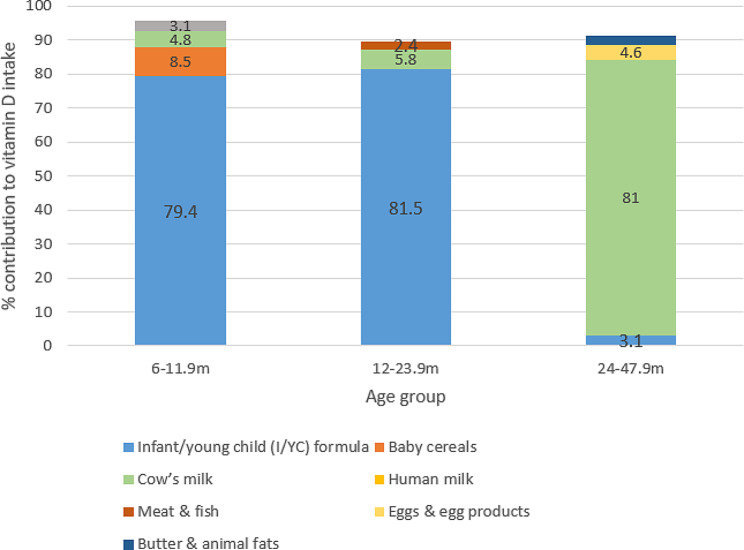
The top food source of fiber was vegetables among children aged 6-47.9 months. Among infants and toddlers, infant/young child formula was the main contributor to iron, zinc, calcium, vitamin D, vitamin A, and folate intakes. Baby cereals also contributed to around 14% of iron intakes among infants. Among preschoolers, meat and fish contributed to 13% of iron intakes and 29% of zinc intakes, while cow's milk was the major contributor of calcium (41%), vitamin D (81%) and vitamin A (25%) intakes. Sweetened beverages and sweet bakery were also ranked among the major food sources contributing to substantial intakes of key nutrients, including fiber, iron, zinc, calcium, vitamin A, and folate among infants, toddlers, and preschoolers.
In addition to milk sources, vegetables, beans and legumes, breads, meats, and rice and pasta, sweet bakery and sweetened beverages have contributed to intakes of key nutrients from early ages. This calls for implementing initiatives and designing approaches to support nutrition education and improve nutrient intakes in infancy and early childhood.
在黎巴嫩,相当一部分婴儿和儿童的膳食纤维、铁、锌、钙、维生素 D、维生素 A 和叶酸摄入量较低。本研究旨在确定黎巴嫩婴儿和幼儿膳食纤维、铁、锌、钙、维生素 D、维生素 A 和叶酸的主要食物来源,并评估从开始补充喂养到 47.9 月龄期间这些营养素的食物来源的演变。
2012 年,作为“黎巴嫩生命早期营养与健康”项目的一部分,采用分层聚类抽样方法开展了一项全国性的横断面调查。使用 24 小时膳食回忆法评估了 6-47.9 月龄(n=763)婴儿和幼儿的膳食摄入量。将食物项目归入食物组,确定每个食物组对营养素摄入量的贡献百分比,以确定膳食纤维和选定微量营养素的前三大食物来源,分为三个年龄组:6-11.9 月龄(婴儿)、12-23.9 月龄(幼儿)和 24-47.9 月龄(学龄前儿童)。
6-47.9 月龄儿童膳食纤维的主要食物来源是蔬菜。对于婴儿和幼儿,婴儿/幼儿配方奶粉是铁、锌、钙、维生素 D、维生素 A 和叶酸摄入量的主要来源。婴儿麦片也为婴儿铁摄入量的 14%做出了贡献。对于学龄前儿童,肉类和鱼类为铁摄入量的 13%和锌摄入量的 29%做出了贡献,而牛奶是钙(41%)、维生素 D(81%)和维生素 A(25%)摄入量的主要来源。含糖饮料和含糖烘焙食品也被列为主要食物来源,为婴儿、幼儿和学龄前儿童提供了大量关键营养素的摄入,包括膳食纤维、铁、锌、钙、维生素 A 和叶酸。
除了奶类食物,蔬菜、豆类、面包、肉类、大米和面食、含糖烘焙食品和含糖饮料也为婴儿和幼儿期的关键营养素摄入做出了贡献。这就需要实施举措并设计方法,以支持营养教育并改善婴儿和幼儿期的营养摄入。