• 文献检索
  • 文档翻译
  • 深度研究
  • 学术资讯
  • Suppr Zotero 插件Zotero 插件
  • 邀请有礼
  • 套餐&价格
  • 历史记录
应用&插件
Suppr Zotero 插件Zotero 插件浏览器插件Mac 客户端Windows 客户端微信小程序
定价
高级版会员购买积分包购买API积分包
服务
文献检索文档翻译深度研究API 文档MCP 服务
关于我们
关于 Suppr公司介绍联系我们用户协议隐私条款
关注我们

Suppr 超能文献

核心技术专利:CN118964589B侵权必究
粤ICP备2023148730 号-1Suppr @ 2026

文献检索

告别复杂PubMed语法,用中文像聊天一样搜索,搜遍4000万医学文献。AI智能推荐,让科研检索更轻松。

立即免费搜索

文件翻译

保留排版,准确专业,支持PDF/Word/PPT等文件格式,支持 12+语言互译。

免费翻译文档

深度研究

AI帮你快速写综述,25分钟生成高质量综述,智能提取关键信息,辅助科研写作。

立即免费体验

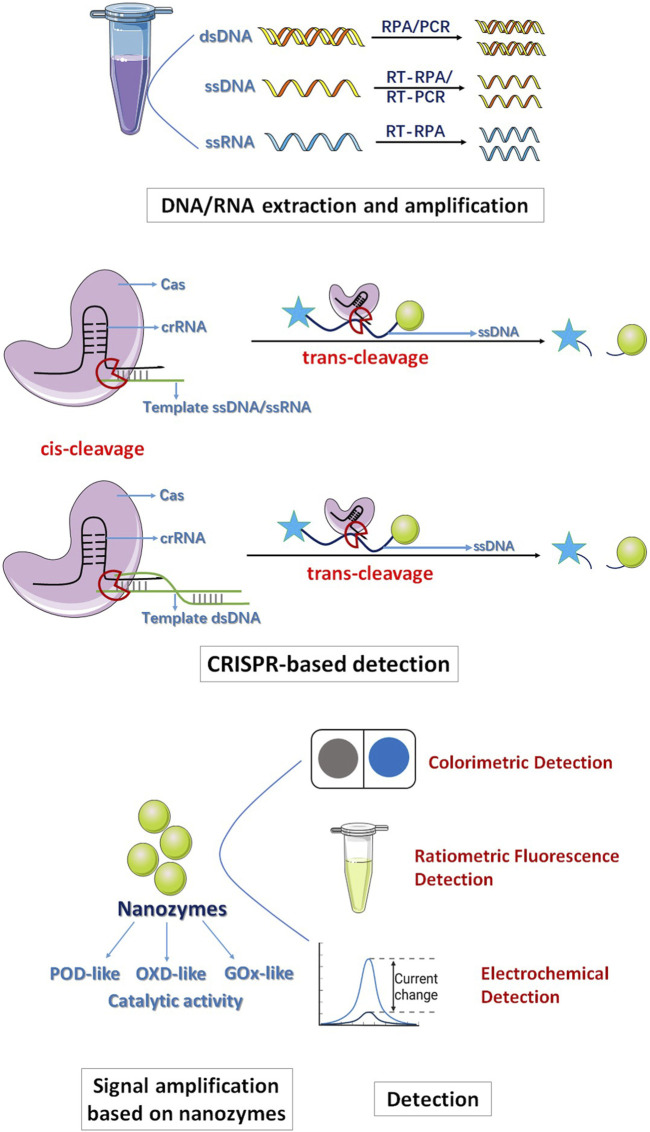
纳米酶辅助的无扩增CRISPR/Cas系统实现了可视化检测。

Nanozyme-assisted amplification-free CRISPR/Cas system realizes visual detection.

作者信息

Zhang Yuan, Yu Wanpeng, Wang Man, Zhang Lei, Li Peifeng

机构信息

Institute for Translational Medicine, The Affiliated Hospital of Qingdao University, Qingdao University, Qingdao, China.

Medical Collage, Qingdao University, Qingdao, China.

出版信息

Front Bioeng Biotechnol. 2024 Jan 5;11:1327498. doi: 10.3389/fbioe.2023.1327498. eCollection 2023.

DOI:10.3389/fbioe.2023.1327498
PMID:38249803
原文链接:https://pmc.ncbi.nlm.nih.gov/articles/PMC10796770/
Abstract

The CRISPR (clustered regularly interspaced short palindromic repeats)/Cas (CRISPR associated) system has proven to be a powerful tool for nucleic acid detection due to its inherent advantages of effective nucleic acid identification and editing capabilities, and is therefore known as the next-generation of molecular diagnostic technology. However, the detection technologies based on CRISPR/Cas systems require preamplification of target analytes; that is, target gene amplification steps through isothermal amplification or PCR before detection to increase target analyte concentrations. This creates a number of testing limitations, such as extended testing time and the need for more sophisticated testing instruments. To overcome the above limitations, various amplification-free assay strategies based on CRISPR/Cas systems have been explored as alternatives, which omit the preamplification step to increase the concentrations of the target analytes. Nanozymes play a pivotal role in enhancing the sensitivity of CRISPR-based detection, enabling visual and rapid CRISPR assays. The utilization of nanozyme exceptional enzyme-like catalytic activity holds great promise for signal amplification in both electrochemical and optical domains, encompassing strategies for electrochemical signal sensors and colorimetric signal sensors. Rather than relying on converting a single detection target analyte into multiple analytes, these methods focus on signal amplification, the main mechanism of which involves the ability to form a large number of reporter molecules or to improve the performance of the sensor. This exploitation of nanozymes for signal amplification results in the heightened sensitivity and accuracy of detection outcomes. In addition to the strategies that improve sensor performance through the application of nanozymes, additional methods are needed to achieve visual signal amplification strategies without preamplification processes. Herein, we review the strategies for improving CRISPR/Cas systems that do not require preamplification, providing a simple, intuitive and preamplification-free CRISPR/Cas system detection platform by improving in-system one-step amplification programs, or enhancing nanozyme-mediated signal amplification strategies.

摘要

CRISPR(成簇规律间隔短回文重复序列)/Cas(CRISPR相关)系统因其在核酸识别和编辑能力方面的固有优势,已被证明是一种强大的核酸检测工具,因此被誉为下一代分子诊断技术。然而,基于CRISPR/Cas系统的检测技术需要对目标分析物进行预扩增;也就是说,在检测前通过等温扩增或聚合酶链反应(PCR)进行目标基因扩增步骤,以提高目标分析物的浓度。这带来了许多检测限制,如检测时间延长以及需要更复杂的检测仪器。为克服上述限制,人们探索了各种基于CRISPR/Cas系统的无扩增检测策略作为替代方案,这些策略省略了预扩增步骤以增加目标分析物的浓度。纳米酶在提高基于CRISPR的检测灵敏度方面发挥着关键作用,可实现可视化和快速的CRISPR检测。利用纳米酶独特的类酶催化活性在电化学和光学领域的信号放大方面具有巨大潜力,包括电化学信号传感器和比色信号传感器策略。这些方法并非依赖于将单个检测目标分析物转化为多个分析物,而是专注于信号放大,其主要机制涉及形成大量报告分子的能力或改善传感器的性能。这种利用纳米酶进行信号放大可提高检测结果的灵敏度和准确性。除了通过应用纳米酶改善传感器性能的策略外,还需要其他方法来实现无需预扩增过程的可视化信号放大策略。在此,我们综述了改进CRISPR/Cas系统的无需预扩增的策略,通过改进系统内一步扩增程序或增强纳米酶介导的信号放大策略,提供一个简单、直观且无需预扩增的CRISPR/Cas系统检测平台。
https://cdn.ncbi.nlm.nih.gov/pmc/blobs/667d/10796770/d9c5a3b8fa3d/fbioe-11-1327498-g005.jpg
https://cdn.ncbi.nlm.nih.gov/pmc/blobs/667d/10796770/129e31bb4b58/fbioe-11-1327498-g001.jpg
https://cdn.ncbi.nlm.nih.gov/pmc/blobs/667d/10796770/d9b6c9608601/fbioe-11-1327498-g002.jpg
https://cdn.ncbi.nlm.nih.gov/pmc/blobs/667d/10796770/23b606868514/fbioe-11-1327498-g003.jpg
https://cdn.ncbi.nlm.nih.gov/pmc/blobs/667d/10796770/9e3ed22ae12d/fbioe-11-1327498-g004.jpg
https://cdn.ncbi.nlm.nih.gov/pmc/blobs/667d/10796770/d9c5a3b8fa3d/fbioe-11-1327498-g005.jpg
https://cdn.ncbi.nlm.nih.gov/pmc/blobs/667d/10796770/129e31bb4b58/fbioe-11-1327498-g001.jpg
https://cdn.ncbi.nlm.nih.gov/pmc/blobs/667d/10796770/d9b6c9608601/fbioe-11-1327498-g002.jpg
https://cdn.ncbi.nlm.nih.gov/pmc/blobs/667d/10796770/23b606868514/fbioe-11-1327498-g003.jpg
https://cdn.ncbi.nlm.nih.gov/pmc/blobs/667d/10796770/9e3ed22ae12d/fbioe-11-1327498-g004.jpg
https://cdn.ncbi.nlm.nih.gov/pmc/blobs/667d/10796770/d9c5a3b8fa3d/fbioe-11-1327498-g005.jpg

相似文献

1
Nanozyme-assisted amplification-free CRISPR/Cas system realizes visual detection.纳米酶辅助的无扩增CRISPR/Cas系统实现了可视化检测。
Front Bioeng Biotechnol. 2024 Jan 5;11:1327498. doi: 10.3389/fbioe.2023.1327498. eCollection 2023.
2
CRISPR-powered microfluidic biosensor for preamplification-free detection of ochratoxin A.基于 CRISPR 的微流控生物传感器,用于无预扩增检测赭曲霉毒素 A。
Talanta. 2024 Mar 1;269:125414. doi: 10.1016/j.talanta.2023.125414. Epub 2023 Nov 17.
3
Integrating CRISPR/Cas within isothermal amplification for point-of-Care Assay of nucleic acid.利用 CRISPR/Cas 进行等温扩增,实现即时检测核酸的点分析。
Talanta. 2022 Jun 1;243:123388. doi: 10.1016/j.talanta.2022.123388. Epub 2022 Mar 12.
4
Amplification-free CRISPR/Cas detection technology: challenges, strategies, and perspectives.无扩增CRISPR/Cas检测技术:挑战、策略与展望
Chem Soc Rev. 2023 Jan 3;52(1):361-382. doi: 10.1039/d2cs00594h.
5
Visual and colorimetric detection of microRNA in clinical samples based on strand displacement amplification and nanozyme-mediated CRISPR-Cas12a system.基于链置换扩增和纳米酶介导的CRISPR-Cas12a系统对临床样本中的微小RNA进行可视化和比色检测。
Talanta. 2024 Sep 1;277:126310. doi: 10.1016/j.talanta.2024.126310. Epub 2024 May 21.
6
Nanozyme-catalysed CRISPR-Cas12a system for the preamplification-free colorimetric detection of lead ion.纳米酶催化的 CRISPR-Cas12a 系统用于无预扩增的比色法检测铅离子。
Anal Chim Acta. 2023 Feb 22;1243:340827. doi: 10.1016/j.aca.2023.340827. Epub 2023 Jan 12.
7
Signal amplification and output of CRISPR/Cas-based biosensing systems: A review.基于 CRISPR/Cas 的生物传感系统的信号放大和输出:综述。
Anal Chim Acta. 2021 Nov 15;1185:338882. doi: 10.1016/j.aca.2021.338882. Epub 2021 Jul 26.
8
Digital Recombinase Polymerase Amplification, Digital Loop-Mediated Isothermal Amplification, and Digital CRISPR-Cas Assisted Assay: Current Status, Challenges, and Perspectives.数字重组酶聚合酶扩增、数字环介导等温扩增和数字CRISPR-Cas辅助检测:现状、挑战与展望
Small. 2023 Dec;19(49):e2303398. doi: 10.1002/smll.202303398. Epub 2023 Aug 23.
9
CRISPR/Cas-Powered Amplification-Free Detection of Nucleic Acids: Current State of the Art, Challenges, and Futuristic Perspectives.CRISPR/Cas 驱动的无扩增核酸检测:当前的技术水平、挑战和未来展望。
ACS Sens. 2023 Dec 22;8(12):4420-4441. doi: 10.1021/acssensors.3c01463. Epub 2023 Nov 18.
10
Clustered Regularly Interspaced Short Palindromic Repeats (CRISPR)/Cas Advancement in Molecular Diagnostics and Signal Readout Approaches.簇状规律间隔短回文重复序列 (CRISPR)/Cas 在分子诊断和信号读出方法中的进展。
J Mol Diagn. 2021 Nov;23(11):1433-1442. doi: 10.1016/j.jmoldx.2021.07.025. Epub 2021 Aug 25.

引用本文的文献

1
Freeze-Driven Adsorption of Oligonucleotides with polyA-Anchors on Au@Pt Nanozyme.带 polyA 锚的寡核苷酸在 Au@Pt 纳米酶上的冷冻驱动吸附。
Int J Mol Sci. 2024 Sep 20;25(18):10108. doi: 10.3390/ijms251810108.

本文引用的文献

1
Copper and Diabetes: Current Research and Prospect.铜与糖尿病:当前研究与展望。
Mol Nutr Food Res. 2023 Dec;67(23):e2300468. doi: 10.1002/mnfr.202300468. Epub 2023 Oct 20.
2
Recent Advancements in the Formulation of Nanomaterials-Based Nanozymes, Their Catalytic Activity, and Biomedical Applications.纳米材料基纳米酶的制剂、催化活性及生物医学应用的最新进展。
ACS Appl Bio Mater. 2023 Sep 18;6(9):3577-3599. doi: 10.1021/acsabm.3c00253. Epub 2023 Aug 17.
3
Exploration of nanozymes in viral diagnosis and therapy.纳米酶在病毒诊断与治疗中的探索。
Exploration (Beijing). 2022 Jan 25;2(1):20210086. doi: 10.1002/EXP.20210086. eCollection 2022 Feb.
4
The applications of nanozymes in neurological diseases: From mechanism to design.纳米酶在神经疾病中的应用:从机制到设计。
Theranostics. 2023 Apr 23;13(8):2492-2514. doi: 10.7150/thno.83370. eCollection 2023.
5
Nanozymes towards Personalized Diagnostics: A Recent Progress in Biosensing.纳米酶在个性化诊断中的研究进展:生物传感领域的新突破。
Biosensors (Basel). 2023 Apr 5;13(4):461. doi: 10.3390/bios13040461.
6
Molecular mechanisms of eukaryotic translation fidelity and their associations with diseases.真核翻译保真度的分子机制及其与疾病的关联。
Int J Biol Macromol. 2023 Jul 1;242(Pt 1):124680. doi: 10.1016/j.ijbiomac.2023.124680. Epub 2023 May 2.
7
Padlock Probe-Based Targeted In Situ Sequencing: Overview of Methods and Applications.基于挂锁探针的靶向原位测序:方法与应用概述。
Annu Rev Genomics Hum Genet. 2023 Aug 25;24:133-150. doi: 10.1146/annurev-genom-102722-092013. Epub 2023 Apr 5.
8
Au-FeO nanozyme coupled with CRISPR-Cas12a for sensitive and visual antibiotic resistance diagnosing.Au-FeO 纳米酶与 CRISPR-Cas12a 偶联用于灵敏可视化抗生素耐药性诊断。
Anal Chim Acta. 2023 Apr 22;1251:341014. doi: 10.1016/j.aca.2023.341014. Epub 2023 Feb 25.
9
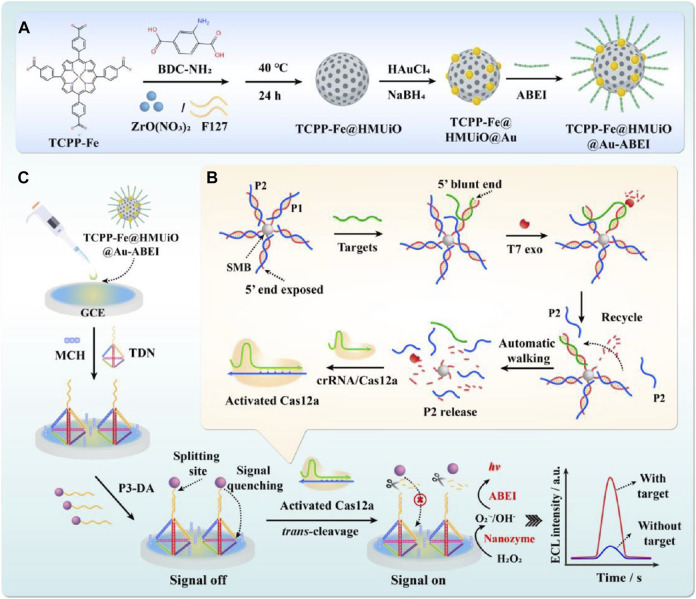
Mesoporous Nanozyme-Enhanced DNA Tetrahedron Electrochemiluminescent Biosensor with Three-Dimensional Walking Nanomotor-Mediated CRISPR/Cas12a for Ultrasensitive Detection of Exosomal microRNA.介孔纳米酶增强的 DNA 四面体电化学发光生物传感器,结合三维行走纳米马达介导的 CRISPR/Cas12a,用于外泌体 microRNA 的超灵敏检测。
Anal Chem. 2023 Mar 7;95(9):4486-4495. doi: 10.1021/acs.analchem.2c05217. Epub 2023 Feb 20.
10
Nanozymes: Definition, Activity, and Mechanisms.纳米酶:定义、活性和作用机制。
Adv Mater. 2024 Mar;36(10):e2211041. doi: 10.1002/adma.202211041. Epub 2023 Feb 17.