Rodrigues Daniela A, Roque Maria, Mateos-Campos Ramona, Figueiras Adolfo, Herdeiro Maria Teresa, Roque Fátima
Research Laboratory on Epidemiology and Population Health, Polytechnic of Guarda (IPG), Guarda, Portugal.
Health Sciences Research Centre, University of Beira Interior (CICS-UBI), Covilhã, Portugal.
Digit Health. 2024 Jan 17;10:20552076231225133. doi: 10.1177/20552076231225133. eCollection 2024 Jan-Dec.
Digital health is described as the use and development of all types of digital technologies to improve health outcomes. It could be used to prevent medication errors, a priority for health systems worldwide. However, the adoption of such tools remains slow. This study aims to identify factors (attitudes, knowledge and beliefs) acting as barriers and/or facilitators reported by healthcare professionals (HCPs) for the adoption of digital health-related tools for medication appropriateness.
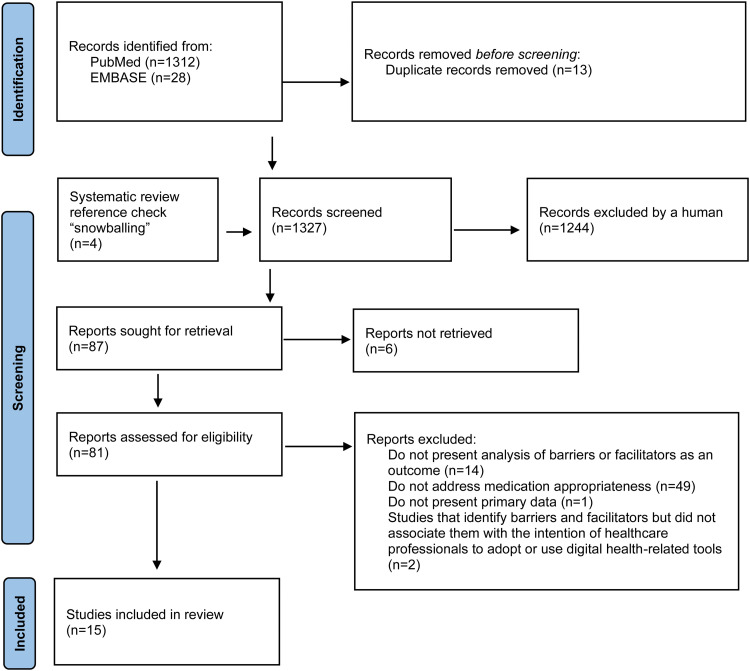
A systematic review was performed by searching the literature in the MEDLINE PubMed, and EMBASE scientific databases for original articles regarding qualitative and quantitative data.
Fifteen articles were included and a total of 125 barriers and 108 facilitators were identified, consolidated and categorized into technical (n = 48), organizational (n = 12), economical (n = 4), user-related (n = 34), and patient-related (n = 8) components. The most often reported barriers and facilitators were technical component-related ones concerning the need for additional training (n = 6), the time consumed (n = 6), and the easy way of using or learning how to use the tools (n = 9), respectively. Regarding setting analysis, agreement with clinical decision recommendations and impact on the doctor-patient relationship were more valued in primary care, while the user interface and system design were in the hospital.
The barriers and facilitators identified in this study provide relevant information to developers and it can be used as a starting point for the designing of successful digital health-related tools, specifically related to medication appropriateness. Future research includes economic evaluation-focused studies and in-depth case studies of specific barriers and facilitators.
数字健康被描述为利用和开发各类数字技术以改善健康结果。它可用于预防用药错误,这是全球卫生系统的一个优先事项。然而,此类工具的采用速度仍然缓慢。本研究旨在确定医疗保健专业人员(HCPs)报告的作为采用数字健康相关工具以确保用药合理性的障碍和/或促进因素的因素(态度、知识和信念)。
通过在MEDLINE PubMed和EMBASE科学数据库中检索有关定性和定量数据的原始文章进行系统综述。
纳入了15篇文章,共识别出125个障碍和108个促进因素,并将其合并和分类为技术(n = 48)、组织(n = 12)、经济(n = 4)、用户相关(n = 34)和患者相关(n = 8)组件。最常报告的障碍和促进因素分别是与技术组件相关的,涉及额外培训需求(n = 6)、耗时(n = 6)以及使用或学习如何使用工具的简便方式(n = 9)。关于环境分析,在初级保健中,与临床决策建议的一致性以及对医患关系的影响更受重视,而在医院中,用户界面和系统设计更受重视。
本研究中确定的障碍和促进因素为开发者提供了相关信息,可作为设计成功的数字健康相关工具(特别是与用药合理性相关的工具)的起点。未来的研究包括以经济评估为重点的研究以及对特定障碍和促进因素的深入案例研究。