NeuroSpin, Cognitive Neuroimaging Unit, CEA, INSERM, Université Paris-Saclay, 91191, Gif/Yvette, France.
École Normale Supérieure, PSL, 75005, Paris, France.
Sci Rep. 2024 Jan 23;14(1):2006. doi: 10.1038/s41598-023-50752-7.
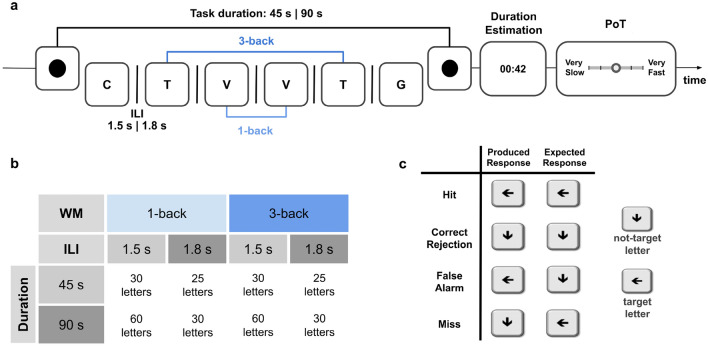
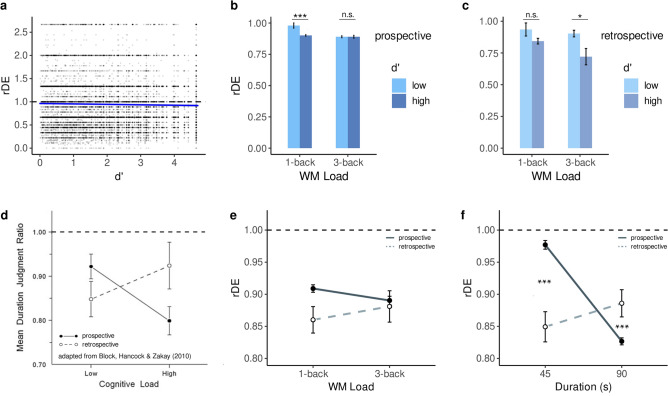
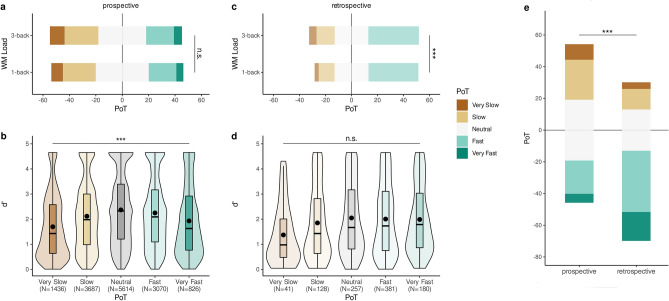
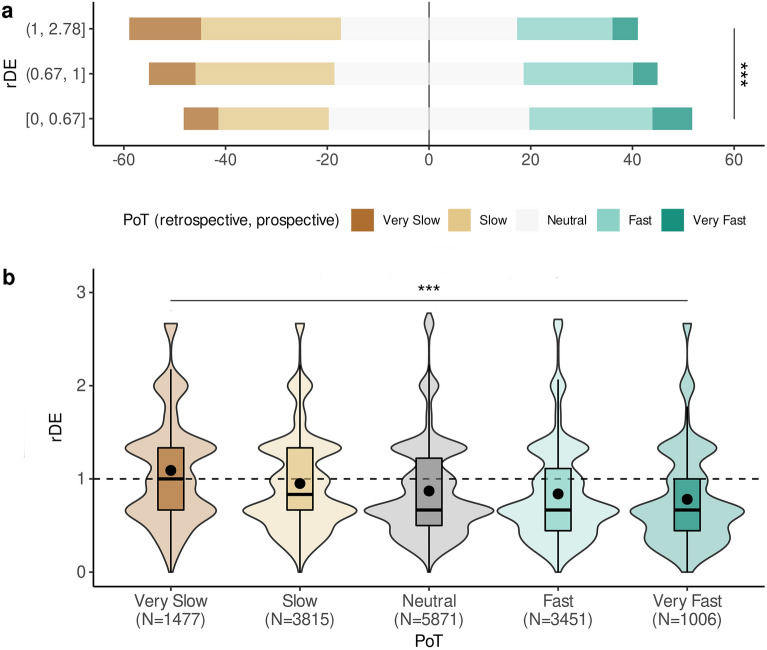
Psychological time is influenced by multiple factors such as arousal, emotion, attention and memory. While laboratory observations are well documented, it remains unclear whether cognitive effects on time perception replicate in real-life settings. This study exploits a set of data collected online during the Covid-19 pandemic, where participants completed a verbal working memory (WM) task in which their cognitive load was manipulated using a parametric n-back (1-back, 3-back). At the end of every WM trial, participants estimated the duration of that trial and rated the speed at which they perceived time was passing. In this within-participant design, we initially tested whether the amount of information stored in WM affected time perception in opposite directions depending on whether duration was estimated prospectively (i.e., when participants attend to time) or retrospectively (i.e., when participants do not attend to time). Second, we tested the same working hypothesis for the felt passage of time, which may capture a distinct phenomenology. Third, we examined the link between duration and speed of time, and found that short durations tended to be perceived as fast. Last, we contrasted two groups of individuals tested in and out of lockdown to evaluate the impact of social isolation. We show that duration and speed estimations were differentially affected by social isolation. We discuss and conclude on the influence of cognitive load on various experiences of time.
心理时间受到多种因素的影响,如觉醒、情绪、注意和记忆。虽然实验室观察得到了很好的记录,但认知对时间感知的影响是否在现实生活环境中重现仍不清楚。本研究利用了在新冠疫情期间在线收集的一组数据,参与者在其中完成了一项口头工作记忆 (WM) 任务,通过参数 n-back(1 回,3 回)来操纵他们的认知负荷。在每个 WM 试验结束时,参与者估计该试验的持续时间,并对他们感知时间流逝速度的速度进行评分。在这种参与者内设计中,我们最初测试了 WM 中存储的信息量是否会根据时间估计是前瞻性的(即当参与者关注时间时)还是回顾性的(即当参与者不关注时间时)以相反的方向影响时间感知。其次,我们对时间流逝的感觉进行了相同的工作假设测试,这可能会捕捉到一种不同的现象学。第三,我们研究了持续时间和时间速度之间的联系,发现较短的持续时间往往被感知为较快。最后,我们比较了在封锁内和封锁外接受测试的两组个体,以评估社会隔离的影响。我们表明,持续时间和速度估计受到社会隔离的不同影响。我们讨论并得出了认知负荷对各种时间体验的影响的结论。