Borges Maria Carolina, Clayton Gemma L, Freathy Rachel M, Felix Janine F, Fernández-Sanlés Alba, Soares Ana Gonçalves, Kilpi Fanny, Yang Qian, McEachan Rosemary R C, Richmond Rebecca C, Liu Xueping, Skotte Line, Irizar Amaia, Hattersley Andrew T, Bodinier Barbara, Scholtens Denise M, Nohr Ellen A, Bond Tom A, Hayes M Geoffrey, West Jane, Tyrrell Jessica, Wright John, Bouchard Luigi, Murcia Mario, Bustamante Mariona, Chadeau-Hyam Marc, Jarvelin Marjo-Riitta, Vrijheid Martine, Perron Patrice, Magnus Per, Gaillard Romy, Jaddoe Vincent W V, Lowe William L, Feenstra Bjarke, Hivert Marie-France, Sørensen Thorkild I A, Håberg Siri E, Serbert Sylvain, Magnus Maria, Lawlor Deborah A
MRC Integrative Epidemiology Unit at the University of Bristol, Oakfield House, Oakfield Grove, Bristol, BS8 2BN, UK.
Population Health Science, Bristol Medical School, University of Bristol, Bristol, UK.
BMC Med. 2024 Jan 29;22(1):32. doi: 10.1186/s12916-023-03167-0.
Higher maternal pre-pregnancy body mass index (BMI) is associated with adverse pregnancy and perinatal outcomes. However, whether these associations are causal remains unclear.
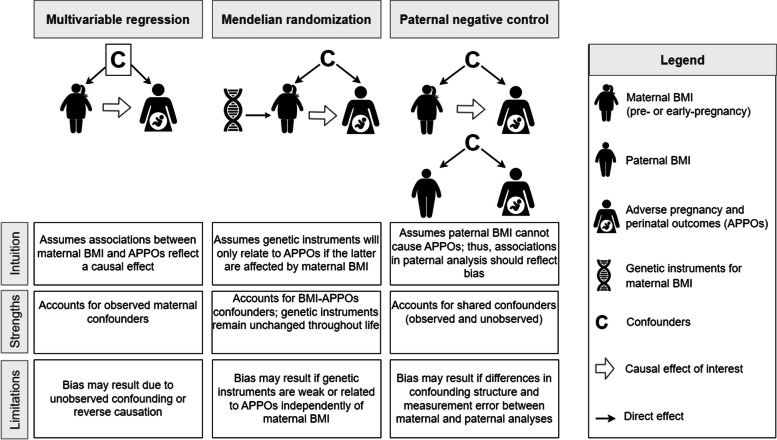
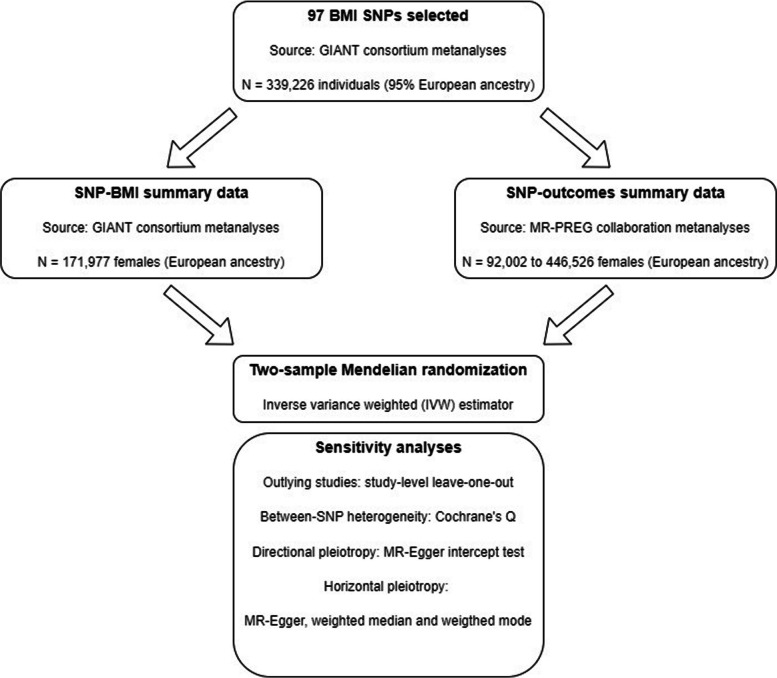
We explored the relation of maternal pre-/early-pregnancy BMI with 20 pregnancy and perinatal outcomes by integrating evidence from three different approaches (i.e. multivariable regression, Mendelian randomisation, and paternal negative control analyses), including data from over 400,000 women.
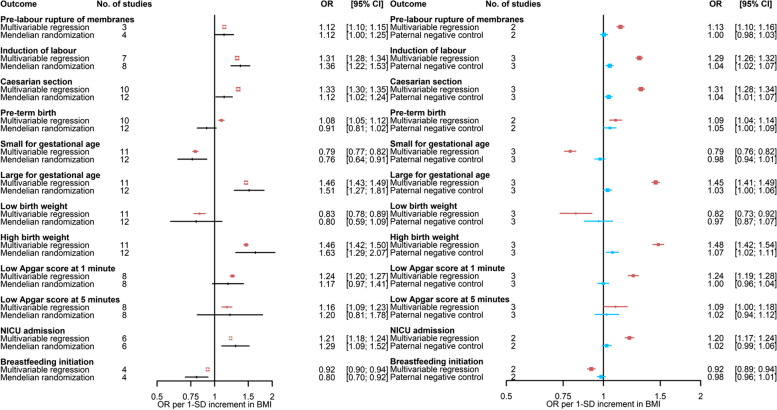
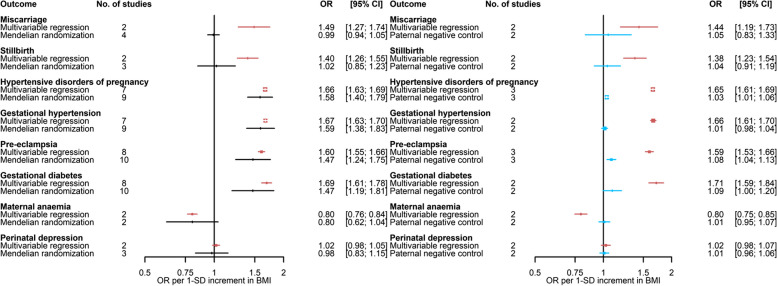
All three analytical approaches supported associations of higher maternal BMI with lower odds of maternal anaemia, delivering a small-for-gestational-age baby and initiating breastfeeding, but higher odds of hypertensive disorders of pregnancy, gestational hypertension, preeclampsia, gestational diabetes, pre-labour membrane rupture, induction of labour, caesarean section, large-for-gestational age, high birthweight, low Apgar score at 1 min, and neonatal intensive care unit admission. For example, higher maternal BMI was associated with higher risk of gestational hypertension in multivariable regression (OR = 1.67; 95% CI = 1.63, 1.70 per standard unit in BMI) and Mendelian randomisation (OR = 1.59; 95% CI = 1.38, 1.83), which was not seen for paternal BMI (OR = 1.01; 95% CI = 0.98, 1.04). Findings did not support a relation between maternal BMI and perinatal depression. For other outcomes, evidence was inconclusive due to inconsistencies across the applied approaches or substantial imprecision in effect estimates from Mendelian randomisation.
Our findings support a causal role for maternal pre-/early-pregnancy BMI on 14 out of 20 adverse pregnancy and perinatal outcomes. Pre-conception interventions to support women maintaining a healthy BMI may reduce the burden of obstetric and neonatal complications.
Medical Research Council, British Heart Foundation, European Research Council, National Institutes of Health, National Institute for Health Research, Research Council of Norway, Wellcome Trust.
较高的孕前体重指数(BMI)与不良妊娠及围产期结局相关。然而,这些关联是否为因果关系仍不明确。
我们通过整合三种不同方法(即多变量回归、孟德尔随机化和父亲阴性对照分析)的证据,探讨了孕前/孕早期母亲BMI与20种妊娠和围产期结局的关系,其中包括来自40多万名女性的数据。
所有三种分析方法均支持较高的母亲BMI与母亲贫血几率较低、分娩小于胎龄儿和开始母乳喂养几率较低相关,但与妊娠高血压疾病、妊娠期高血压、先兆子痫、妊娠期糖尿病、胎膜早破、引产、剖宫产、大于胎龄儿、高出生体重、1分钟时阿氏评分低以及新生儿重症监护病房入院几率较高相关。例如,在多变量回归中(每标准单位BMI的OR = 1.67;95% CI = 1.63, 1.70)和孟德尔随机化中(OR = 1.59;95% CI = 1.38, 1.83),较高的母亲BMI与妊娠期高血压风险较高相关,而父亲BMI则未显示出这种关联(OR = 1.01;95% CI = 0.98, 1.04)。研究结果不支持母亲BMI与围产期抑郁症之间存在关联。对于其他结局,由于所应用方法之间存在不一致或孟德尔随机化效应估计存在较大不精确性,证据尚无定论。
我们的研究结果支持孕前/孕早期母亲BMI对20种不良妊娠和围产期结局中的14种具有因果作用。支持女性维持健康BMI的孕前干预措施可能会减轻产科和新生儿并发症的负担。
医学研究理事会、英国心脏基金会、欧洲研究理事会、美国国立卫生研究院、英国国家卫生研究所、挪威研究理事会、惠康信托基金会。