Department of Animal Sciences, College of Agriculture, Isfahan University of Technology, Isfahan, Iran.
Department of Animal Biotechnology, Reproductive Biomedicine Research Center, Royan Institute for Biotechnology, ACECR, Isfahan, Iran.
Amino Acids. 2024 Jan 27;56(1):2. doi: 10.1007/s00726-023-03370-6.
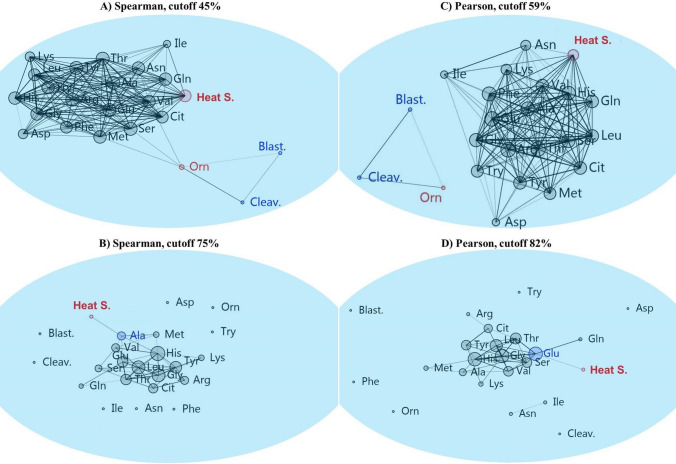
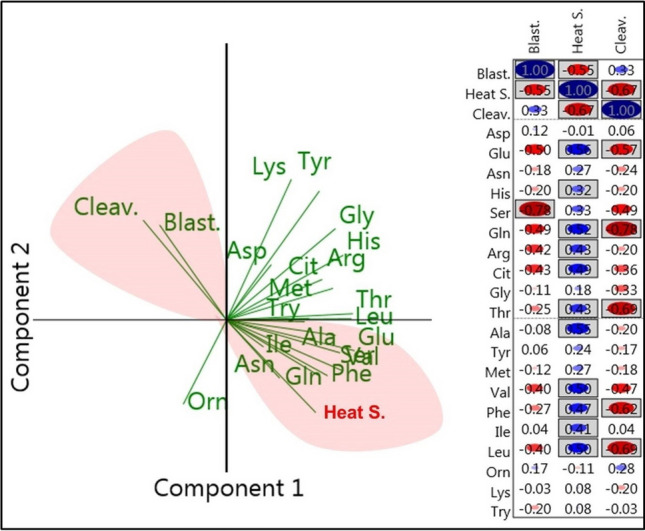
By affecting the ovarian pool of follicles and their enclosed oocytes, heat stress has an impact on dairy cow fertility. This study aimed to determine how heat shock (HS) during in vitro maturation affected the ability of the bovine cumulus-oocyte complexes (COCs) to develop, as well as their metabolism of amino acids (AAs). In this study, COCs were in vitro matured for 23 h at 38.5 °C (control; n = 322), 39.5 °C (mild HS (MHS); n = 290), or 40.5 °C (severe HS (SHS); n = 245). In comparison to the control group, the MHS and SHS groups significantly decreased the percentage of metaphase-II oocytes, as well as cumulus cell expansion and viability. The SHS decreased the rates of cleavage and blastocyst formation in comparison to the control and MHS. Compared to the control and MHS-COCs, the SHS-COCs produced significantly more phenylalanine, threonine, valine, arginine, alanine, glutamic acid, and citrulline while depleting less leucine, glutamine, and serine. Data showed that SHS-COCs had the highest appearance and turnover of all AAs and essential AAs. Heat shock was positively correlated with the appearance of glutamic acid, glutamine, isoleucine, alanine, serine, valine, phenylalanine, and asparagine. Network analysis identified the relationship between HS and alanine or glutamic acid, as well as the relationship between blastocyst and cleavage rates and ornithine. The findings imply that SHS may have an impact on the quality and metabolism of AAs in COCs. Moreover, the use of a multistep analysis could simply identify the AAs most closely linked to HS and the developmental competence of bovine COCs.
热应激通过影响卵巢卵泡池及其内含的卵母细胞,对奶牛的生育能力产生影响。本研究旨在确定热休克(HS)在体外成熟过程中如何影响牛卵丘-卵母细胞复合物(COCs)的发育能力及其氨基酸(AA)代谢。在这项研究中,COCs 在 38.5°C(对照;n=322)、39.5°C(轻度 HS(MHS);n=290)或 40.5°C(重度 HS(SHS);n=245)下体外成熟 23 小时。与对照组相比,MHS 和 SHS 组卵母细胞中期 II 比例、卵丘细胞扩张和活力显著降低。与对照组和 MHS 相比,SHS 降低了卵裂和囊胚形成的速度。与对照组和 MHS-COCs 相比,SHS-COCs 产生的苯丙氨酸、苏氨酸、缬氨酸、精氨酸、丙氨酸、谷氨酸和瓜氨酸明显更多,而亮氨酸、谷氨酰胺和丝氨酸消耗更少。数据表明,SHS-COCs 所有 AA 和必需 AA 的出现和周转率最高。HS 与谷氨酸、谷氨酰胺、异亮氨酸、丙氨酸、丝氨酸、缬氨酸、苯丙氨酸和天冬酰胺的出现呈正相关。网络分析确定了 HS 与丙氨酸或谷氨酸之间的关系,以及囊胚和卵裂率与鸟氨酸之间的关系。这些发现表明,SHS 可能会影响 COCs 中 AA 的质量和代谢。此外,使用多步分析可以简单地识别与 HS 最密切相关的 AA 以及牛 COCs 的发育能力。