Social, Genetic and Developmental Psychiatry Centre, Institute of Psychiatry, Psychology and Neuroscience, King's College London, London, UK.
School of Psychology, Cardiff University, Cardiff, UK.
Occup Med (Lond). 2023 Dec 30;73(9):557-567. doi: 10.1093/occmed/kqad138.
Loneliness is a risk factor for a range of mental and physical health problems and has gained increasing interest from policy-makers and researchers in recent years. However, little attention has been paid to loneliness at work and its implications for workers and employers.
Identify workplace, health and personal factors associated with workplace loneliness.
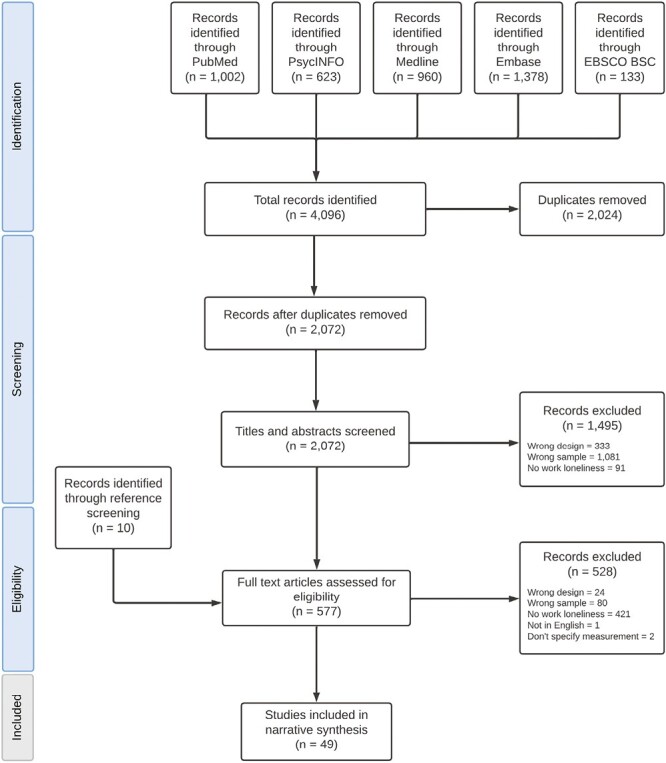
We searched five databases (PubMed, MEDLINE, EMBASE, PsycINFO and EBSCO Business Source Complete) for relevant articles published from 1 January 2000 to 23 February 2023. Quantitative data were synthesized using narrative synthesis and random-effects meta-analysis of correlation coefficients. Qualitative data were synthesized using thematic synthesis. Evidence quality was appraised using the Mixed-Methods Appraisal Tool.
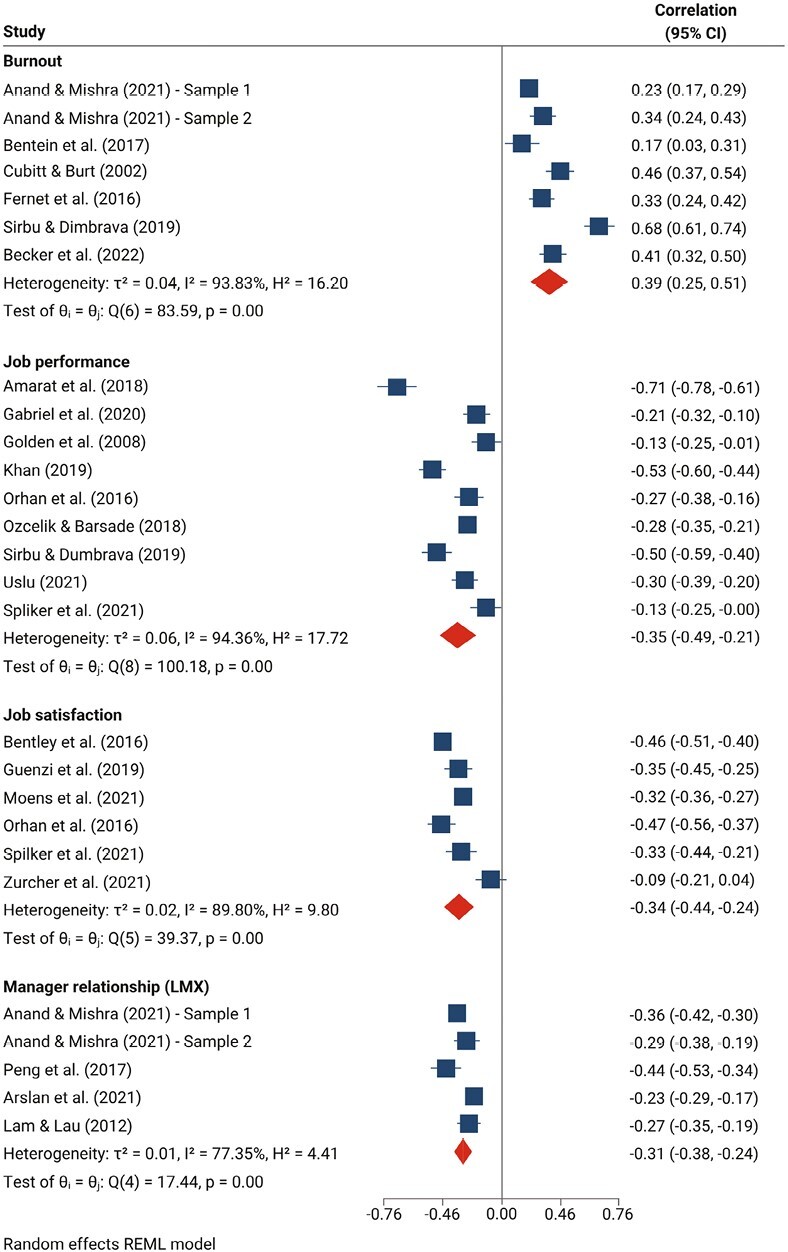
We identified 49 articles meeting the inclusion criteria. Pooled results indicate that workplace loneliness was associated with lower job performance (r = -0.35, 95% CI -0.49, -0.21), reduced job satisfaction (r = -0.34, 95% CI -0.44, -0.24), worse worker-manager relationship (r = -0.31, 95% CI -0.38, -0.24) and elevated burnout (r = 0.39, 95% CI 0.25, 0.51). Qualitative results suggest links between loneliness and inadequate workplace social interactions and mental health problems. As most studies used cross-sectional data and few adjusted for potential confounders, the direction and robustness of the associations remain untested.
Our results indicate that loneliness is associated with poor occupational functioning and well-being among workers. Results also show that loneliness is associated with modifiable aspects of the work environment, suggesting that the workplace may offer a fruitful avenue for interventions targeting loneliness.
孤独是一系列身心健康问题的风险因素,近年来越来越受到政策制定者和研究人员的关注。然而,人们对工作场所的孤独感及其对工人和雇主的影响关注甚少。
确定与工作场所孤独感相关的工作场所、健康和个人因素。
我们在五个数据库(PubMed、MEDLINE、EMBASE、PsycINFO 和 EBSCO Business Source Complete)中搜索了 2000 年 1 月 1 日至 2023 年 2 月 23 日期间发表的相关文章。使用叙事综合法和相关性系数的随机效应荟萃分析对定量数据进行综合。使用主题综合法对定性数据进行综合。使用混合方法评估工具评估证据质量。
我们确定了符合纳入标准的 49 篇文章。汇总结果表明,工作场所孤独感与较低的工作绩效(r=-0.35,95%CI-0.49,-0.21)、降低的工作满意度(r=-0.34,95%CI-0.44,-0.24)、较差的工人-经理关系(r=-0.31,95%CI-0.38,-0.24)和较高的倦怠感(r=0.39,95%CI 0.25,0.51)有关。定性结果表明孤独感与工作场所社交互动不足和心理健康问题之间存在联系。由于大多数研究使用横断面数据,且很少有研究对潜在混杂因素进行调整,因此关联的方向和稳健性仍未得到检验。
我们的研究结果表明,孤独感与工人的职业功能和健康状况不佳有关。研究结果还表明,孤独感与工作环境的可改变方面有关,这表明工作场所可能为针对孤独感的干预措施提供了一个有成效的途径。