Wang Yuxuan, Tian Ye, Zhu Jinying, She Haotian, Jiang Yinlai, Jiang Zhihong, Yokoi Hiroshi
School of Mechatronical Engineering, Beijing Institute of Technology, Beijing, China.
Faculty of Informatics and Engineering, The University of Electro-Communications, Tokyo, Japan.
Cyborg Bionic Syst. 2024 Jan 29;5:0066. doi: 10.34133/cbsystems.0066. eCollection 2024.
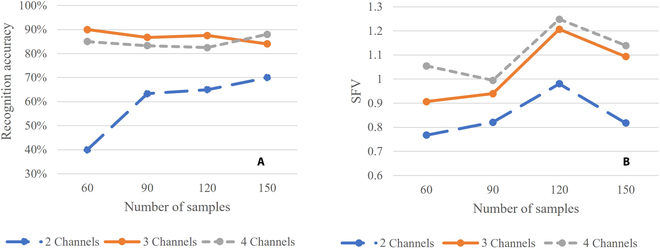
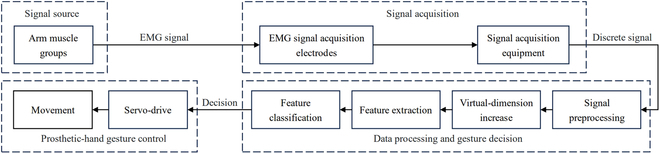
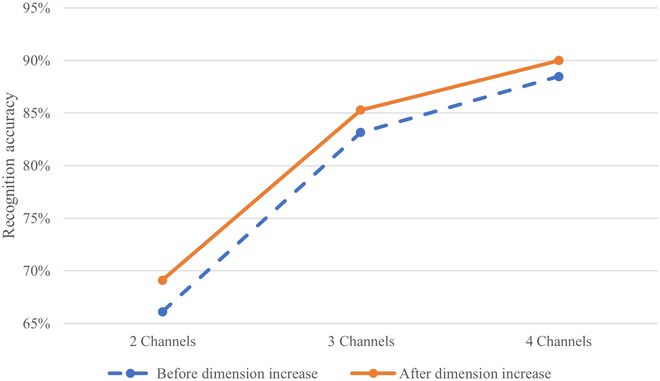
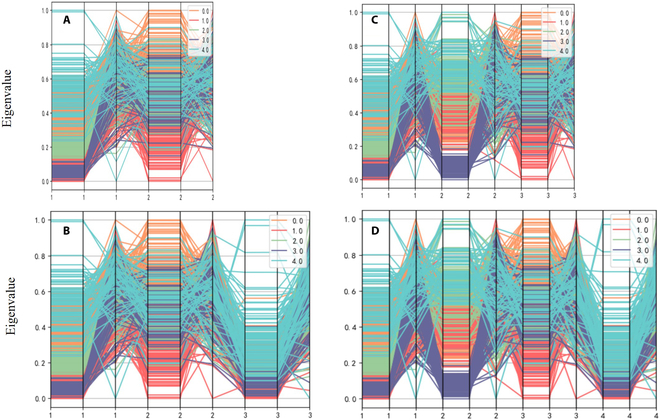
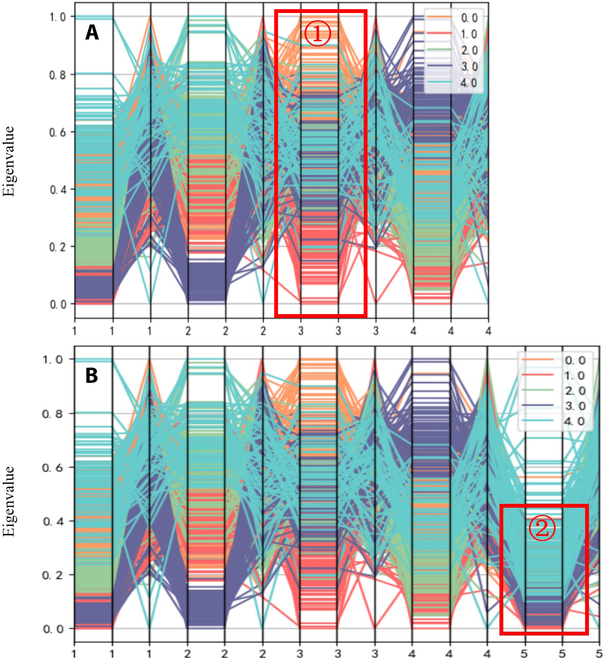
The electromyography(EMG) signal is the biocurrent associated with muscle contraction and can be used as the input signal to a myoelectric intelligent bionic hand to control different gestures of the hand. Increasing the number of myoelectric-signal channels can yield richer information of motion intention and improve the accuracy of gesture recognition. However, as the number of acquisition channels increases, its effect on the improvement of the accuracy of gesture recognition gradually diminishes, resulting in the improvement of the control effect reaching a plateau. To address these problems, this paper presents a proposed method to improve gesture recognition accuracy by virtually increasing the number of EMG signal channels. This method is able to improve the recognition accuracy of various gestures by virtually increasing the number of EMG signal channels and enriching the motion intention information extracted from data collected from a certain number of physical channels, ultimately providing a solution to the issue of the recognition accuracy plateau caused by saturation of information from physical recordings. Meanwhile, based on the idea of the filtered feature selection method, a quantitative measure of sample sets (separability of feature vectors [SFV]) derived from the divergence and correlation of the extracted features is introduced. The SFV value can predict the classification effect before performing the classification, and the effectiveness of the virtual-dimension increase strategy is verified from the perspective of feature set differentiability change. Compared to the statistical motion intention recognition success rate, SFV is a more representative and faster measure of classification effectiveness and is also suitable for small sample sets.
肌电图(EMG)信号是与肌肉收缩相关的生物电流,可作为肌电智能仿生手的输入信号,用于控制手部的不同手势。增加肌电信号通道的数量可以产生更丰富的运动意图信息,并提高手势识别的准确性。然而,随着采集通道数量的增加,其对手势识别准确性提高的效果逐渐减弱,导致控制效果的提升达到一个平台期。为了解决这些问题,本文提出了一种通过虚拟增加EMG信号通道数量来提高手势识别准确性的方法。该方法能够通过虚拟增加EMG信号通道数量并丰富从一定数量物理通道采集的数据中提取的运动意图信息,提高各种手势的识别准确性,最终解决由物理记录信息饱和导致的识别准确性平台期问题。同时,基于滤波特征选择方法的思想,引入了一种从提取特征的散度和相关性导出的样本集定量度量(特征向量可分离性[SFV])。SFV值可以在进行分类之前预测分类效果,并从特征集可区分性变化的角度验证了虚拟维度增加策略的有效性。与统计运动意图识别成功率相比,SFV是一种更具代表性且更快的分类有效性度量,也适用于小样本集。