Department of Radiology, Medical Imaging Center Groningen, University of Groningen, University Medical Center Groningen, PO Box 30001, 9700 RB, Groningen, The Netherlands.
Diagnostic Image Analysis Group, Department of Medical Imaging, Radboud University Medical Center, 6500 HB, Nijmegen, The Netherlands.
Abdom Radiol (NY). 2024 Apr;49(4):1122-1131. doi: 10.1007/s00261-023-04178-4. Epub 2024 Jan 30.
Detecting ablation site recurrence (ASR) after thermal ablation remains a challenge for radiologists due to the similarity between tumor recurrence and post-ablative changes. Radiomic analysis and machine learning methods may show additional value in addressing this challenge. The present study primarily sought to determine the efficacy of radiomic analysis in detecting ASR on follow-up computed tomography (CT) scans. The second aim was to develop a visualization tool capable of emphasizing regions of ASR between follow-up scans in individual patients.
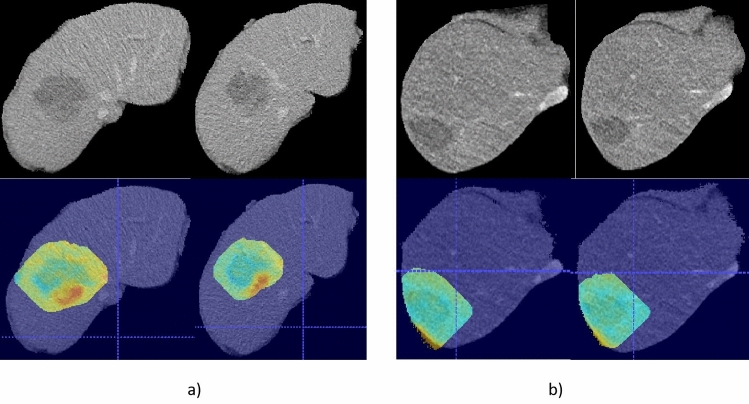
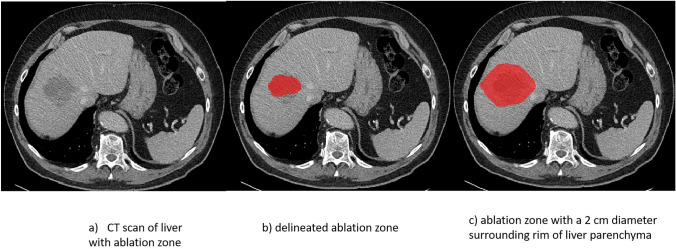
Lasso regression and Extreme Gradient Boosting (XGBoost) classifiers were employed for modeling radiomic features extracted from regions of interest delineated by two radiologists. A leave-one-out test (LOOT) was utilized for performance evaluation. A visualization method, creating difference heatmaps (diff-maps) between two follow-up scans, was developed to emphasize regions of growth and thereby highlighting potential ASR.
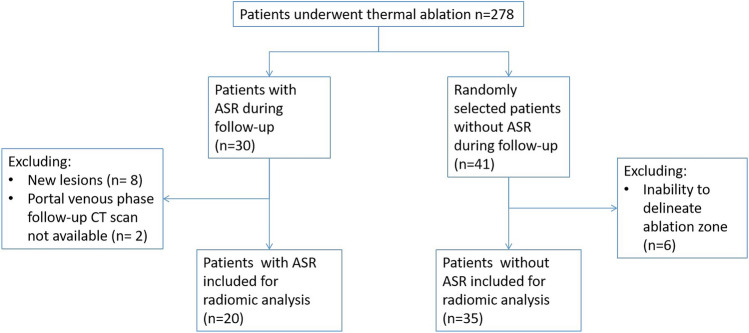
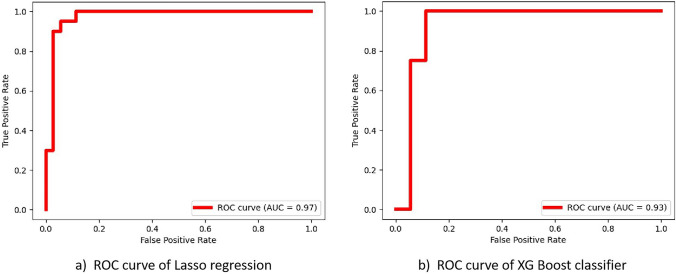
A total of 55 patients, including 20 with and 35 without ASR, were included in the radiomic analysis. The best performing model was achieved by Lasso regression tested with the LOOT approach, reaching an area under the curve (AUC) of 0.97 and an accuracy of 92.73%. The XGBoost classifier demonstrated better performance when trained with all extracted radiomic features than without feature selection, achieving an AUC of 0.93 and an accuracy of 89.09%. The diff-maps correctly highlighted post-ablative liver tumor recurrence in all patients.
Machine learning-based radiomic analysis and growth visualization proved effective in detecting ablation site recurrence on follow-up CT scans.
由于肿瘤复发与消融后改变之间存在相似性,热消融后消融部位复发(ASR)的检测对放射科医生来说仍是一项挑战。放射组学分析和机器学习方法可能在解决这一挑战方面具有额外的价值。本研究主要旨在确定放射组学分析在检测后续 CT 扫描中 ASR 的功效。第二个目的是开发一种可视化工具,能够在个体患者的随访扫描中突出显示 ASR 区域。
使用套索回归和极端梯度提升(XGBoost)分类器对由两位放射科医生勾画的感兴趣区域的放射组学特征进行建模。采用留一法(LOOT)进行性能评估。开发了一种创建两次随访扫描之间差异热图(diff-maps)的可视化方法,以强调生长区域,从而突出潜在的 ASR。
共纳入 55 例患者,其中 20 例有 ASR,35 例无 ASR。对 Lasso 回归进行 LOOT 测试的最佳模型,曲线下面积(AUC)为 0.97,准确率为 92.73%。XGBoost 分类器在使用所有提取的放射组学特征进行训练时的性能优于不进行特征选择,AUC 为 0.93,准确率为 89.09%。diff-maps 正确地突出了所有患者消融后肝肿瘤的复发。
基于机器学习的放射组学分析和生长可视化在检测后续 CT 扫描中的消融部位复发方面是有效的。