Division of Gastroenterology and Hepatology, University Hospital Zurich, University of Zurich, Rämistrasse 100, 8091, Zurich, Switzerland.
Division of Gastroenterology and Hepatology, Stadtspital Zurich, Zurich, Switzerland.
BMC Gastroenterol. 2024 Jan 30;24(1):54. doi: 10.1186/s12876-023-03116-4.
BACKGROUND & AIMS: With the increase in patients at risk of advanced liver disease due to the obesity epidemic, there will be a need for simple screening tools for advanced liver fibrosis. Soluble suppression of tumorigenicity 2 (sST2) is a serum biomarker for fibrotic processes. The aim of this study was to evaluate sST2 as marker for liver fibrosis in patients successfully treated for chronic hepatitis C.
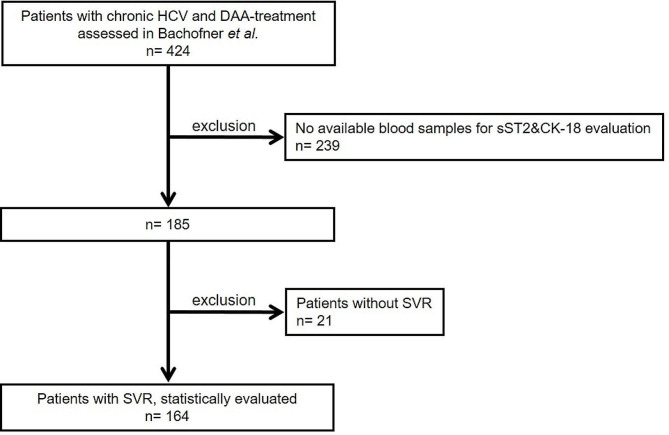
424 patients from the Swiss Hepatitis C Cohort Study were screened for inclusion in this post-hoc cohort study. Inclusion criteria were sustained virological response (SVR), available elastography (VCTE) and serum samples for biomarker analysis before and after treatment. For the validation of sST2, values were compared to VCTE, FIB-4 and APRI using Spearman's correlation and AUROC analyses.
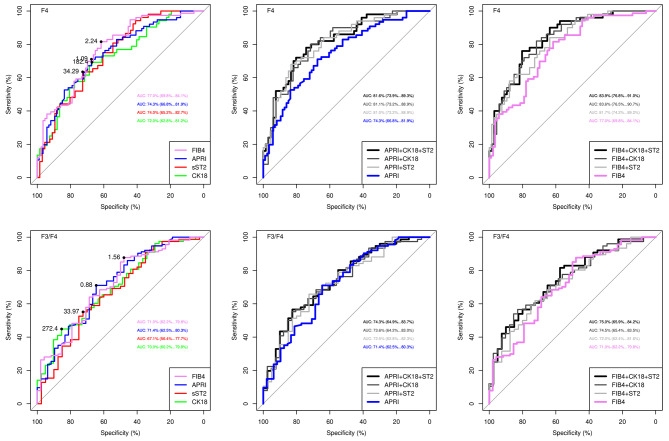
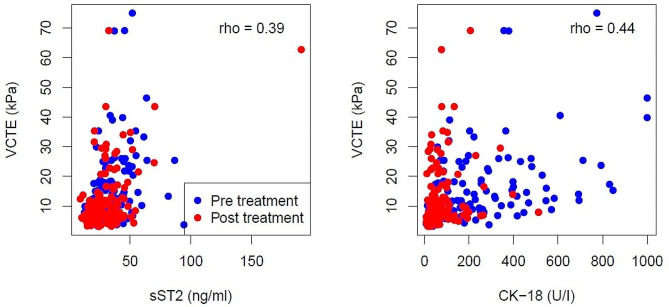
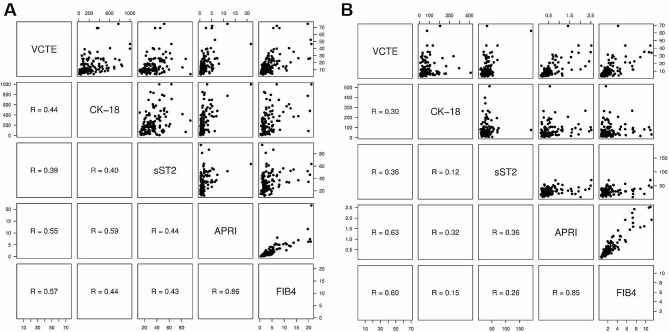
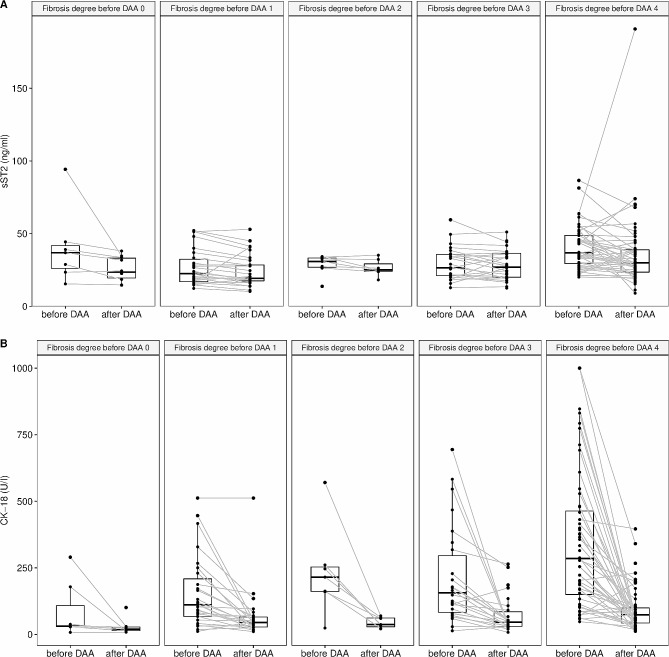
Data of 164 subjects were finally analyzed. Median sST2 values slightly increased with VCTE-derived fibrosis stages and remained stable after reaching SVR within the respective fibrosis stage, suggesting that sST2 is not influenced by liver inflammation. However, correlation of sST2 pre- and post-treatment with VCTE was fair (Spearman's rho = 0.39 and rho = 0.36). The area under the curve (AUROC) for sST2 in detecting VCTE-defined F4 fibrosis (vs. F0-F3) before therapy was 0.74 (95%CI 0.65-0.83), and 0.67(95%CI 0.56-0.78) for the discrimination of F3/F4 fibrosis vs. F0-F2. Adding sST2 to either APRI or FIB-4, respectively, increased diagnostic performance of both tests.
sST2 can potentially identify patients with advanced fibrosis as a single serum marker and in combination with APRI and FIB-4.
由于肥胖症的流行,患有晚期肝病风险的患者数量不断增加,因此需要简单的先进肝纤维化筛查工具。可溶性肿瘤抑制物 2(sST2)是纤维化过程的血清生物标志物。本研究旨在评估 sST2 在成功治疗慢性丙型肝炎患者中的肝纤维化标志物。
瑞士丙型肝炎队列研究中的 424 名患者被筛选入组本队列研究。入组标准为持续病毒学应答(SVR)、有弹性成像(VCTE)和治疗前后的血清标志物分析样本。为了验证 sST2,使用 Spearman 相关和 AUROC 分析将其值与 VCTE、FIB-4 和 APRI 进行比较。
最终分析了 164 名患者的数据。中位数 sST2 值随 VCTE 纤维化分期略有升高,并在达到相应纤维化分期的 SVR 后保持稳定,表明 sST2 不受肝脏炎症的影响。然而,治疗前后 sST2 与 VCTE 的相关性尚可(Spearman's rho=0.39 和 rho=0.36)。sST2 在检测 VCTE 定义的 F4 纤维化(vs. F0-F3)的曲线下面积(AUROC)在治疗前为 0.74(95%CI 0.65-0.83),在区分 F3/F4 纤维化与 F0-F2 时为 0.67(95%CI 0.56-0.78)。分别将 sST2 添加到 APRI 或 FIB-4 中,可分别提高这两种检测的诊断性能。
sST2 可作为单一血清标志物潜在地识别出患有晚期纤维化的患者,也可与 APRI 和 FIB-4 联合使用。