Division for Medical Informatics, Osaka University Dental Hospital, 1-8 Yamada-oka, Suita, Osaka, 565-0871, Japan.
Department of Pediatric Dentistry, Osaka University Graduate School of Dentistry, 1-8 Yamada-oka, Suita, Osaka, 565-0871, Japan.
BMC Oral Health. 2024 Jan 31;24(1):143. doi: 10.1186/s12903-024-03928-0.
Dental age is crucial for treatment planning in pediatric and orthodontic dentistry. Dental age calculation methods can be categorized into morphological, biochemical, and radiological methods. Radiological methods are commonly used because they are non-invasive and reproducible. When radiographs are available, dental age can be calculated by evaluating the developmental stage of permanent teeth and converting it into an estimated age using a table, or by measuring the length between some landmarks such as the tooth, root, or pulp, and substituting them into regression formulas. However, these methods heavily depend on manual time-consuming processes. In this study, we proposed a novel and completely automatic dental age calculation method using panoramic radiographs and deep learning techniques.
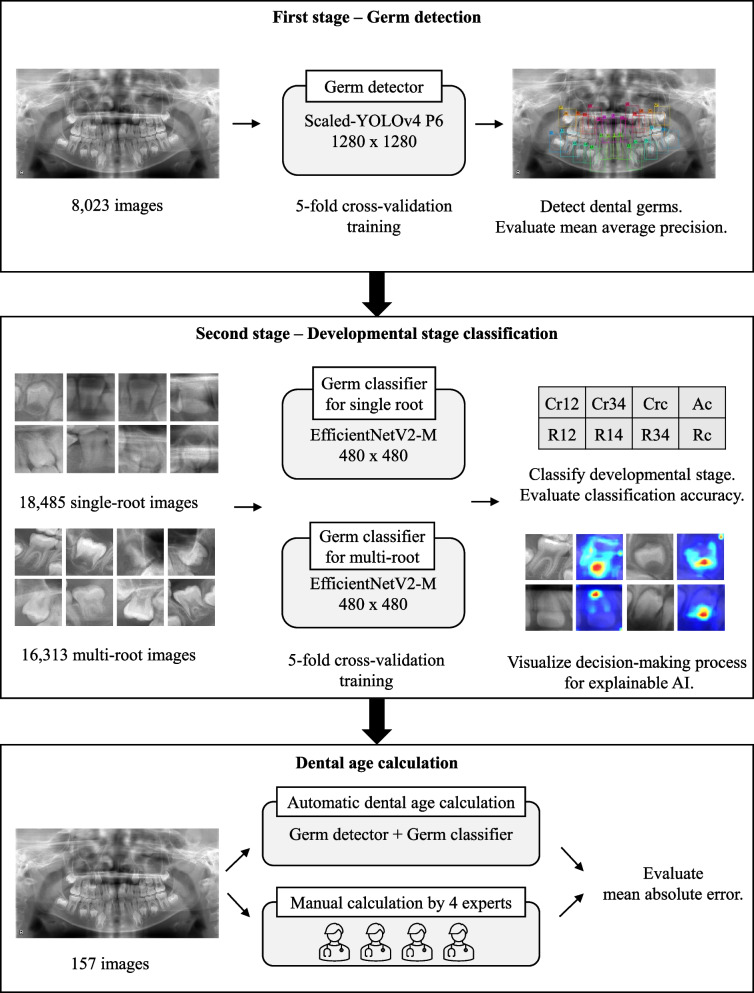
Overall, 8,023 panoramic radiographs were used as training data for Scaled-YOLOv4 to detect dental germs and mean average precision were evaluated. In total, 18,485 single-root and 16,313 multi-root dental germ images were used as training data for EfficientNetV2 M to classify the developmental stages of detected dental germs and Top-3 accuracy was evaluated since the adjacent stages of the dental germ looks similar and the many variations of the morphological structure can be observed between developmental stages. Scaled-YOLOv4 and EfficientNetV2 M were trained using cross-validation. We evaluated a single selection, a weighted average, and an expected value to convert the probability of developmental stage classification to dental age. One hundred and fifty-seven panoramic radiographs were used to compare automatic and manual human experts' dental age calculations.
Dental germ detection was achieved with a mean average precision of 98.26% and dental germ classifiers for single and multi-root were achieved with a Top-3 accuracy of 98.46% and 98.36%, respectively. The mean absolute errors between the automatic and manual dental age calculations using single selection, weighted average, and expected value were 0.274, 0.261, and 0.396, respectively. The weighted average was better than the other methods and was accurate by less than one developmental stage error.
Our study demonstrates the feasibility of automatic dental age calculation using panoramic radiographs and a two-stage deep learning approach with a clinically acceptable level of accuracy.
牙龄对于儿科和正畸牙科的治疗计划至关重要。牙龄计算方法可分为形态学、生化和影像学方法。由于影像学方法是非侵入性且可重复的,因此通常被使用。当有射线照片时,可以通过评估恒牙的发育阶段并使用表格将其转换为估计年龄,或者通过测量牙齿、牙根或牙髓等一些地标之间的长度,并将其代入回归公式来计算牙龄。然而,这些方法严重依赖于耗时的手动过程。在本研究中,我们提出了一种使用全景射线照片和深度学习技术的新颖且完全自动化的牙龄计算方法。
总共使用了 8023 张全景射线照片作为 Scaled-YOLOv4 的训练数据,以检测牙胚,并评估了平均精度。总共使用了 18485 个单根和 16313 个多根牙胚图像作为 EfficientNetV2 M 的训练数据,以对检测到的牙胚的发育阶段进行分类,并评估了前三名的准确率,因为牙胚的相邻阶段看起来相似,并且可以观察到发育阶段之间形态结构的许多变化。Scaled-YOLOv4 和 EfficientNetV2 M 使用交叉验证进行训练。我们评估了一种单一选择、加权平均值和期望值,以将发育阶段分类的概率转换为牙龄。使用 157 张全景射线照片来比较自动和手动人类专家的牙龄计算。
牙胚检测的平均精度达到 98.26%,单根和多根牙胚分类器的前三名准确率分别达到 98.46%和 98.36%。使用单一选择、加权平均值和期望值进行自动和手动牙龄计算之间的平均绝对误差分别为 0.274、0.261 和 0.396。加权平均值优于其他方法,并且误差不超过一个发育阶段。
我们的研究表明,使用全景射线照片和两阶段深度学习方法自动计算牙龄是可行的,具有临床可接受的准确性。