Lo Monaco Marika, Mallaci Bocchio Raffaella, Natoli Giuseppe, Giardina Annarita, Cangemi Ignazio, Scibetta Salvatore, Argano Christiano, Corrao Salvatore
Department of Health Promotion Sciences, Maternal and Infant Care, Internal Medicine and Medical Specialties [PROMISE], University of Palermo, Palermo, Italy.
Department of Clinical Medicine, Internal Medicine Unit with Rheumatology, Dermatology, Diabetology and Tertiary Diabetic Foot Healthcare, National Relevance and High Specialization Hospital Trust ARNAS Civico, Di Cristina, Benfratelli, Palermo, Italy.
Front Med (Lausanne). 2024 Jan 16;10:1332432. doi: 10.3389/fmed.2023.1332432. eCollection 2023.
Psoriatic arthritis (PsA) is a heterogeneous, chronic inflammatory disease that negatively impacts patients' quality of life. Patient-reported outcome measures (PROMs) are used to capture patient perspectives in disease assessment, and physicians use the Disease Activity Index for Psoriatic Arthritis (DAPSA) to evaluate disease activity in PsA. The study aimed to assess the relationship between PROMs and the DAPSA score in consecutive outpatients affected by PsA.
A cross-sectional study was conducted from March 2018 to October 2020 at the PsA clinic of the ARNAS Civico in Palermo (Italy), enrolling outpatients with PsA. Patients were assessed for their disease activity according to the DAPSA score, and PROMs, such as PHQ-9, HAQ, FACIT-F, and PsAID, were evaluated. Linear regression analysis evaluated the relationship between the DAPSA Score and the included PROMs.
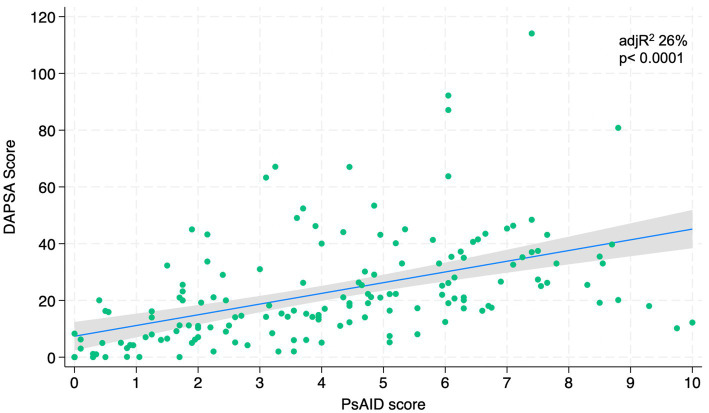
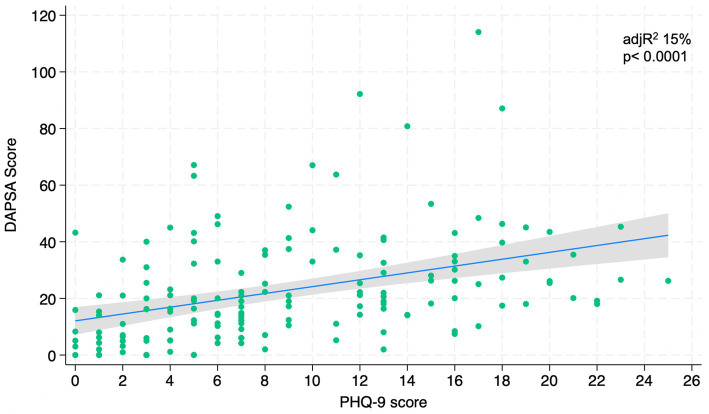
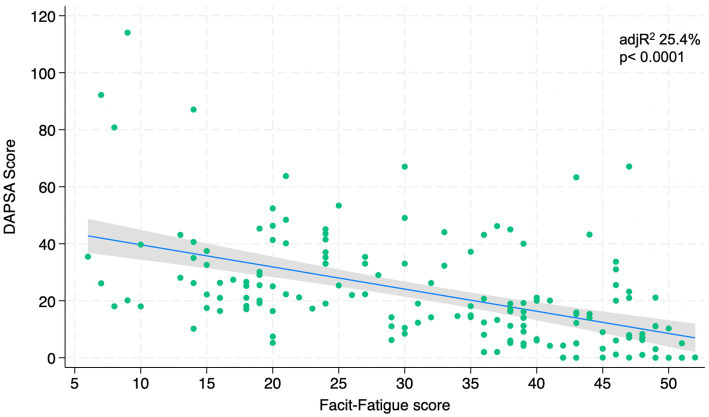
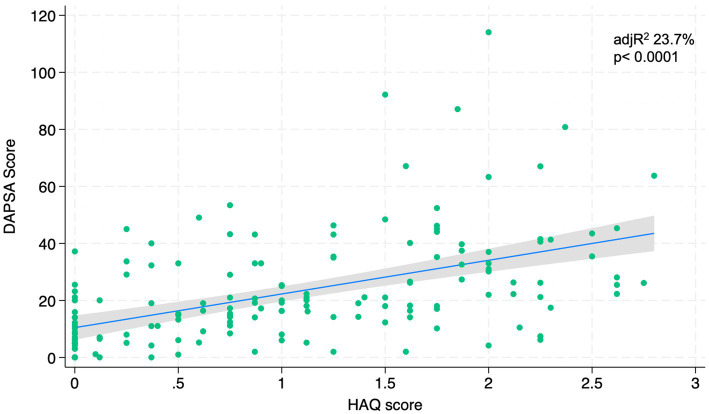
158 PsA consecutive peripheral subset psoriatic arthritis outpatients were recruited. The median years of illness was 10.6 (9.3-11.9), and the median DAPSA score was 19.02 (9-33.1). The regression analysis highlighted a strong relationship between the DAPSA score and the PsAID (adjR 26%, < 0.0001), the FACIT-F (adjR 25.4%, p < 0.0001), the HAQ (adjR 23.7%, < 0.0001), and PHQ-9 (adjR 15%, < 0.0001).
PROMs are strongly associated with the DAPSA score, but it allows in-depth evaluation of the impact of the disease on different domains of PsA patients' life.
银屑病关节炎(PsA)是一种异质性慢性炎症性疾病,对患者的生活质量产生负面影响。患者报告结局指标(PROMs)用于在疾病评估中获取患者的观点,而医生使用银屑病关节炎疾病活动指数(DAPSA)来评估PsA的疾病活动度。本研究旨在评估连续的PsA门诊患者中PROMs与DAPSA评分之间的关系。
2018年3月至2020年10月在意大利巴勒莫的ARNAS Civico银屑病关节炎诊所进行了一项横断面研究,纳入PsA门诊患者。根据DAPSA评分评估患者的疾病活动度,并评估PROMs,如PHQ-9、HAQ、FACIT-F和PsAID。线性回归分析评估DAPSA评分与纳入的PROMs之间的关系。
招募了158例PsA连续外周型银屑病关节炎门诊患者。疾病中位数病程为10.6(9.3 - 11.9)年,DAPSA评分中位数为19.02(9 - 33.1)。回归分析突出显示DAPSA评分与PsAID(调整R² 26%,p < 0.0001)、FACIT-F(调整R² 25.4%,p < 0.0001)、HAQ(调整R² 23.7%,p < 0.0001)和PHQ-9(调整R² 15%,p < 0.0001)之间存在密切关系。
PROMs与DAPSA评分密切相关,但它有助于深入评估疾病对PsA患者生活不同领域的影响。