
社区抗逆转录病毒治疗药物分发的病毒学及护理结果:刚果民主共和国金沙萨PODI+模式的经验
Virological and care outcomes of community ART distribution: Experience with the PODI+ model in Kinshasa, Democratic Republic of the Congo.
作者信息
Gill Michelle M, Bakebua Winnie, Ditekemena John, Gbomosa Cady Nyombe, Tshishi Dieudonné, Loando Aimé, Giri Abhigya, Ngantsui Roger Beni, Hoffman Heather J
机构信息
Elizabeth Glaser Pediatric AIDS Foundation, Washington, District of Columbia, United States of America.
Elizabeth Glaser Pediatric AIDS Foundation, Kinshasa, Democratic Republic of the Congo.
出版信息
PLOS Glob Public Health. 2024 Jan 31;4(1):e0002343. doi: 10.1371/journal.pgph.0002343. eCollection 2024.
INTRODUCTION
Differentiated service delivery models for HIV treatment can minimize unnecessary burdens on health systems and promote efficient delivery of antiretroviral therapy (ART). Under the PODI+ (poste de distribution communautaire) model, ART multi-month dispensation (MMD) was provided by lay workers (peers) in communities. We compared outcomes among clinically stable adults living with HIV receiving MMD via PODI+ or health facility (HF).
METHODS
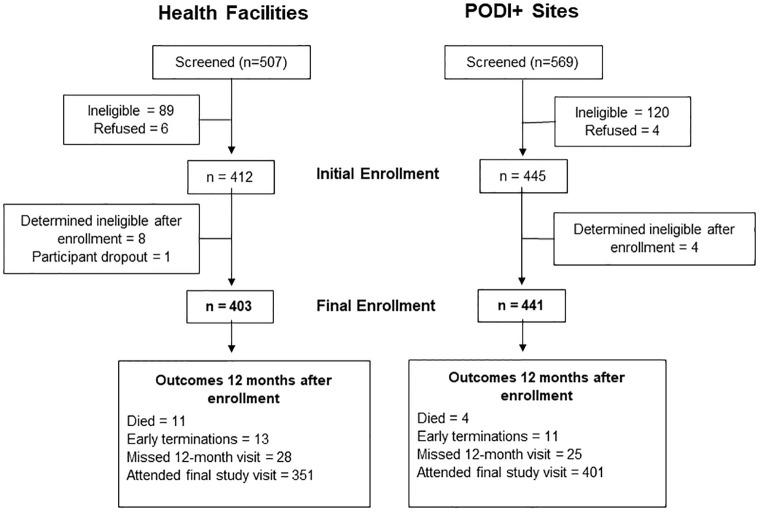
Clients receiving MMD at nine HFs and two PODI+ sites in Kinshasa were followed prospectively for one year (2018-2020). Medication possession ratio (MPR) was measured as proportion of total days with medication during the study through record abstraction at 3-month intervals. Viral load was assessed at enrollment and 12 months. We compared MPR and viral load suppression by arm and examined associations and potential confounders using unadjusted and adjusted odds ratios (AOR). Likert-style client satisfaction was collected during 12-month interviews and described by arm.
RESULTS
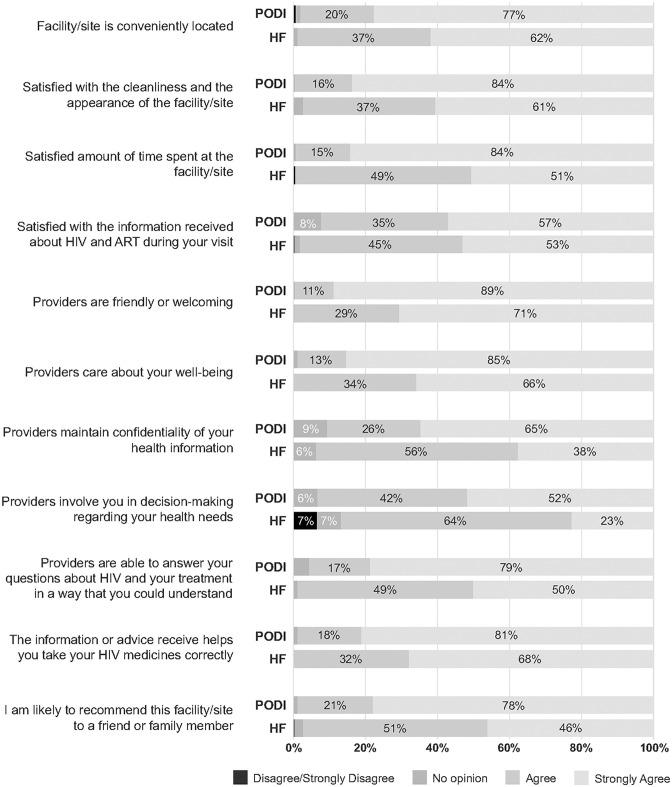
Odds of maintaining viral load suppression at 12 months for PODI+ participants were two times that for HF participants. In adjusted models, PODI+ participants had 1.89 times the odds of being suppressed at 12 months compared to HF participants (95% CI: 1.10, 3.27). No significant differences in MPR were found between groups (OR: 0.86, 0.38-1.99). Older participants had significantly higher odds of MPR (AOR: 1.02, 95% CI: 1.01, 1.03) and viral suppression (AOR: 1.03, 95% CI: 1.00, 1.07). Satisfaction with services was ≥87% overall, but PODI+ participants rated time spent at site, provider attributes and other care aspects more favorably.
CONCLUSIONS
Participants receiving MMD via peer-run community distribution points had similar MPR, but better virological outcomes and greater satisfaction with care than clinically similar participants receiving MMD through facilities. PODI+ could be a useful model for expansion to serve larger clinic populations from overburdened health facilities, particularly as policy shifts towards more inclusive MMD eligibility requirements.
引言
针对艾滋病毒治疗的差异化服务提供模式可将对卫生系统的不必要负担降至最低,并促进抗逆转录病毒疗法(ART)的高效提供。在PODI+(社区分发点)模式下,抗逆转录病毒疗法多月份配药(MMD)由社区中的非专业工作人员(同伴)提供。我们比较了通过PODI+或医疗机构(HF)接受MMD的临床稳定的艾滋病毒感染者的治疗结果。
方法
对在金沙萨的9个医疗机构和2个PODI+站点接受MMD的患者进行了为期一年(2018 - 2020年)的前瞻性随访。通过每3个月提取记录,将药物持有率(MPR)测量为研究期间有药物的总天数的比例。在入组时和12个月时评估病毒载量。我们按分组比较了MPR和病毒载量抑制情况,并使用未调整和调整后的优势比(AOR)检查了关联和潜在混杂因素。在12个月的访谈中收集了李克特式的患者满意度,并按分组进行了描述。
结果
PODI+参与者在12个月时维持病毒载量抑制的几率是医疗机构参与者的两倍。在调整模型中,与医疗机构参与者相比,PODI+参与者在12个月时被抑制的几率是其1.89倍(95%置信区间:1.10,3.27)。两组之间在MPR方面未发现显著差异(优势比:0.86,0.38 - 1.99)。年龄较大的参与者MPR(调整后优势比:1.02,95%置信区间:1.01,1.03)和病毒抑制(调整后优势比:1.03,95%置信区间:1.00,1.07)的几率显著更高。总体而言,对服务的满意度≥87%,但PODI+参与者对在站点花费的时间、提供者属性和其他护理方面的评价更高。
结论
通过同伴运营的社区分发点接受MMD的参与者的MPR相似,但与通过医疗机构接受MMD的临床情况相似的参与者相比,病毒学结果更好,对护理的满意度更高。PODI+可能是一个有用的模式,可扩大规模以服务来自负担过重的医疗机构的更多临床人群,特别是随着政策转向更具包容性的MMD资格要求。
 Zotero 插件