Netherlands Institute for Health Services Research (Nivel), Utrecht, The Netherlands.
ARQ National Psychotrauma Centre, Diemen, The Netherlands.
Euro Surveill. 2024 Feb;29(5). doi: 10.2807/1560-7917.ES.2024.29.5.2300244.
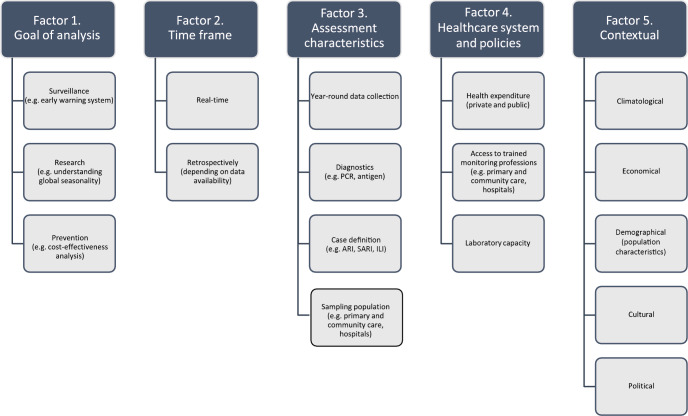
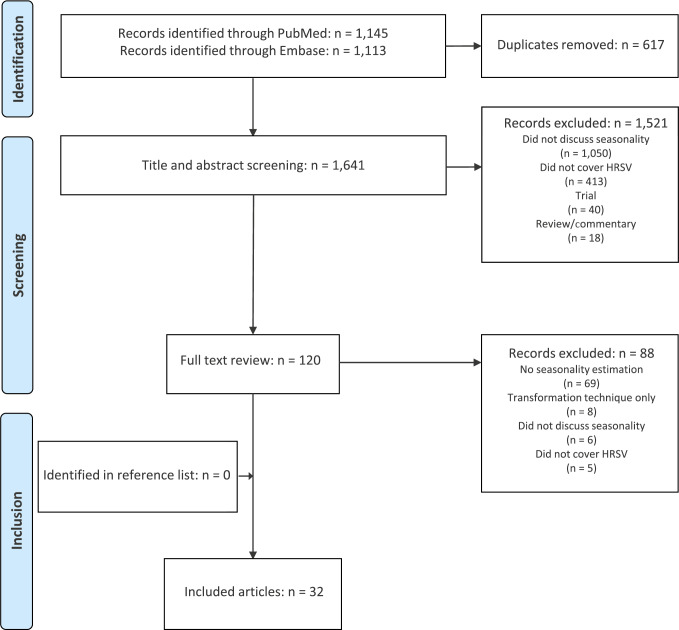
BackgroundThere is currently no standardised approach to estimate respiratory syncytial virus (RSV) epidemics' timing (or seasonality), a critical information for their effective prevention and control.AimWe aimed to provide an overview of methods to define RSV seasonality and identify factors supporting method choice or interpretation/comparison of seasonal estimates.MethodsWe systematically searched PubMed and Embase (2016-2021) for studies using quantitative approaches to determine the start and end of RSV epidemics. Studies' features (data-collection purpose, location, regional/(sub)national scope), methods, and assessment characteristics (case definitions, sampled population's age, in/outpatient status, setting, diagnostics) were extracted. Methods were categorised by their need of a denominator (i.e. numbers of specimens tested) and their retrospective vs real-time application. Factors worth considering when choosing methods and assessing seasonal estimates were sought by analysing studies.ResultsWe included 32 articles presenting 49 seasonality estimates (18 thereof through the 10% positivity threshold method). Methods were classified into eight categories, two requiring a denominator (1 retrospective; 1 real-time) and six not (3 retrospective; 3 real-time). A wide range of assessment characteristics was observed. Several studies showed that seasonality estimates varied when methods differed, or data with dissimilar assessment characteristics were employed. Five factors (comprising study purpose, application time, assessment characteristics, healthcare system and policies, and context) were identified that could support method choice and result interpretation.ConclusionMethods and assessment characteristics used to define RSV seasonality are heterogeneous. Our categorisation of methods and proposed framework of factors may assist in choosing RSV seasonality methods and interpretating results.
目前尚无标准化方法来估计呼吸道合胞病毒 (RSV) 流行的时间(或季节性),这是有效预防和控制 RSV 的关键信息。
我们旨在提供 RSV 季节性定义方法概述,并确定支持方法选择或季节性估计解释/比较的因素。
我们系统地检索了 PubMed 和 Embase(2016-2021 年)中使用定量方法来确定 RSV 流行开始和结束的研究。提取了研究的特征(数据收集目的、地点、区域/(亚)国家范围)、方法和评估特征(病例定义、采样人群的年龄、门诊/住院状态、设置、诊断)。方法根据其对分母(即测试标本数量)的需求和回顾性与实时应用进行分类。通过分析研究,寻求选择方法和评估季节性估计时值得考虑的因素。
我们纳入了 32 篇文章,其中包含 49 个季节性估计(其中 18 个通过 10%阳性率阈值方法)。方法分为 8 类,其中 2 类需要分母(1 个回顾性;1 个实时),6 类不需要(3 个回顾性;3 个实时)。观察到评估特征的范围很广。一些研究表明,当方法不同或使用具有不同评估特征的数据时,季节性估计会有所不同。确定了五个因素(包括研究目的、应用时间、评估特征、医疗保健系统和政策以及背景),这些因素可以支持方法选择和结果解释。
用于定义 RSV 季节性的方法和评估特征具有异质性。我们对方法的分类和提出的因素框架可能有助于选择 RSV 季节性方法和解释结果。