Glass David S, Bren Anat, Vaisbourd Elizabeth, Mayo Avi, Alon Uri
Department of Molecular Cell Biology, Weizmann Institute of Science, Rehovot 76100, Israel.
Department of Molecular Cell Biology, Weizmann Institute of Science, Rehovot 76100, Israel.
Cell. 2024 Feb 15;187(4):931-944.e12. doi: 10.1016/j.cell.2024.01.024. Epub 2024 Feb 5.
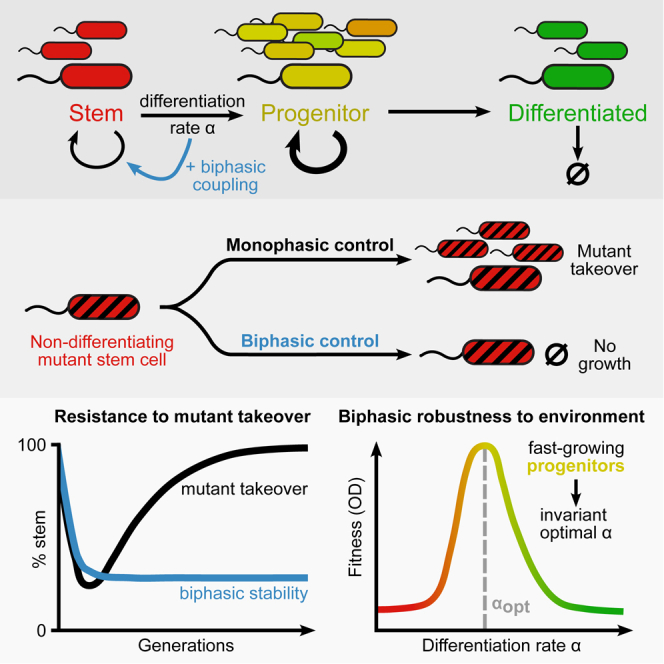
Differentiation is crucial for multicellularity. However, it is inherently susceptible to mutant cells that fail to differentiate. These mutants outcompete normal cells by excessive self-renewal. It remains unclear what mechanisms can resist such mutant expansion. Here, we demonstrate a solution by engineering a synthetic differentiation circuit in Escherichia coli that selects against these mutants via a biphasic fitness strategy. The circuit provides tunable production of synthetic analogs of stem, progenitor, and differentiated cells. It resists mutations by coupling differentiation to the production of an essential enzyme, thereby disadvantaging non-differentiating mutants. The circuit selected for and maintained a positive differentiation rate in long-term evolution. Surprisingly, this rate remained constant across vast changes in growth conditions. We found that transit-amplifying cells (fast-growing progenitors) underlie this environmental robustness. Our results provide insight into the stability of differentiation and demonstrate a powerful method for engineering evolutionarily stable multicellular consortia.
分化对于多细胞生物至关重要。然而,它本质上易受未能分化的突变细胞影响。这些突变体通过过度自我更新胜过正常细胞。目前尚不清楚哪些机制能够抵抗此类突变体的扩张。在此,我们展示了一种解决方案,即通过在大肠杆菌中构建一个合成分化电路,该电路通过双相适应性策略来筛选这些突变体。该电路可调节产生干细胞、祖细胞和分化细胞的合成类似物。它通过将分化与一种必需酶的产生相耦合来抵抗突变,从而使未分化的突变体处于劣势。该电路在长期进化中选择并维持了正向分化率。令人惊讶的是,在生长条件发生巨大变化时,这一比率保持恒定。我们发现过渡扩增细胞(快速生长的祖细胞)是这种环境稳健性的基础。我们的结果为分化的稳定性提供了见解,并展示了一种构建进化稳定多细胞群落的强大方法。