Department of Molecular and Cellular Biology, University of Arizona, Tucson, AZ, USA.
Department of Mathematics, Massachusetts Institute of Technology, Cambridge, MA, USA.
Nature. 2022 Aug;608(7922):324-329. doi: 10.1038/s41586-022-04944-2. Epub 2022 Aug 10.
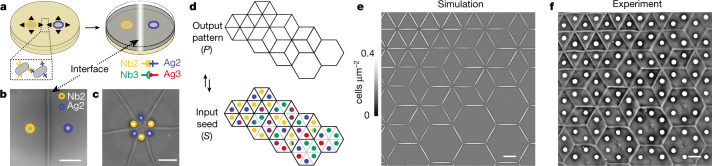
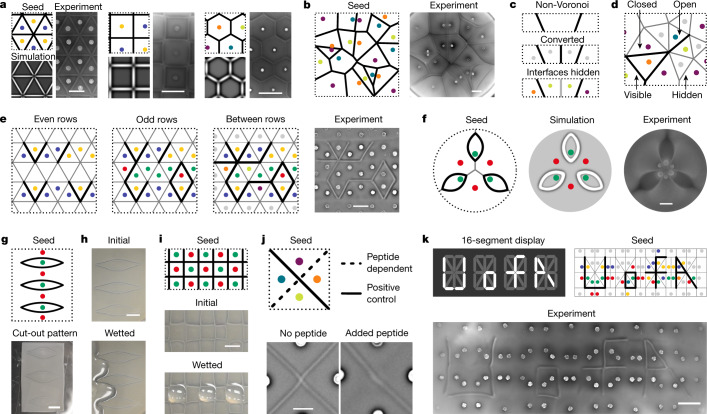
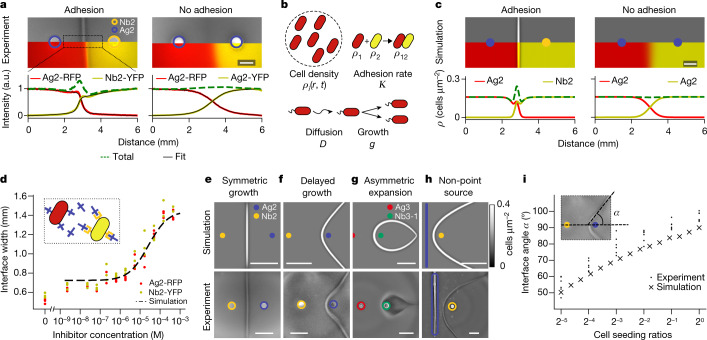
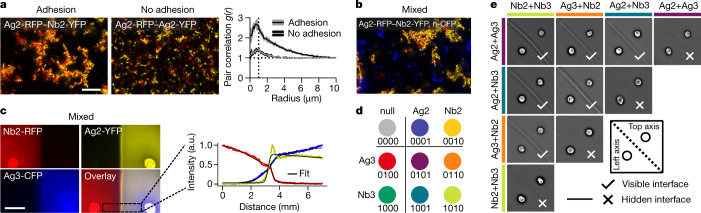
Multicellular systems, from bacterial biofilms to human organs, form interfaces (or boundaries) between different cell collectives to spatially organize versatile functions. The evolution of sufficiently descriptive genetic toolkits probably triggered the explosion of complex multicellular life and patterning. Synthetic biology aims to engineer multicellular systems for practical applications and to serve as a build-to-understand methodology for natural systems. However, our ability to engineer multicellular interface patterns is still very limited, as synthetic cell-cell adhesion toolkits and suitable patterning algorithms are underdeveloped. Here we introduce a synthetic cell-cell adhesin logic with swarming bacteria and establish the precise engineering, predictive modelling and algorithmic programming of multicellular interface patterns. We demonstrate interface generation through a swarming adhesion mechanism, quantitative control over interface geometry and adhesion-mediated analogues of developmental organizers and morphogen fields. Using tiling and four-colour-mapping concepts, we identify algorithms for creating universal target patterns. This synthetic 4-bit adhesion logic advances practical applications such as human-readable molecular diagnostics, spatial fluid control on biological surfaces and programmable self-growing materials. Notably, a minimal set of just four adhesins represents 4 bits of information that suffice to program universal tessellation patterns, implying a low critical threshold for the evolution and engineering of complex multicellular systems.
多细胞系统,从细菌生物膜到人体器官,在不同的细胞群体之间形成界面(或边界),以空间方式组织多样化的功能。具有足够描述性的遗传工具包的进化可能引发了复杂多细胞生命和模式形成的爆炸。合成生物学旨在为实际应用设计多细胞系统,并作为自然系统的一种构建理解方法。然而,我们设计多细胞界面模式的能力仍然非常有限,因为合成的细胞间黏附工具包和合适的模式算法还不够发达。在这里,我们引入了一种具有群体行为的细菌的合成细胞间黏附逻辑,并建立了多细胞界面模式的精确工程、预测建模和算法编程。我们通过群体黏附机制展示了界面的生成,对界面几何形状进行了定量控制,并模拟了发育组织者和形态发生场的黏附介导类似物。通过平铺和四色映射的概念,我们确定了创建通用目标图案的算法。这种合成的 4 位黏附逻辑推进了实际应用,如人类可读的分子诊断、生物表面的空间流体控制和可编程自生长材料。值得注意的是,仅仅由四个黏附素组成的最小集合代表了足以编程通用平铺图案的 4 位信息,这意味着对于复杂多细胞系统的进化和工程来说,存在一个低的临界阈值。