School of Pharmacy, Hubei University of Science and Technology, Xianning, China.
Department of Obstetrics, Xianning Central Hospital, First Affiliated Hospital of Hubei University of Science and Technology, Xianning, China.
J Cell Mol Med. 2024 Feb;28(4):e18136. doi: 10.1111/jcmm.18136.
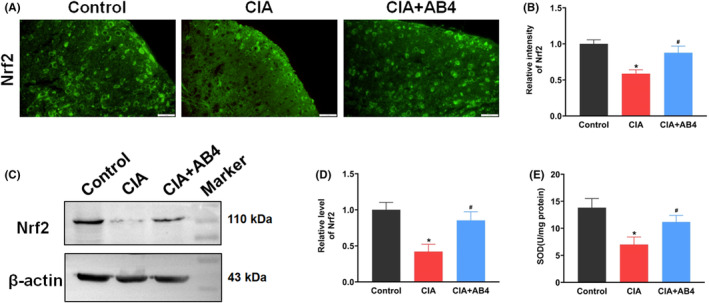
Chronic pain is the key manifestations of rheumatoid arthritis. Neuroinflammation in the spinal cord drives central sensitization and chronic pain. Ferroptosis has potentially important roles in the occurrence of neuroinflammation and chronic pain. In the current study, mouse model of collagen-induced arthritis was established by intradermal injection of type II collagen in complete Freund's adjuvant (CFA) solution. CFA inducement resulted in swollen paw and ankle, mechanical and spontaneous pain, and impaired motor coordination. The spinal inflammation was triggered, astrocytes were activated, and increased NLRP3-mediated inflammatory signal was found in CFA spinal cord. Oxidative stress and ferroptosis in the spinal cord were manifested. Meanwhile, enhancive spinal GSK-3β activity and abnormal phosphorylated Drp1 were observed. To investigate the potential therapeutic options for arthritic pain, mice were intraperitoneally injected with AB4 for three consecutive days. AB4 treatment reduced pain sensitivity and increased the motor coordination. In the spinal cord, AB4 treatment inhibited NLRP3 inflammasome-mediated inflammatory response, increased antioxidation, decreased mitochondrial reactive oxygen species and ferroptosis. Furthermore, AB4 decreased GSK-3β activity by binding with GSK-3β through five electrovalent bonds. Our findings indicated that AB treatment relieves arthritis pain by inhibiting GSK-3β activation, increasing antioxidant capability, reducing Drp1-mediated mitochondrial dysfunction and suppressing neuroinflammation.
慢性疼痛是类风湿关节炎的主要表现。脊髓中的神经炎症驱动中枢敏化和慢性疼痛。铁死亡在神经炎症和慢性疼痛的发生中具有潜在的重要作用。在本研究中,通过在完全弗氏佐剂(CFA)溶液中皮内注射 II 型胶原建立了胶原诱导性关节炎的小鼠模型。CFA 诱导导致爪子和脚踝肿胀、机械性和自发性疼痛以及运动协调受损。脊髓炎症被触发,星形胶质细胞被激活,并且在 CFA 脊髓中发现 NLRP3 介导的炎症信号增加。脊髓中的氧化应激和铁死亡表现出来。同时,观察到增强的脊髓 GSK-3β活性和异常磷酸化的 Drp1。为了研究关节炎疼痛的潜在治疗选择,小鼠连续 3 天腹腔注射 AB4。AB4 治疗降低了疼痛敏感性并增加了运动协调性。在脊髓中,AB4 治疗通过与 GSK-3β 通过五个电价键结合来抑制 NLRP3 炎性小体介导的炎症反应,增加抗氧化能力,减少线粒体活性氧和铁死亡。此外,AB4 通过与 GSK-3β 结合来抑制 GSK-3β 活性。我们的研究结果表明,AB 治疗通过抑制 GSK-3β 激活、增加抗氧化能力、减少 Drp1 介导的线粒体功能障碍和抑制神经炎症来缓解关节炎疼痛。