Lörinczi František, Vanderka Marián, Lörincziová Drahomíra, Kushkestani Mehdi
Faculty of Physical Education and Sport, Comenius University in Bratislava, Bratislava, Slovakia.
University of Economics in Bratislava, Bratislava, Slovakia.
BMC Sports Sci Med Rehabil. 2024 Feb 9;16(1):42. doi: 10.1186/s13102-024-00840-6.
It has been reported that the way we breathe (whether through the nose or mouth) can influence many aspects of our health and to some extent, sport performance. The purpose of this study was to evaluate the acute effects of different breathing regimens on muscular endurance and physiological variables.
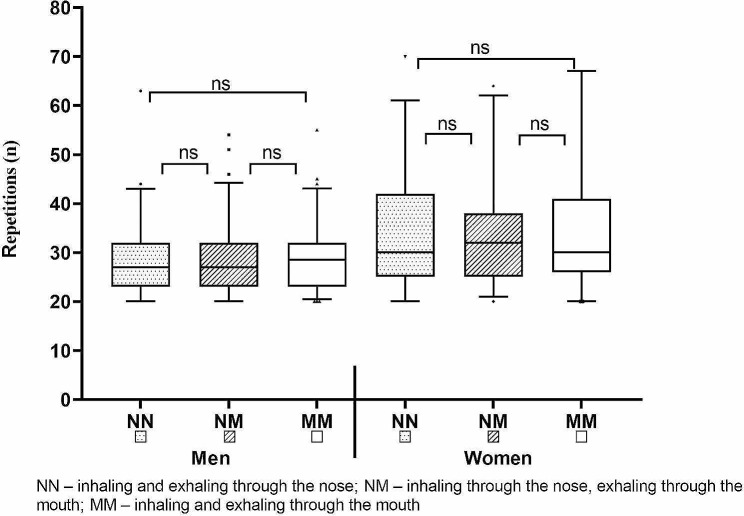
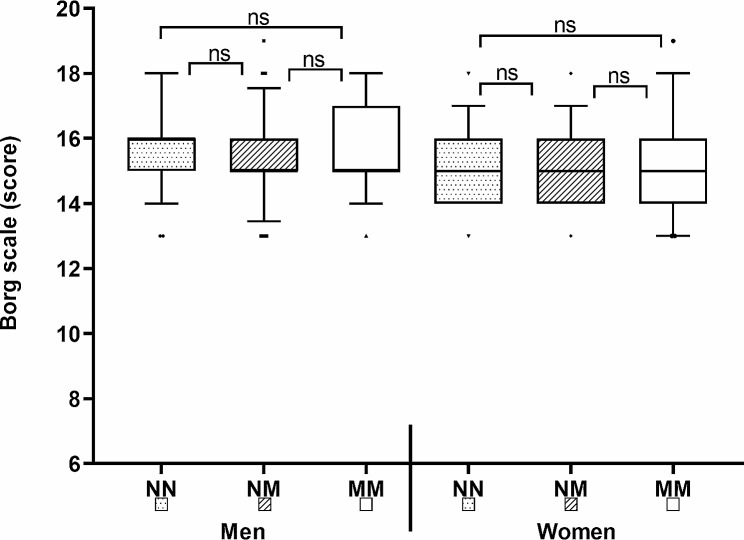
A randomized experiment to verify the acute effect of different breathing regimens (NN- inhaling and exhaling through the nose; NM- inhaling through the nose, exhaling through the mouth; MM- inhaling and exhaling through the mouth) on the muscular endurance performance was conducted. 107 physically active college students (68 males, 39 females) performed repeated bench press testing protocol (repetitions to failure (RTF) with 60% of body weight for males (BP60), respectively 40% of body weight for females (BP40)) with various breathing regimens (NN, NM, MM) in random order. Heart rate (HR), blood oxygen saturation (SpO2) and perceived exertion by Borg scale (RPE) were measured as well. A short questionnaire, given after the testing protocol and observation during familiarization, was used to detect each subject's normal breathing approach during resistance training.
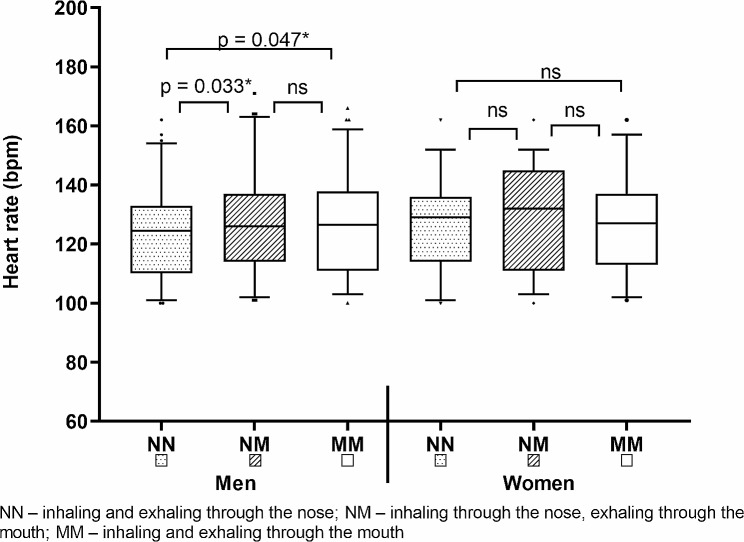
In both genders, no significant differences in RTF, RPE and SpO2 were found. No individual case of deviation of arterial oxygen saturation outside the physiological norm was recorded. In the male group, significantly lower HR values were found during the NN trials, compared to during the NM (p = 0.033) and MM (p = 0.047) trials with no significant differences in females. The HR differences in the males demonstrated a small effect size (NN < NM, d = 0.32; NN < MM, d = 0.30). Questionnaire results suggest that 80% of our participants use NM breathing, 15% use MM breathing and 5% use NN breathing during resistance training.
It seems, that various breathing regimens have none or only minor effect on muscular endurance performance and selected physiological parameters. NN seems to be as efficient as other two regimens, which are mostly used in practice (NM, MM).
据报道,我们的呼吸方式(无论是通过鼻子还是嘴巴)会影响我们健康的许多方面,并在一定程度上影响运动表现。本研究的目的是评估不同呼吸方式对肌肉耐力和生理变量的急性影响。
进行了一项随机实验,以验证不同呼吸方式(NN——通过鼻子吸气和呼气;NM——通过鼻子吸气,通过嘴巴呼气;MM——通过嘴巴吸气和呼气)对肌肉耐力表现的急性影响。107名身体活跃的大学生(68名男性,39名女性)以随机顺序采用不同的呼吸方式(NN、NM、MM)进行重复卧推测试方案(男性以体重的60%(BP60)、女性以体重的40%(BP40)进行至力竭重复次数(RTF))。同时测量心率(HR)、血氧饱和度(SpO2)以及用Borg量表评估的主观用力程度(RPE)。在测试方案结束后发放一份简短问卷,并在熟悉过程中进行观察,以检测每个受试者在阻力训练期间的正常呼吸方式。
在男性和女性中,RTF、RPE和SpO2均未发现显著差异。未记录到动脉血氧饱和度偏离生理正常范围的个体案例。在男性组中,与NM(p = 0.033)和MM(p = 0.047)试验相比,NN试验期间的HR值显著更低,而女性中无显著差异。男性的HR差异显示出较小的效应量(NN < NM,d = 0.32;NN < MM,d = 0.30)。问卷结果表明,80%的参与者在阻力训练期间使用NM呼吸,15%使用MM呼吸,5%使用NN呼吸。
似乎不同的呼吸方式对肌肉耐力表现和选定的生理参数没有影响或只有轻微影响。NN似乎与实践中最常用的其他两种方式(NM、MM)一样有效。