Stastny Petr, Gołaś Artur, Blazek Dusan, Maszczyk Adam, Wilk Michał, Pietraszewski Przemysław, Petr Miroslav, Uhlir Petr, Zając Adam
Department of Sport Games, Faculty of Physical Education and Sport, Charles University, Prague, Czech Republic.
Department of Sports Theory, The Jerzy Kukuczka Academy of Physical Education, Katowice, Poland.
PLoS One. 2017 Feb 7;12(2):e0171632. doi: 10.1371/journal.pone.0171632. eCollection 2017.
The bench press exercise (BP) plays an important role in recreational and professional training, in which muscle activity is an important multifactorial phenomenon. The objective of this paper is to systematically review electromyography (EMG) studies performed on the barbell BP exercise to answer the following research questions: Which muscles show the greatest activity during the flat BP? Which changes in muscle activity are related to specific conditions under which the BP movement is performed?
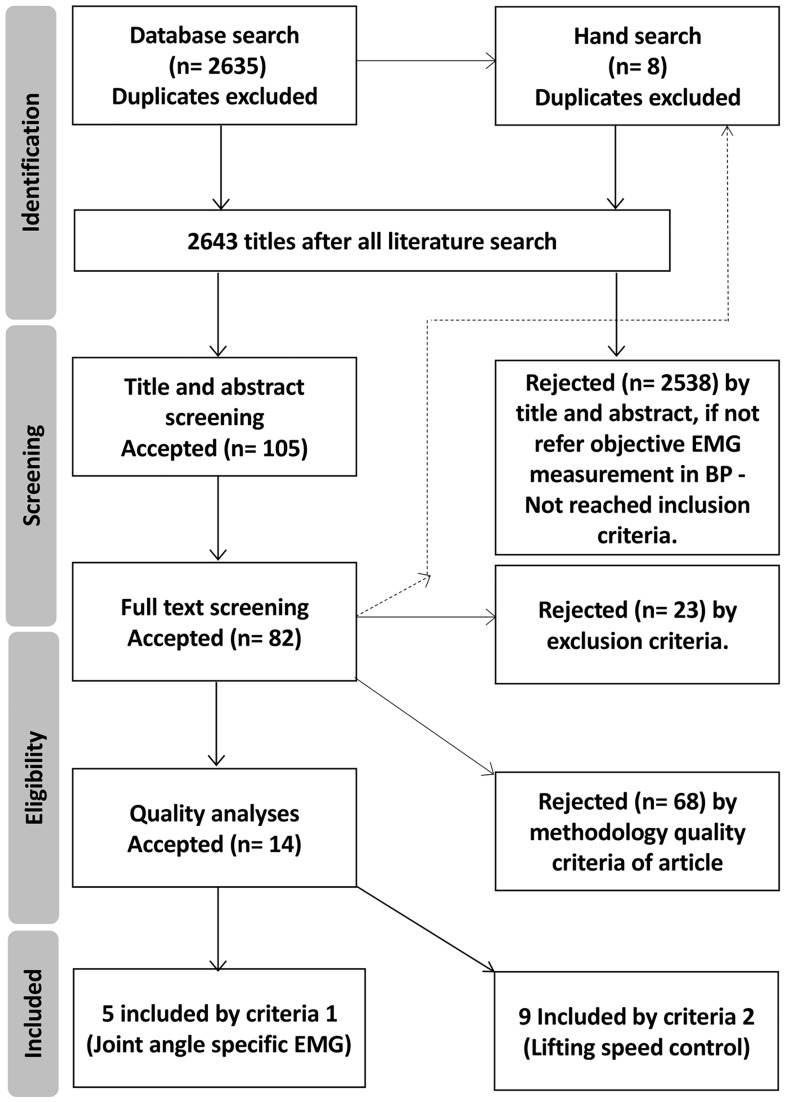
PubMed, Scopus, Web of Science and Cochrane Central Register of Controlled Trials (CENTRAL) in the Cochrane Library were searched through June 10, 2016. A combination of the following search terms was used: bench press, chest press, board press, test, measure, assessment, dynamometer, kinematics and biomechanics. Only original, full-text articles were considered.
The search process resulted in 14 relevant studies that were included in the discussion. The triceps brachii (TB) and pectoralis major (PM) muscles were found to have similar activity during the BP, which was significantly higher than the activity of the anterior deltoid. During the BP movement, muscle activity changes with exercise intensity, velocity of movement, fatigue, mental focus, movement phase and stability conditions, such as bar vibration or unstable surfaces. Under these circumstances, TB is the most common object of activity change.
PM and TB EMG activity is more dominant and shows greater EMG amplitude than anterior deltoid during the BP. There are six factors that can influence muscle activity during the BP; however, the most important factor is exercise intensity, which interacts with all other factors. The research on muscle activity in the BP has several unresolved areas, such as clearly and strongly defined guidelines to perform EMG measurements (e.g., how to elaborate with surface EMG limits) or guidelines for the use of exact muscle models.
卧推运动在休闲和专业训练中都起着重要作用,其中肌肉活动是一个重要的多因素现象。本文的目的是系统回顾对杠铃卧推运动进行的肌电图(EMG)研究,以回答以下研究问题:在平板卧推过程中,哪些肌肉表现出最大的活动?肌肉活动的哪些变化与进行卧推运动的特定条件有关?
检索了截至2016年6月10日的PubMed、Scopus、科学网和Cochrane图书馆的Cochrane对照试验中心注册库(CENTRAL)。使用了以下搜索词的组合:卧推、胸推、平板卧推、测试、测量、评估、测力计、运动学和生物力学。仅考虑原创的全文文章。
搜索过程产生了14项相关研究,纳入了讨论。发现肱三头肌(TB)和胸大肌(PM)在卧推过程中的活动相似,明显高于三角肌前束的活动。在卧推运动过程中,肌肉活动随运动强度、运动速度、疲劳、精神专注度、运动阶段和稳定条件(如杠铃振动或不稳定表面)而变化。在这些情况下,TB是活动变化最常见的对象。
在卧推过程中,PM和TB的肌电图活动比三角肌前束更占主导地位,且肌电图幅度更大。有六个因素会影响卧推过程中的肌肉活动;然而,最重要的因素是运动强度,它与所有其他因素相互作用。卧推中肌肉活动的研究有几个未解决的领域,如进行肌电图测量的明确且严格定义的指南(例如,如何详细说明表面肌电图的限制)或使用精确肌肉模型的指南。