Department of Burn and Plastic Surgery, West China Hospital of Sichuan University, Chengdu, China.
Int Wound J. 2024 Feb;21(2):e14733. doi: 10.1111/iwj.14733.
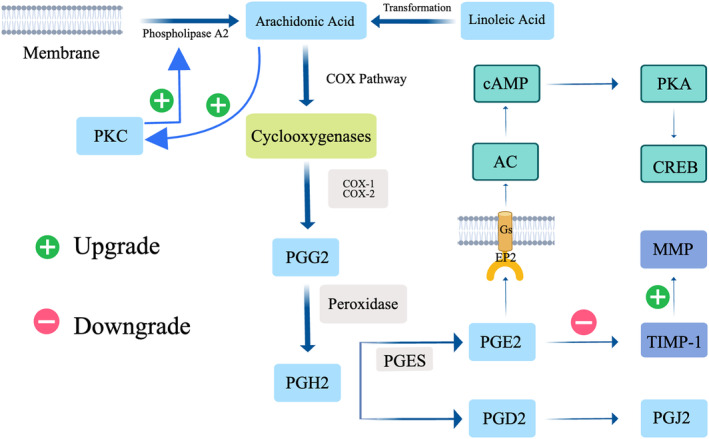
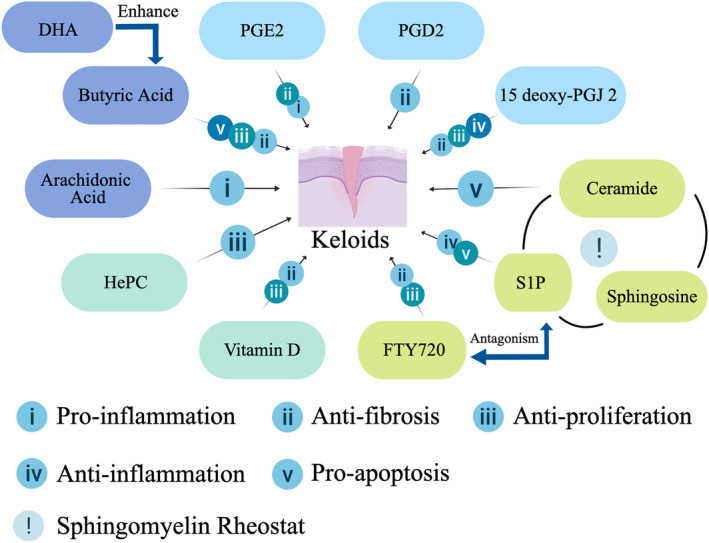
Keloids, pathological scars resulting from skin trauma, have traditionally posed significant clinical management challenges due to their persistence and high recurrence rates. Our research elucidates the pivotal roles of lipids and their derivatives in keloid development, driven by underlying mechanisms of abnormal cell proliferation, apoptosis, and extracellular matrix deposition. Key findings suggest that abnormalities in arachidonic acid (AA) synthesis and non-essential fatty acid synthesis are integral to keloid formation. Further, a complex interplay exists between lipid derivatives, notably butyric acid (BA), prostaglandin E2 (PGE2), prostaglandin D2 (PGD2), and the regulation of hyperfibrosis. Additionally, combinations of docosahexaenoic acid (DHA) with BA and 15-deoxy-Δ12,14-Prostaglandin J2 have exhibited pronounced cytotoxic effects. Among sphingolipids, ceramide (Cer) displayed limited pro-apoptotic effects in keloid fibroblasts (KFBs), whereas sphingosine 1-phosphate (S1P) was found to promote keloid hyperfibrosis, with its analogue, FTY720, demonstrating contrasting benefits. Both Vitamin D and hexadecylphosphorylcholine (HePC) showed potential antifibrotic and antiproliferative properties, suggesting their utility in keloid management. While keloids remain a prevalent concern in clinical practice, this study underscores the promising potential of targeting specific lipid molecules for the advancement of keloid therapeutic strategies.
瘢痕疙瘩是一种病理性瘢痕,源于皮肤创伤,由于其持续存在和高复发率,一直给临床管理带来巨大挑战。我们的研究阐明了脂质及其衍生物在瘢痕疙瘩发展中的关键作用,其背后的机制是异常细胞增殖、细胞凋亡和细胞外基质沉积。主要发现表明,花生四烯酸(AA)合成和非必需脂肪酸合成异常是瘢痕疙瘩形成的关键。此外,脂质衍生物之间存在复杂的相互作用,特别是丁酸(BA)、前列腺素 E2(PGE2)、前列腺素 D2(PGD2)和过度纤维化的调节。此外,二十二碳六烯酸(DHA)与 BA 和 15-脱氧-Δ12,14-前列腺素 J2 的组合表现出明显的细胞毒性作用。在鞘脂中,神经酰胺(Cer)在瘢痕疙瘩成纤维细胞(KFB)中显示出有限的促凋亡作用,而神经鞘氨醇 1-磷酸(S1P)被发现促进瘢痕疙瘩过度纤维化,其类似物 FTY720 则表现出相反的益处。维生素 D 和十六烷基磷酸胆碱(HePC)都显示出潜在的抗纤维化和抗增殖特性,表明它们在瘢痕疙瘩管理中的应用潜力。虽然瘢痕疙瘩在临床实践中仍然是一个普遍存在的问题,但这项研究强调了针对特定脂质分子的治疗策略在推进瘢痕疙瘩治疗方面的巨大潜力。