Graml Maximilian, Zollner Klaus, Hernangómez-Pérez Daniel, Faria Junior Paulo E, Wilhelm Jan
Institute of Theoretical Physics, University of Regensburg, 93053 Regensburg, Germany.
Regensburg Center for Ultrafast Nanoscopy (RUN), University of Regensburg, 93053 Regensburg, Germany.
J Chem Theory Comput. 2024 Mar 12;20(5):2202-2208. doi: 10.1021/acs.jctc.3c01230. Epub 2024 Feb 14.
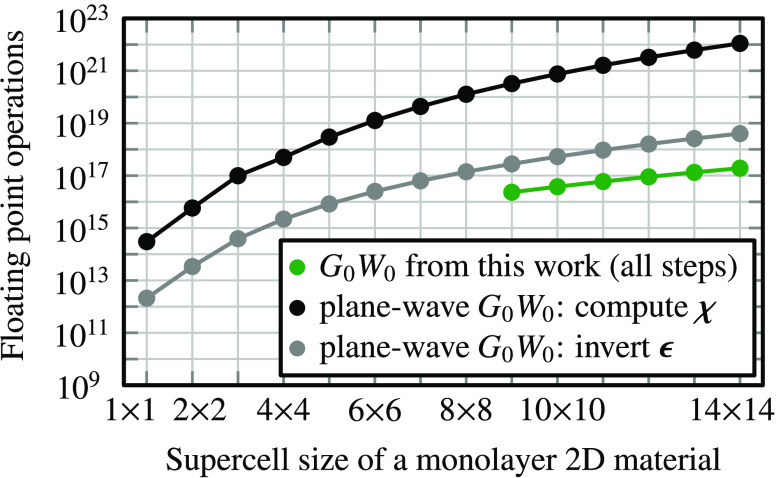
The method is widely used for calculating the electronic band structure of materials. The high computational cost of algorithms prohibits their application to many systems of interest. We present a periodic, low-scaling, and highly efficient algorithm that benefits from the locality of the Gaussian basis and the polarizability. The algorithm enables calculations on a MoSe/WS bilayer with 984 atoms per unit cell, in 42 h using 1536 cores. This is 4 orders of magnitude faster than a plane-wave algorithm, allowing for unprecedented computational studies of electronic excitations at the nanoscale.
该方法被广泛用于计算材料的电子能带结构。算法的高计算成本限制了它们在许多感兴趣的系统中的应用。我们提出了一种周期性、低尺度且高效的算法,该算法受益于高斯基的局部性和极化率。该算法能够在每单位晶胞有984个原子的MoSe/WS双层上进行计算,使用1536个核心在42小时内完成。这比平面波算法快4个数量级,使得在纳米尺度上对电子激发进行前所未有的计算研究成为可能。