Beijing Key Laboratory of Applied Experimental Psychology, National Demonstration Center for Experimental Psychology Education (Beijing Normal University), Faculty of Psychology, Beijing Normal University, Beijing, China.
Sino-Danish College, University of Chinese Academy of Sciences, Beijing, China.
Psychon Bull Rev. 2024 Oct;31(5):2137-2147. doi: 10.3758/s13423-024-02474-8. Epub 2024 Feb 20.
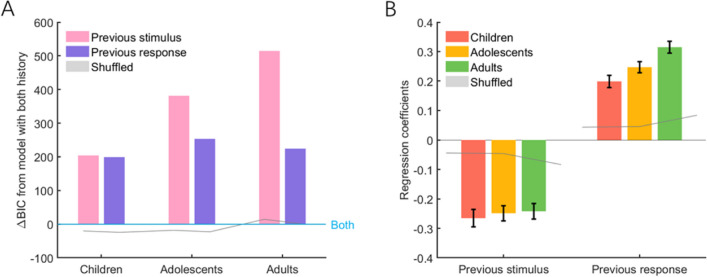
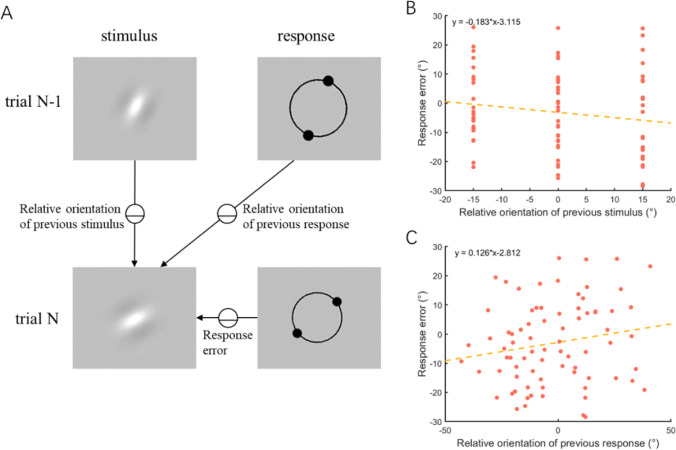
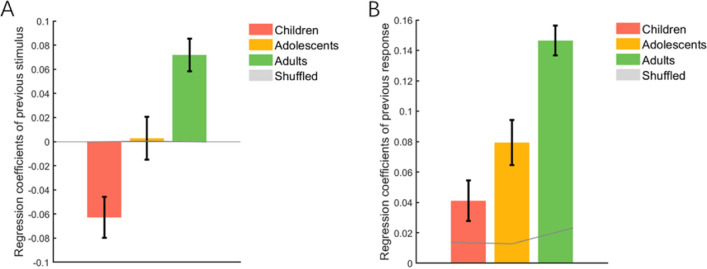
Serial dependence (SD) is a phenomenon wherein current perceptions are biased by the previous stimulus and response. This helps to attenuate perceptual noise and variability in sensory input and facilitates stable ongoing perceptions of the environment. However, little is known about the developmental trajectory of SD. This study investigates how the stimulus and response biases of the SD effect develop across three age groups. Conventional analyses, in which previous stimulus and response biases were assessed separately, revealed significant changes in the biases over time. Previous stimulus bias shifted from repulsion to attraction, while previous response bias evolved from attraction to greater attraction. However, there was a strong correlation between stimulus and response orientations. Therefore, a generalized linear mixed-effects (GLME) analysis that simultaneously considered both previous stimulus and response, outperformed separate analyses. This revealed that previous stimulus and response resulted in two distinct biases with different developmental trajectories. The repulsion bias of previous stimulus remained relatively stable across all age groups, whereas the attraction bias of previous response was significantly stronger in adults than in children and adolescents. These findings demonstrate that the repulsion bias towards preceding stimuli is established early in the developing brain (at least by around 10 years old), while the attraction bias towards responses is not fully developed until adulthood. Our findings provide new insights into the development of the SD phenomenon and how humans integrate two opposing mechanisms into their perceptual responses to external input during development.
序列依赖(SD)是一种现象,即当前的感知受到先前刺激和反应的影响。这有助于减轻感知噪声和感官输入的可变性,并促进对环境的稳定持续感知。然而,关于 SD 的发展轨迹知之甚少。本研究调查了 SD 效应的刺激和反应偏差如何在三个年龄组中发展。在分别评估先前刺激和反应偏差的传统分析中,发现偏差随时间发生了显著变化。先前刺激的偏差从排斥转变为吸引,而先前反应的偏差则从吸引转变为更大的吸引。然而,刺激和反应方向之间存在很强的相关性。因此,同时考虑先前刺激和反应的广义线性混合效应(GLME)分析优于单独分析。这表明先前的刺激和反应导致了两种具有不同发展轨迹的不同偏差。先前刺激的排斥偏差在所有年龄组中都相对稳定,而先前反应的吸引偏差在成年人中比在儿童和青少年中要强得多。这些发现表明,对先前刺激的排斥偏差在发育中的大脑中很早就建立了(至少在 10 岁左右),而对反应的吸引偏差直到成年期才完全发展。我们的发现为 SD 现象的发展以及人类如何在发育过程中将两种相反的机制整合到对外界输入的感知反应中提供了新的见解。