Department of Rehabilitation, Physical and Sports Medicine, Faculty of Medicine, Institute of Health Sciences, Vilnius University, 21/27 M.K. Ciurlionio St, 03101, Vilnius, Lithuania.
Institute of Health Sciences, Faculty of Medicine, Vilnius University, 21/27 M.K. Ciurlionio Street, 03101, Vilnius, Lithuania.
BMC Public Health. 2024 Feb 21;24(1):546. doi: 10.1186/s12889-024-17806-5.
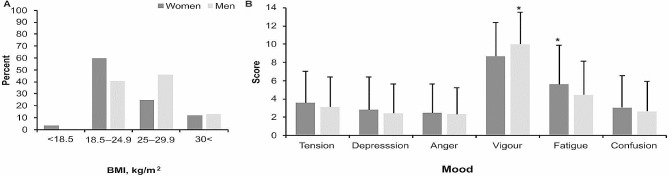
The aim of our study was to determine how six mood indicators (vigour, fatigue, depression, anger, confusion, tension) depend on moderate to vigorous physical activity, walking time and sedentary time at work, after working hours and during leisure time, in men and women of different age groups.
A total of 1,140 individuals aged 18 to 64 years participated in the study. The participants were enrolled in this cross-sectional survey using a snowball sampling method. An online questionnaire was shared through popular social networks and emails within the period October 2019 to June 2020. Mood responses were assessed using The Brunel Mood Scale-LTU. Physical activity was assessed using the long International Physical Activity Questionnaire. Descriptive analysis, a two-way analysis of variance, and linear regression analysis were used to interpret the data.
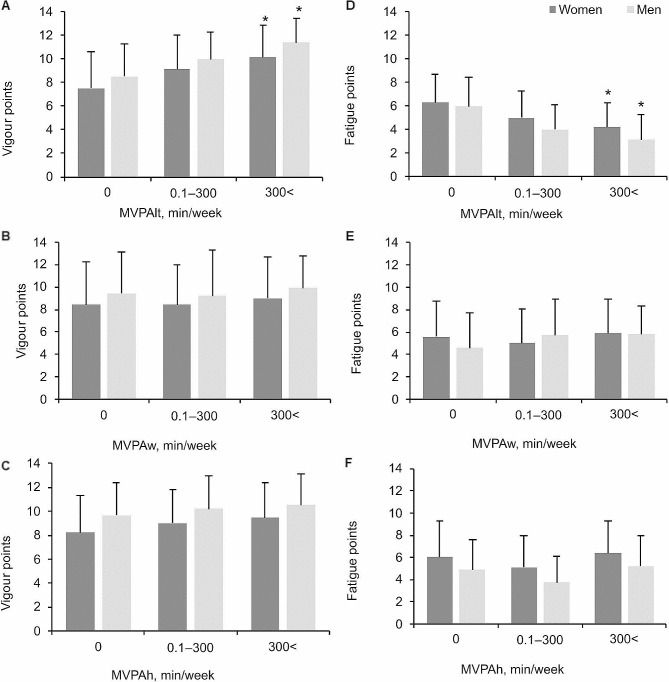
The survey results showed that vigour and fatigue correlated significantly only with leisure-time moderate to vigorous physical activity. The present results show a significant positive correlation between women and men moods and leisure-time moderate to vigorous physical activity, the length of time walking to work and back home, and negative correlation between moods and leisure-time sedentary behaviour. However, there was no significant correlation between moods and work-related moderate to vigorous physical activity and household moderate to vigorous physical activity, walking at work, and sitting duration at work.
This study provides theoretical implications of the physical activity paradox, justifying the benefits of moderate to vigorous physical activity practiced in different circumstances. According to the regression analysis, exercising men in all age groups moved the most (had a higher moderate to vigorous physical activity level) during leisure time, the highest work-related moderate to vigorous physical activity was observed in men and women with lower education, and the highest household moderate to vigorous physical activity was observed in older age men and women living in rural areas. Clinicians and leaders at all levels of health care should consider the greater importance of leisure-time physical activity for mental health when choosing the most targeted physical activity recommendations for mood profile improvement in men and women of different age groups.
我们的研究旨在确定六种情绪指标(活力、疲劳、抑郁、愤怒、困惑、紧张)如何取决于男女不同年龄组在工作时、工作后、闲暇时的中高强度身体活动、步行时间和久坐时间。
共有 1140 名 18 至 64 岁的个体参与了这项研究。采用滚雪球抽样法,通过热门社交网络和电子邮件邀请参与者参与这项横断面调查。使用布鲁内尔情绪量表-LTU 评估情绪反应。使用长国际体力活动问卷评估体力活动。采用描述性分析、双向方差分析和线性回归分析来解释数据。
调查结果表明,活力和疲劳仅与闲暇时间的中高强度体力活动显著相关。目前的结果表明,女性和男性的情绪与闲暇时间的中高强度体力活动、步行上下班的时间长短呈显著正相关,与闲暇时间的久坐行为呈显著负相关。然而,情绪与工作相关的中高强度体力活动和家务相关的中高强度体力活动、工作时的步行时间和工作时的坐立时间之间没有显著相关性。
这项研究提供了体力活动悖论的理论意义,证明了在不同环境下进行中高强度体力活动的益处。根据回归分析,所有年龄段的男性在闲暇时间运动最多(中高强度体力活动水平最高);教育程度较低的男性和女性工作时的中高强度体力活动最高;农村地区年龄较大的男性和女性的家务中高强度体力活动最高。各级临床医生和卫生保健领导者在为不同年龄组的男性和女性选择最有针对性的改善情绪特征的体力活动建议时,应考虑闲暇时间体力活动对心理健康的更大重要性。