College of Life Science and Technology, Beijing Advanced Innovation Center for Soft Matter Science and Engineering, Beijing University of Chemical Technology, Beijing, 100029, China.
Department of Life Sciences, Chalmers University of Technology, SE412 96, Gothenburg, Sweden.
Nat Commun. 2024 Feb 21;15(1):1591. doi: 10.1038/s41467-024-45557-9.
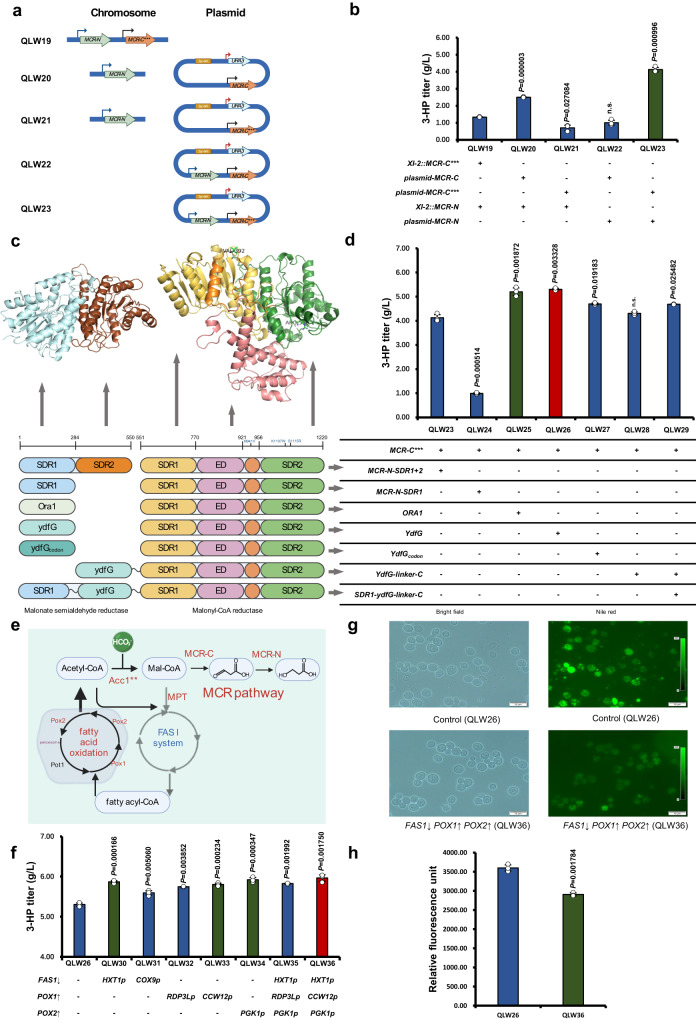
CO fixation plays a key role to make biobased production cost competitive. Here, we use 3-hydroxypropionic acid (3-HP) to showcase how CO fixation enables approaching theoretical-yield production. Using genome-scale metabolic models to calculate the production envelope, we demonstrate that the provision of bicarbonate, formed from CO, restricts previous attempts for high yield production of 3-HP. We thus develop multiple strategies for bicarbonate uptake, including the identification of Sul1 as a potential bicarbonate transporter, domain swapping of malonyl-CoA reductase, identification of Esbp6 as a potential 3-HP exporter, and deletion of Uga1 to prevent 3-HP degradation. The combined rational engineering increases 3-HP production from 0.14 g/L to 11.25 g/L in shake flask using 20 g/L glucose, approaching the maximum theoretical yield with concurrent biomass formation. The engineered yeast forms the basis for commercialization of bio-acrylic acid, while our CO fixation strategies pave the way for CO being used as the sole carbon source.
CO 固定对于使生物基生产具有成本竞争力起着关键作用。在这里,我们使用 3-羟基丙酸(3-HP)来展示 CO 固定如何使接近理论产量的生产成为可能。我们使用基因组规模的代谢模型来计算生产范围,证明了碳酸氢盐(由 CO 形成)的供应限制了之前尝试生产 3-HP 的高产量。因此,我们开发了多种碳酸氢盐摄取策略,包括鉴定 Sul1 作为潜在的碳酸氢盐转运蛋白、丙二酰辅酶 A 还原酶的结构域交换、鉴定 Esbp6 作为潜在的 3-HP 外排蛋白,以及删除 Uga1 以防止 3-HP 降解。综合理性工程使摇瓶中使用 20g/L 葡萄糖的 3-HP 产量从 0.14g/L 增加到 11.25g/L,接近最大理论产量,同时形成生物质。工程酵母为生物丙烯酸的商业化奠定了基础,而我们的 CO 固定策略为 CO 被用作唯一碳源铺平了道路。