Zhang Yiming, Su Mo, Wang Zheng, Nielsen Jens, Liu Zihe
Beijing Advanced Innovation Center for Soft Matter Science and Engineering, College of Life Science and Technology, Beijing University of Chemical Technology, 100029, Beijing, China.
Bloomage Biotechnolgy CO, LTD, 250000, Jinan, China.
Synth Syst Biotechnol. 2022 Jun 15;7(4):1034-1043. doi: 10.1016/j.synbio.2022.06.004. eCollection 2022 Dec.
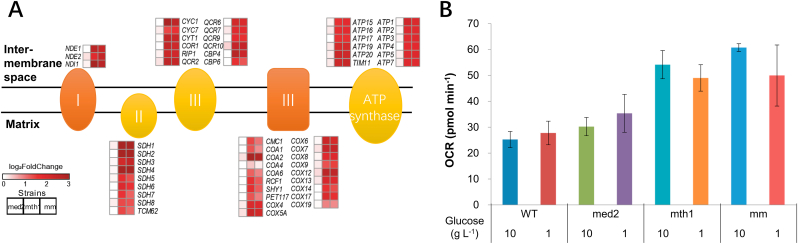
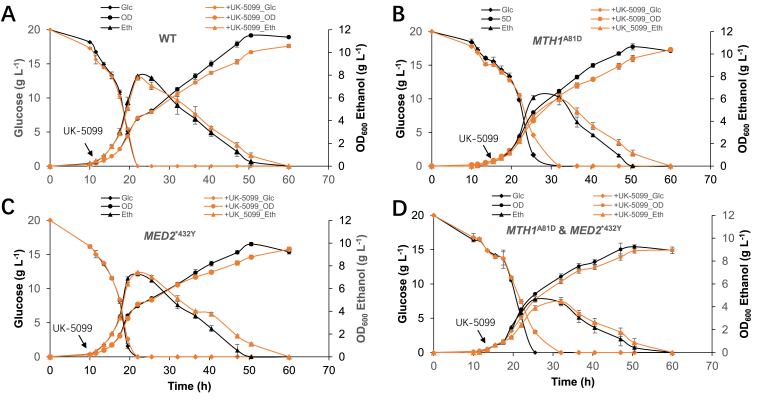
The respiro-fermentative metabolism in the yeast , also called the Crabtree effect, results in lower energy efficiency and biomass yield which can impact yields of chemicals to be produced using this cell factory. Although it can be engineered to become Crabtree negative, the slow growth and glucose consumption rate limit its industrial application. Here the Crabtree effect in yeast can be alleviated by engineering the transcription factor Mth1 involved in glucose signaling and a subunit of the RNA polymerase II mediator complex Med2. It was found that the mutant with the &* allele could grow in glucose rich medium with a specific growth rate of 0.30 h, an ethanol yield of 0.10 g g, and a biomass yield of 0.21 g g, compared with a specific growth rate of 0.40 h, an ethanol yield of 0.46 g g, and a biomass yield of 0.11 g g in the wild-type strain CEN.PK 113-5D. Transcriptome analysis revealed significant downregulation of the glycolytic process, as well as the upregulation of the TCA cycle and the electron transfer chain. Significant expression changes of several reporter transcription factors were also identified, which might explain the higher energy efficiencies in the engineered strain. We further demonstrated the potential of the engineered strain with the production of 3-hydroxypropionic acid at a titer of 2.04 g L, 5.4-fold higher than that of a reference strain, indicating that the alleviated glucose repression could enhance the supply of mitochondrial acetyl-CoA. These results suggested that the engineered strain could be used as an efficient cell factory for mitochondrial production of acetyl-CoA derived chemicals.
酵母中的呼吸发酵代谢,也称为克奈特效应,会导致能量效率和生物量产量降低,这可能会影响使用这种细胞工厂生产的化学品产量。尽管可以通过工程改造使其变为克奈特阴性,但生长缓慢和葡萄糖消耗率限制了其工业应用。在此,通过对参与葡萄糖信号传导的转录因子Mth1和RNA聚合酶II中介复合物Med2的一个亚基进行工程改造,可以缓解酵母中的克奈特效应。结果发现,与野生型菌株CEN.PK 113-5D相比,具有&*等位基因的突变体能够在富含葡萄糖的培养基中生长,其比生长速率为0.30 h,乙醇产量为0.10 g/g,生物量产量为0.21 g/g,而野生型菌株的比生长速率为0.40 h,乙醇产量为0.46 g/g,生物量产量为0.11 g/g。转录组分析显示糖酵解过程显著下调,以及三羧酸循环和电子传递链上调。还鉴定了几个报告转录因子的显著表达变化,这可能解释了工程菌株中较高的能量效率。我们进一步证明了工程菌株生产3-羟基丙酸的潜力,其产量为2.04 g/L,比参考菌株高5.4倍,表明缓解的葡萄糖阻遏可以增强线粒体乙酰辅酶A的供应。这些结果表明,工程菌株可作为线粒体生产乙酰辅酶A衍生化学品的高效细胞工厂。