Fitzmaurice Yvonne, Beeke Suzanne, Isaksen Jytte, Cunningham Una, Jagoe Caroline, Shé Éidín Ní, McMenamin Ruth
School of Health Sciences, University of Galway, Galway, H91 TK33, Ireland.
Division of Psychology and Language Sciences, University College London, London, England, WC1E 6BT, UK.
HRB Open Res. 2024 Apr 17;6:60. doi: 10.12688/hrbopenres.13783.1. eCollection 2023.
Stroke acquired communication impairments impede effective communication. Consequently, in stroke care, communicative interactions can be challenging for both patients and staff and can predispose patients to increased risk of preventable adverse events. Communication partner training (CPT) can mitigate such negative outcomes by optimising communicative interactions. Providing CPT to student health and social care professionals (SH&SCPs) has the potential to enhance their clinical expertise and experiences and enhance the future clinical care of patients with stroke acquired communication impairments. This research aims to expand our understanding of how CPT is operationalised for SH&SCPs in higher education institutions and determine: what works; for whom; in what contexts; how and why?
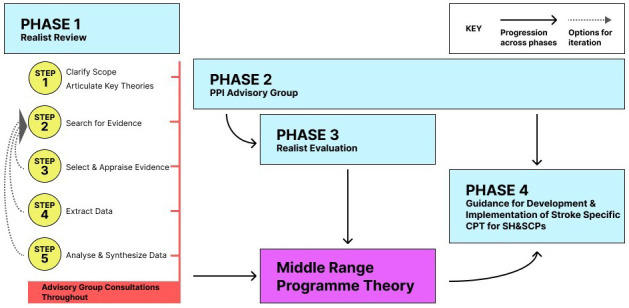
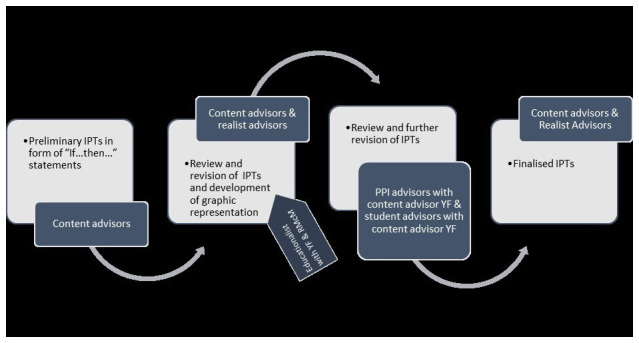
This review is Phase 1 of a research project employing a realist approach with public and patient involvement (PPI). It incorporates five iterative steps: 1.) Clarifying the scope; 2.) Searching for evidence; 3.) Selecting and appraising evidence; 4.) Data extraction; 5.) Synthesising data and developing a middle range theory explaining how CPT is expected to work for SH&SCPs. An advisory panel, including PPI advisors, content advisors, student advisors, realist advisors and educationalist advisor has been set up to consult throughout the review and collaboratively agree the middle range theory.
While there is an evolving evidence base for CPT, including stroke specific CPT for SH&SCPs, it is acknowledged that there are challenges to its implementation in complex real-world settings. In combining empirical evidence with theoretical understanding, realist review permits synthesis of data from diverse sources and goes beyond determining efficacy to explore generative causation and solutions for real world practice. A middle range realist programme theory that coherently explains how CPT is expected to work when teaching SH&SCPs to communicate with people with stroke acquired communication impairments will provide educators with new insights into CPT development and implementation in their higher education institutions.
中风后获得性沟通障碍会妨碍有效沟通。因此,在中风护理中,沟通互动对患者和医护人员来说都具有挑战性,并且可能使患者面临可预防不良事件风险增加的问题。沟通伙伴培训(CPT)可以通过优化沟通互动来减轻此类负面结果。为学生健康与社会护理专业人员(SH&SCPs)提供CPT有潜力增强他们的临床专业知识和经验,并改善未来对中风后获得性沟通障碍患者的临床护理。本研究旨在扩大我们对高等教育机构中如何为SH&SCPs实施CPT的理解,并确定:什么有效;对谁有效;在什么背景下有效;如何以及为何有效?
本综述是一个采用现实主义方法并让公众和患者参与(PPI)的研究项目的第一阶段。它包含五个迭代步骤:1.)明确范围;2.)寻找证据;3.)选择和评估证据;4.)数据提取;5.)综合数据并发展一个中层理论,解释CPT预期如何对SH&SCPs起作用。已设立一个咨询小组,包括PPI顾问、内容顾问、学生顾问、现实主义顾问和教育顾问,以便在整个综述过程中进行咨询,并共同商定中层理论。
虽然CPT的证据基础在不断发展,包括针对SH&SCPs的中风特异性CPT,但人们认识到在复杂的现实环境中实施CPT存在挑战。通过将实证证据与理论理解相结合,现实主义综述允许综合来自不同来源的数据,并超越确定疗效,探索生成性因果关系和现实世界实践的解决方案。一个连贯解释在教导SH&SCPs与中风后获得性沟通障碍患者沟通时CPT预期如何起作用的中层现实主义项目理论,将为教育工作者在其高等教育机构中开展CPT开发和实施提供新的见解。