Paulson Lars, Narayanasamy Sankar Raju, Shelby Megan L, Frank Matthias, Trebbin Martin
Department of Chemistry & Research and Education in Energy, Environment and Water (RENEW), The State University of New York at Buffalo, Buffalo, New York 14260, USA.
Biosciences and Biotechnology Division, Physical and Life Sciences Directorate, Lawrence Livermore National Laboratory, Livermore, California 94550, USA.
Struct Dyn. 2024 Feb 21;11(1):011101. doi: 10.1063/4.0000229. eCollection 2024 Jan.
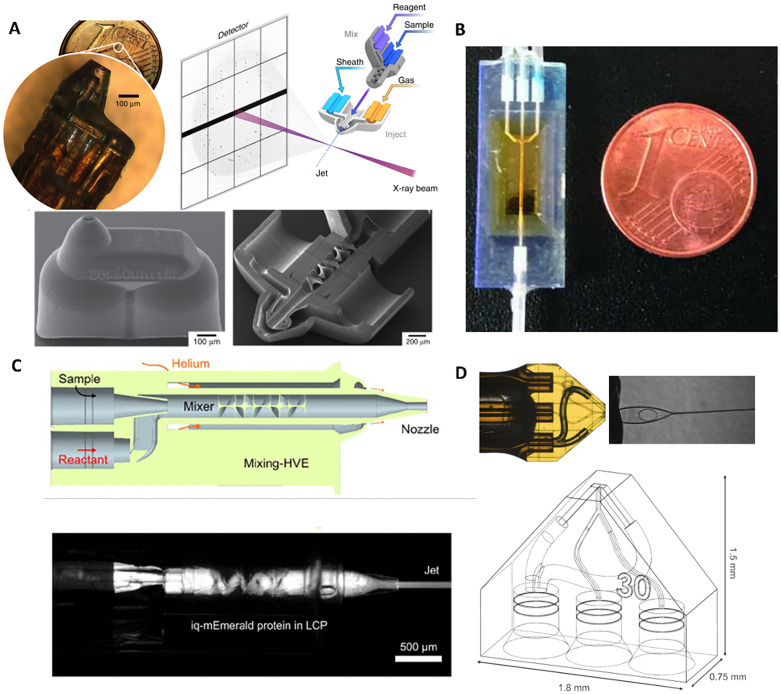
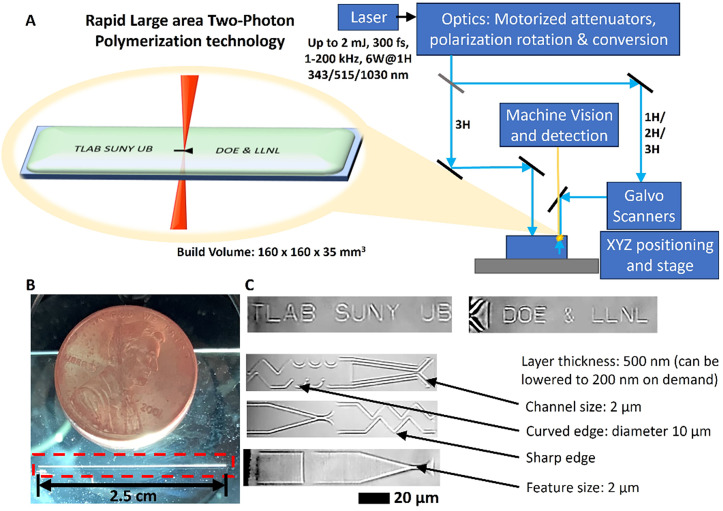
Serial crystallography at large facilities, such as x-ray free-electron lasers and synchrotrons, evolved as a powerful method for the high-resolution structural investigation of proteins that are critical for human health, thus advancing drug discovery and novel therapies. However, a critical barrier to successful serial crystallography experiments lies in the efficient handling of the protein microcrystals and solutions at microscales. Microfluidics are the obvious approach for any high-throughput, nano-to-microliter sample handling, that also requires design flexibility and rapid prototyping to deal with the variable shapes, sizes, and density of crystals. Here, we discuss recent advances in polymer 3D printing for microfluidics-based serial crystallography research and present a demonstration of emerging, large-scale, nano-3D printing approaches leading into the future of 3D sample environment and delivery device fabrication from liquid jet gas-dynamic virtual nozzles devices to fixed-target sample environment technology.
在大型设施(如X射线自由电子激光器和同步加速器)中进行的串行晶体学,已发展成为一种用于对人类健康至关重要的蛋白质进行高分辨率结构研究的强大方法,从而推动了药物发现和新疗法的发展。然而,成功进行串行晶体学实验的一个关键障碍在于在微观尺度上对蛋白质微晶和溶液的有效处理。微流体技术是进行任何高通量、纳升至微升样品处理的明显方法,这也需要设计灵活性和快速原型制作,以应对晶体的各种形状、尺寸和密度。在这里,我们讨论了用于基于微流体的串行晶体学研究的聚合物3D打印的最新进展,并展示了新兴的大规模纳米3D打印方法,这些方法引领了从液体喷射气体动力学虚拟喷嘴装置到固定目标样品环境技术的3D样品环境和输送装置制造的未来发展。