Institute of Pathology, University Hospital Essen, University of Duisburg Essen, 45147 Essen, Germany.
Department of Pathology, Diakonissenkrankenhaus Flensburg, 24939 Flensburg, Germany.
Genes (Basel). 2024 Feb 6;15(2):209. doi: 10.3390/genes15020209.
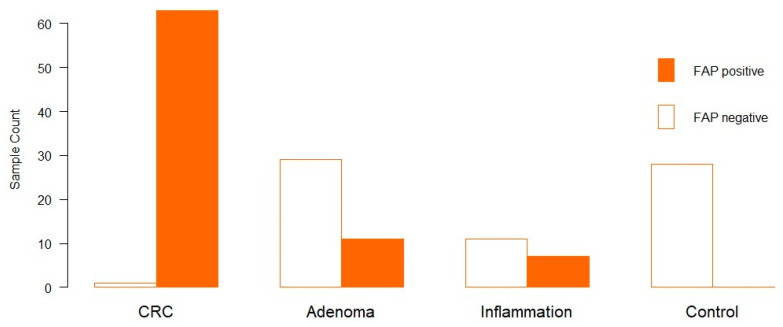
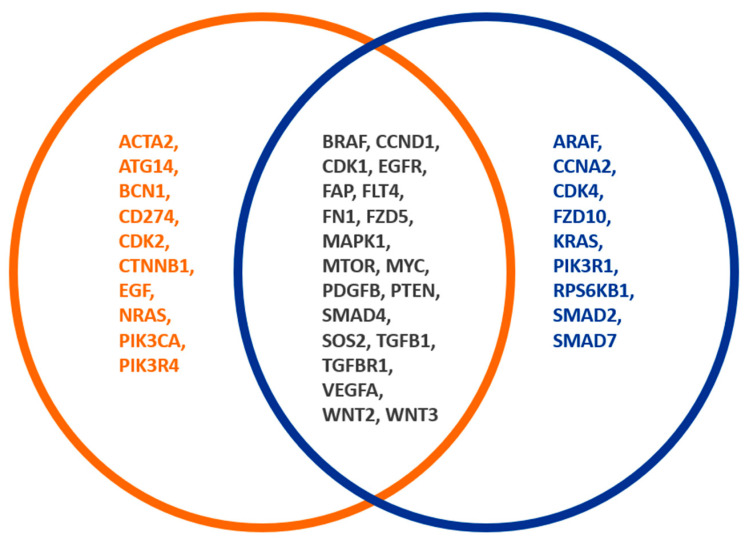
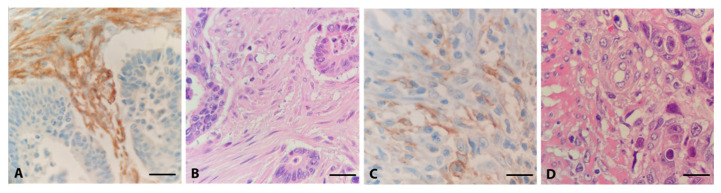
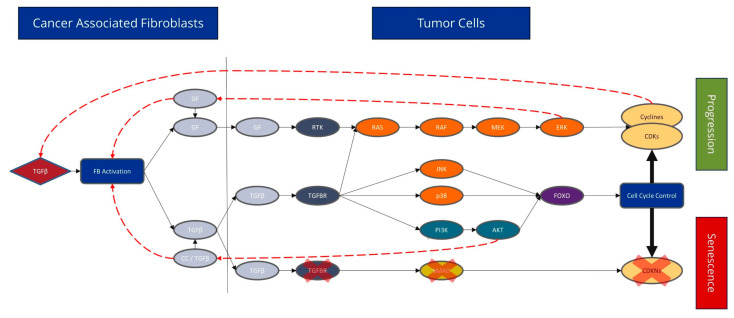
(1) Colorectal cancer (CRC) is a leading cause of cancer-related deaths globally. Cancer-associated fibroblasts (CAFs) are major components of CRC's tumour microenvironment (TME), but their biological background and interplay with the TME remain poorly understood. This study investigates CAF biology and its impact on CRC progression. (2) The cohort comprises 155 cases, including CRC, with diverse localizations, adenomas, inflammations, and controls. Digital gene expression analysis examines genes associated with signalling pathways (MAPK, PI3K/Akt, TGF-β, WNT, p53), while next-generation sequencing (NGS) determines CRC mutational profiles. Immunohistochemical FAP scoring assesses CAF density and activity. (3) FAP expression is found in 81 of 150 samples, prevalent in CRC (98.4%), adenomas (27.5%), and inflammatory disease (38.9%). Several key genes show significant associations with FAP-positive fibroblasts. Gene set enrichment analysis (GSEA) highlights PI3K and MAPK pathway enrichment alongside the activation of immune response pathways like natural killer (NK)-cell-mediated cytotoxicity via CAFs. (4) The findings suggest an interplay between CAFs and cancer cells, influencing growth, invasiveness, angiogenesis, and immunogenicity. Notably, TGF-β, CDKs, and the Wnt pathway are affected. In conclusion, CAFs play a significant role in CRC and impact the TME throughout development.
(1) 结直肠癌(CRC)是全球癌症相关死亡的主要原因。癌症相关成纤维细胞(CAFs)是 CRC 肿瘤微环境(TME)的主要组成部分,但它们的生物学背景及其与 TME 的相互作用仍知之甚少。本研究探讨了 CAF 的生物学特性及其对 CRC 进展的影响。(2) 该队列包括 155 例病例,包括 CRC,以及不同部位的腺瘤、炎症和对照。数字基因表达分析检查与信号通路(MAPK、PI3K/Akt、TGF-β、WNT、p53)相关的基因,而下一代测序(NGS)则确定 CRC 的突变谱。免疫组织化学 FAP 评分评估 CAF 密度和活性。(3) 在 150 个样本中的 81 个样本中发现 FAP 表达,在 CRC(98.4%)、腺瘤(27.5%)和炎症性疾病(38.9%)中普遍存在。一些关键基因与 FAP 阳性成纤维细胞有显著关联。基因集富集分析(GSEA)突出了 PI3K 和 MAPK 通路的富集,以及 CAFs 介导的自然杀伤(NK)细胞介导的细胞毒性等免疫反应途径的激活。(4) 这些发现表明 CAFs 与癌细胞之间存在相互作用,影响肿瘤的生长、侵袭、血管生成和免疫原性。值得注意的是,TGF-β、CDKs 和 Wnt 通路受到影响。总之,CAFs 在 CRC 中发挥重要作用,并在整个发展过程中影响 TME。