Laboratório de Virologia, Instituto de Medicina Tropical, Universidade de São Paulo, São Paulo 05403-000, SP, Brazil.
Laboratório de Virologia, Instituto de Ciências Biomédicas, Universidade de São Paulo, São Paulo 05403-000, SP, Brazil.
Viruses. 2024 Feb 9;16(2):274. doi: 10.3390/v16020274.
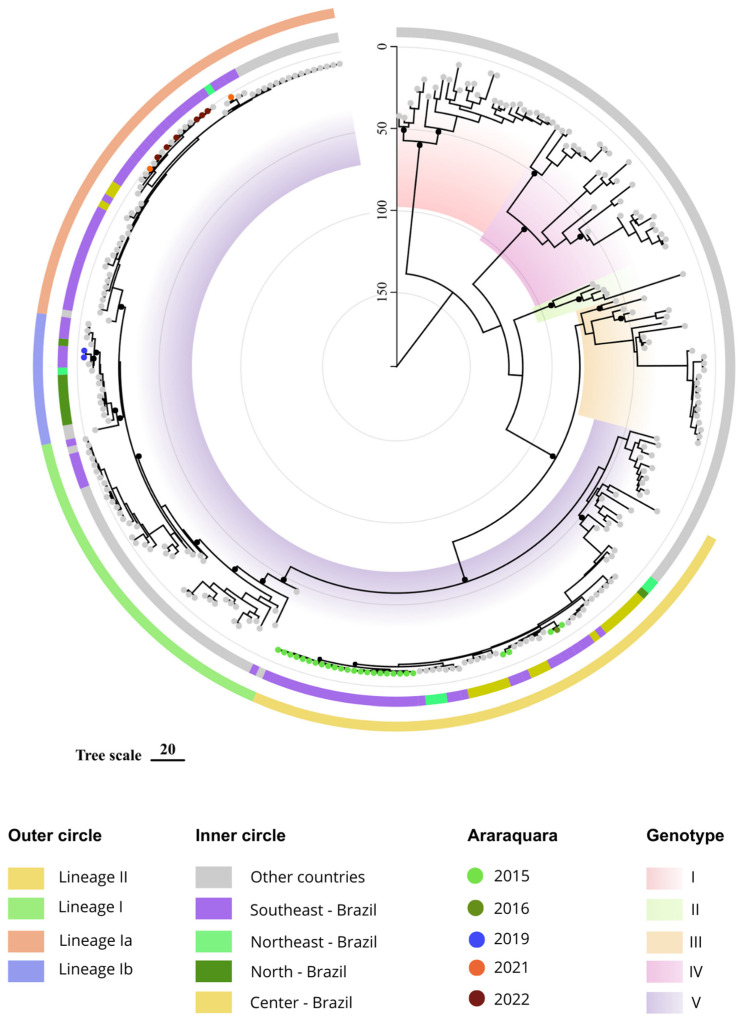
Dengue virus (DENV) is a prominent arbovirus with global spread, causing approximately 390 million infections each year. In Brazil, yearly epidemics follow a well-documented pattern of serotype replacement every three to four years on average. Araraquara, located in the state of São Paulo, has faced significant impacts from DENV epidemics since the emergence of DENV-1 in 2010. The municipality then transitioned from low to moderate endemicity in less than 10 years. Yet, there remains an insufficient understanding of virus circulation dynamics, particularly concerning DENV-1, in the region, as well as the genetic characteristics of the virus. To address this, we sequenced 37 complete or partial DENV-1 genomes sampled from 2015 to 2022 in Araraquara. Then, using also Brazilian and worldwide DENV-1 sequences we reconstructed the evolutionary history of DENV-1 in Araraquara and estimated the time to the most recent common ancestor (tMRCA) for serotype 1, for genotype V and its main lineages. Within the last ten years, there have been at least three introductions of genotype V in Araraquara, distributed in two main lineages (L Ia and L Ib, and L II). The tMRCA for the first sampled lineage (2015/2016 epidemics) was approximately 15 years ago (in 2008). Crucially, our analysis challenges existing assumptions regarding the emergence time of the DENV-1 genotypes, suggesting that genotype V might have diverged more recently than previously described. The presence of the two lineages of genotype V in the municipality might have contributed to the extended persistence of DENV-1 in the region.
登革热病毒(DENV)是一种具有全球传播性的重要虫媒病毒,每年导致约 3.9 亿例感染。在巴西,每年的流行疫情按照每三到四年更替一种血清型的明确模式发生。阿拉拉夸拉位于圣保罗州,自 2010 年出现 DENV-1 以来,一直受到登革热疫情的严重影响。该城市在不到 10 年内从低度流行转变为中度流行。然而,该地区对病毒循环动态,特别是 DENV-1 的病毒以及病毒的遗传特征的了解仍然不足。为了解决这个问题,我们对 2015 年至 2022 年在阿拉拉夸拉采集的 37 株完整或部分 DENV-1 基因组进行了测序。然后,我们还使用巴西和全球的 DENV-1 序列重建了 DENV-1 在阿拉拉夸拉的进化史,并估计了血清型 1、基因型 V 及其主要谱系的最近共同祖先(tMRCA)的时间。在过去的十年中,至少有三次基因型 V 被引入阿拉拉夸拉,分布在两个主要谱系(L Ia 和 L Ib,以及 L II)中。第一个被采样的谱系(2015/2016 年疫情)的 tMRCA 大约在 15 年前(2008 年)。重要的是,我们的分析挑战了关于 DENV-1 基因型出现时间的现有假设,表明基因型 V 可能比之前描述的时间更近才发生分化。该城市两种基因型 V 谱系的存在可能导致 DENV-1 在该地区的持续存在。